
Trump Snubs Iran Statement, Highlighting G-7 Tensions
BANFF, Alberta — President Donald Trump declined to join a statement at the Group of Seven summit calling for de-escalation of attacks between Israel and Iran, a White House official said Monday, highlighting the sharp divide between his worldview and that of the other heads of state at the gathering in the Canadian Rockies.
The G-7 began on the fourth day of conflict between Israel and Iran , a fresh wave of violence in the Middle East that undermines Trump’s commitments to serve as a global peacemaker. Throughout the day, officials said they were uncertain whether the leaders could forge a joint statement on the conflict, with the questions mostly focused on the U.S. position.
“It’ll be up to the American side to decide whether we’re going to have a G-7 statement on the Middle East or not,” Stefan Kornelius, a spokesman for the German government, said earlier in the day. Trump had a conversation Monday afternoon with German Chancellor Friedrich Merz about the Middle East and Ukraine.
The conflict between Iran and Israel was likely to come up for further discussion at an evening session on global security, said senior Canadian and European officials, who spoke on the condition of anonymity to discuss a sensitive matter.
The White House official did not specifically say why Trump declined to sign the statement negotiated by the other participating countries.
“President Trump will continue to work towards ensuring Iran cannot obtain a nuclear weapon,” the person said, speaking on the condition of anonymity to discuss the negotiations.
The decision highlighted the challenges vexing other leaders at the G-7, who are attempting to navigate conversations about the Middle East, the war in Ukraine and global trade without inviting Trump’s ire. In less than five months in office, Trump has upended U.S. diplomacy with a friendlier posture toward Russia and an antagonistic approach to longtime U.S. allies, including the G-7 host, Canada.
At a morning meeting, Trump confirmed that he has received signals through intermediaries that Iran wants to de-escalate the fighting. He said Iran should have struck a deal to impose limits on its nuclear program before a 60-day deadline that he had set.
“They have to make a deal,” he said. “And it’s painful for both parties. But I’d say Iran is not winning this war … and they should talk immediately before it’s too late.”
Despite the disagreement over Iran, Trump on Monday avoided the personal attacks on U.S. allies that have defined many of his past international summits .
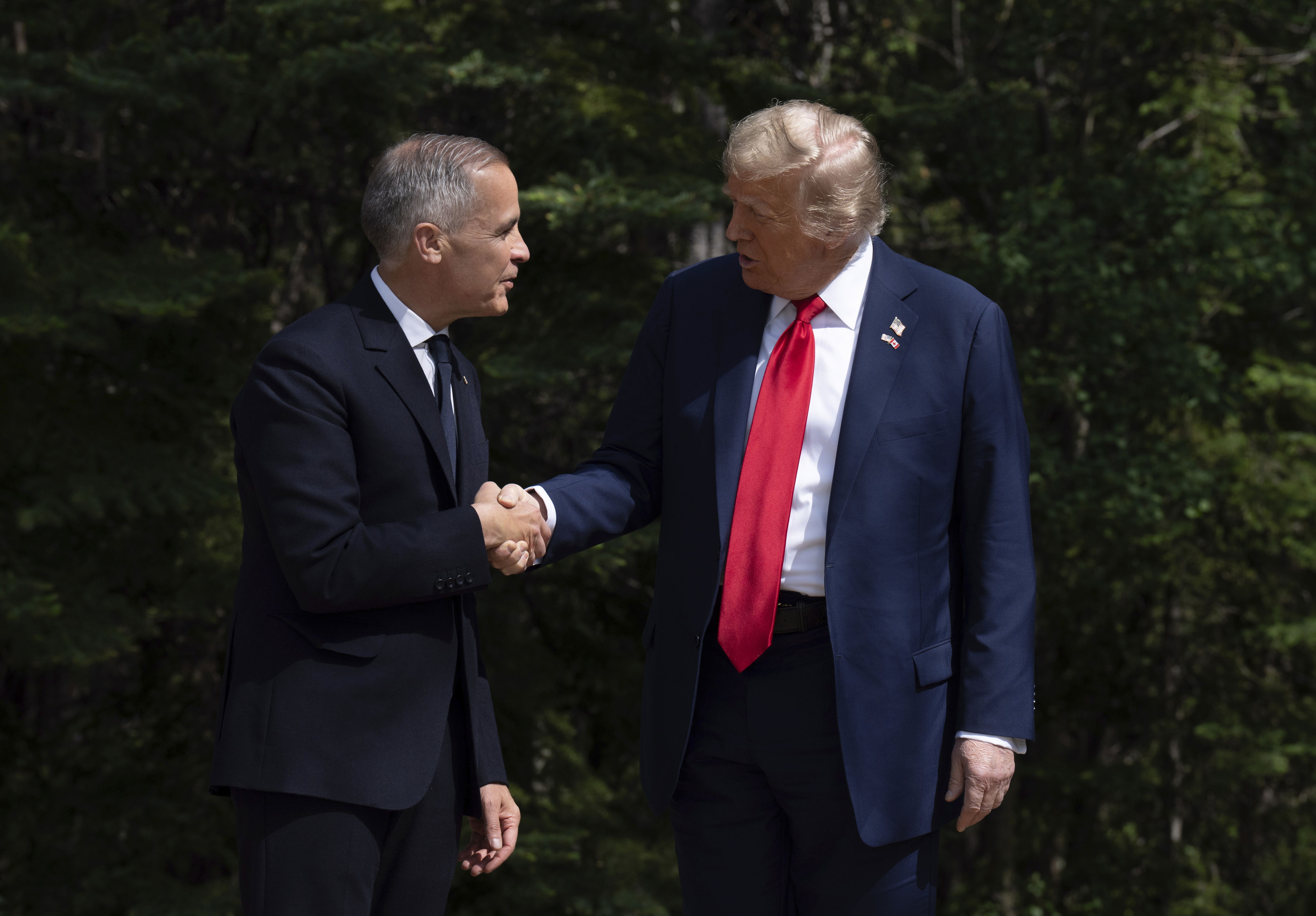
Trump appeared to be on good terms even with leaders on the other end of the political spectrum, including British Prime Minister Keir Starmer.
“He’s slightly more liberal than I am, but for some reason we get along,” Trump said. Trump and Starmer signed a trade agreement, finalizing a pact that the administration announced in May.
After a one-on-one meeting with Canadian Prime Minister Mark Carney, Trump was restrained, even conciliatory. He expressed optimism that he and Carney could work out a deal on trade, and he directed no venom at the world leaders with whom he would be meeting, even as he criticized their predecessors.
“I’m a tariff person. I’ve always been a tariff — simple. It’s easy, it’s precise, and it just goes very quickly,” Trump said when asked about Monday’s trade talks. “And I think Mark has a more complex idea but also very good. So we’re going to look at both.”
“We’ve developed a very good relationship,” he added.
A senior Canadian government official said Monday that Trump and Carney had a “productive” meeting that lasted for more than an hour and focused on trade and security negotiations. The official, who spoke on the condition of anonymity to discuss a sensitive topic, said the tone of the conversation between the two leaders was encouraging.
Carney told reporters the meeting was “fantastic.”
Carney started the meeting by flattering Trump, wishing Trump and the U.S. military a belated happy birthday and praising Trump’s “bold” decision-making. The tone marked a contrast from April’s federal election campaign here, where Carney cast himself as the anti-Trump and rode to victory on a wave of anger about Trump’s tariffs and repeated threats to use “economic force” to make Canada the 51st state.
Trump wore a lapel pin featuring the flags of Canada and the United States. Secretary of State Marco Rubio and Treasury Secretary Scott Bessent wore gold maple leaf pins on their lapels. The pins were not part of a welcome gift from the hosts, said Emily Williams, a spokeswoman for Carney.
There were early signs, however, that Trump was not aligned with his counterparts. He began the summit with criticism of former leaders and said made a “big mistake” in 2014 when they booted Russian President Vladimir Putin from what was then called the Group of Eight. He did not acknowledge that Russia was suspended because it invaded and later annexed the Crimean Peninsula. Putin was “insulted” by the exclusion, Trump said, claiming that the war in Ukraine could have been avoided if Putin had been kept in the fold.
“You know you have your enemy at the table,” Trump said. “He wasn’t really an enemy at that time. There was no concept — if I were president, this war would have never happened.”
Trump blamed the decision to exclude Russia on former U.S. president Barack Obama and former Canadian prime minister Justin Trudeau, even though Trudeau did not take office until the following year. He said he was unsure whether Putin should be allowed back in the group because “ too much water has gone over the dam, maybe.”
He also said it was “not a bad idea” when asked whether Chinese President Xi Jinping should be invited to future G-7 meetings.
In addition to the international turmoil surrounding this week’s meeting, Trump also faces domestic unrest. The past week included the shootings of two Democratic lawmakers and their spouses in Minnesota, nationwide demonstrations against Trump and the deployment of the National Guard in response to protests against immigration raids. Trump has called for more immigration enforcement in other cities with Democratic leaders.
“I want them to focus on the cities because the cities are where you really have what’s called ‘sanctuary cities’ and that’s where the people are,” Trump told reporters.
Tariffs are at the top of the agenda for many G-7 attendees, as the forum founded to foster economic cooperation evolves into a negotiating forum after Trump launched trade wars against key U.S. partners.
In remarks at a session on the global economic outlook, Ursula von der Leyen, president of the European Commission, said that it was “in our shared interest to keep trade between G-7 countries open.” She said that tariffs create uncertainty and fuel inflation and divert energy from countering China’s unfair trade practices.
“We agree: the current global trading system is not working as it should,” von der Leyen said, according to a statement released from her office. “Guardrails are clearly missing. On this point, Donald is right — there is a serious problem. But we strongly feel that the biggest challenges are not the trade between G-7 partners.”
Trump has imposed several sets of tariffs on Canadian goods, including levies on autos, steel, aluminum and imports that are not compliant with the U.S.-Mexico-Canada Agreement. Canada has imposed tariffs of its own in response and has not ruled out further retaliation. Trump doubled the import tax on steel and aluminum to 50 percent this month — a move that could badly hurt the Canadian industries.
Canadian officials have been flying back and forth to Washington to press their U.S. counterparts to lift all of the tariffs on Canada, while the Trump administration has said that a baseline tariff might be permanent.
After Monday’s bilateral meeting, Dominic LeBlanc, the Canadian cabinet minister responsible for U.S.-Canada trade, said that both sides had agreed to meet later this week and that Trump and Carney agreed to “collectively accelerate our work” on a trade and security deal. A statement from the prime minister’s office said “the leaders agreed to pursue negotiations toward a deal within the coming 30 days.”
He declined to say whether the president had raised the prospect of Canada becoming the 51st state behind closed doors Monday.
A fundamental philosophical divide on trade, however, broke through the bonhomie.
“We have a president who is very convinced of the policy that he has around tariffs,” Kirsten Hillman, the Canadian ambassador to the United States, told reporters. “We are very convinced that applying that policy to Canada is actually detrimental to his overall goals.”

Post a Comment for "Trump Snubs Iran Statement, Highlighting G-7 Tensions"
Post a Comment