
Land swaps with Russia are unlawful and widely opposed in Ukraine
The Legal and Political Challenges of a Territorial Swap
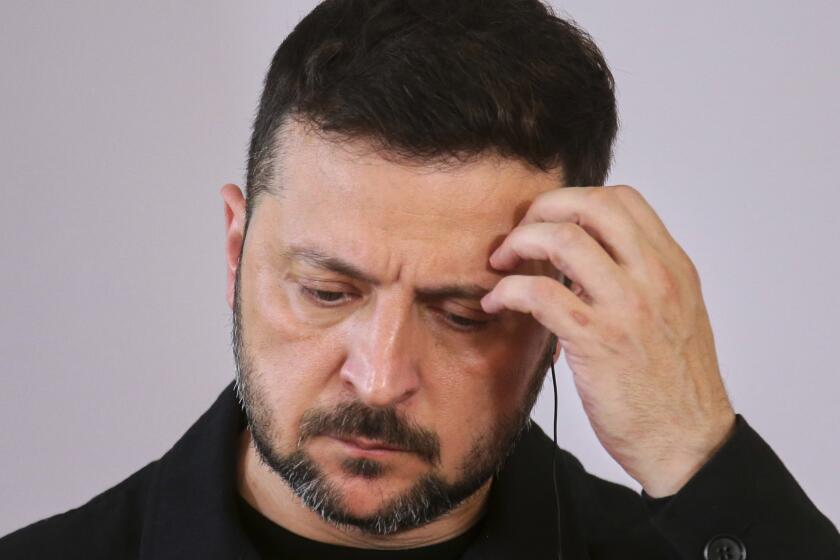
A proposed peace deal that would require Ukraine to exchange territory with Russia faces significant legal, political, and public opposition. President Volodymyr Zelensky has firmly rejected any agreement that involves ceding land, emphasizing that such a move would be both unconstitutional and deeply unpopular among the Ukrainian people.
Zelensky’s stance comes in response to comments made by former U.S. President Donald Trump, who suggested that a territorial swap could benefit both sides. Trump stated that “some land swapping going on” would be “good stuff, not bad stuff,” but his remarks have been met with skepticism and concern from Ukrainian officials and experts.
The Ukrainian constitution explicitly states that changes to the country’s borders must be approved through a national referendum. This means that no single leader, including Zelensky, can unilaterally agree to a territorial swap without the consent of the people. As Ihor Reiterovych, a professor at the Taras Shevchenko National University of Kyiv, explained, “Changes in territorial integrity can be done only by the decision of the people — not the president, the cabinet of ministers or the parliament can change it.”
The Complexity of the Front Lines
Russia currently occupies approximately one-fifth of Ukraine, including areas in the northeast, the Crimean Peninsula, and parts of the Donbas region. The front lines stretch across six regions, covering at least 680 miles, and can extend up to 1,430 miles when measured from the border with Russia. These areas include Luhansk, Donetsk, Kherson, Zaporizhzhia, and parts of Dnipropetrovsk, where Russian forces have established control.
The Donbas region, known as the industrial heartland of Ukraine, remains a focal point of the conflict. Russia has long sought to annex this area, and despite initial setbacks, it continues to exert influence over large portions of the region. Similarly, the Kherson region is strategically important for maintaining supply routes from Crimea, while the Zaporizhzhia region houses Europe’s largest nuclear power plant, which was seized by Russian forces.
Risks of Conceding Territory
Conceding land to Russia poses serious risks for Ukraine. It could lead to mass displacement of civilians who refuse to live under Russian rule, further deepening the humanitarian crisis. From a military perspective, abandoning key regions like Donetsk would weaken Ukraine’s defensive capabilities and make future invasions more likely.
According to the Institute for the Study of War, relinquishing control of the Donetsk region would compromise Ukraine’s “fortress belt,” a critical defensive line established since 2014. The report warns that such a move would leave the country vulnerable to renewed aggression without guarantees of lasting peace.
Public Sentiment and Political Pressure
Public sentiment in Ukraine strongly opposes any territorial concessions. After more than three years of war, many citizens view any loss of land as a betrayal of their sacrifices. Zelensky’s recent reversal on a law that weakened anti-corruption institutions has also damaged his credibility, making it even harder for him to gain public support for a land swap.
Analysts suggest that freezing the conflict along the current front lines may be the most viable option for now. While this approach would prevent further bloodshed, it would also mean accepting that some territories cannot be retaken militarily. This reality could be difficult for Ukrainians to accept, especially given the historical significance of these regions.
The Path Forward
Freezing the conflict offers time for both sides to rebuild and strengthen their military capabilities. For Ukraine, securing strong security guarantees from Western allies will be crucial in deterring future Russian aggression. However, this option is not a long-term solution and carries its own set of challenges.
As the debate over a potential peace deal continues, the constitutional and legal barriers to a territorial swap remain formidable. Zelensky’s position reflects not only the legal constraints of his office but also the deep-seated resistance among the Ukrainian people to any compromise that would involve giving up territory.

Post a Comment for "Land swaps with Russia are unlawful and widely opposed in Ukraine"
Post a Comment