
Oil and Gas Dollars Shape Research, Fueling an Academic Echo Chamber
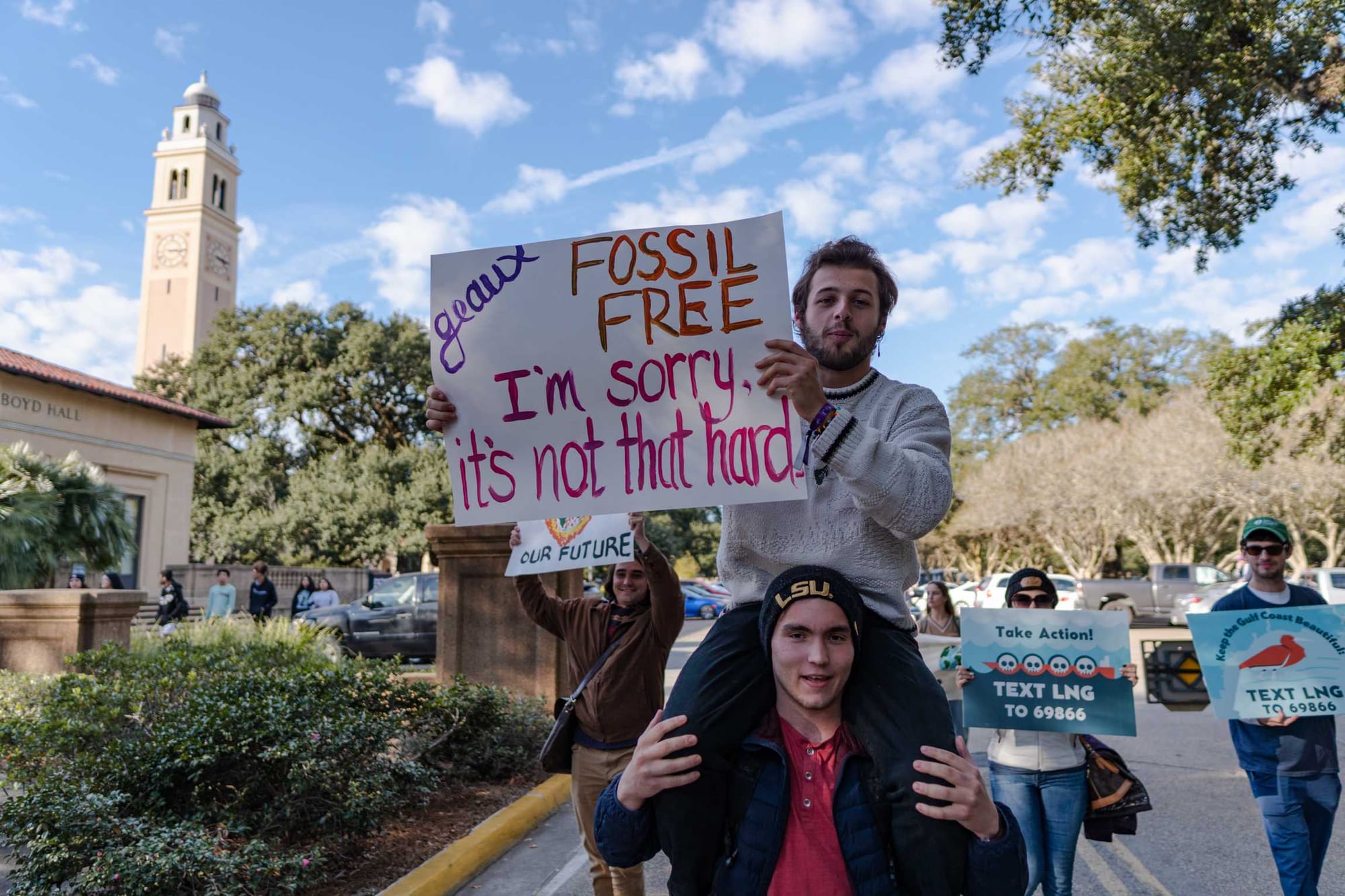
The Influence of Fossil Fuel Funding on Louisiana State University
Jackson Voss, a graduate of Louisiana State University (LSU), has a deep appreciation for his alma mater. He acknowledges that his undergraduate education was funded through a program initiated by an oil magnate and that he received additional scholarships from ExxonMobil and Shell. However, as a socially conscious individual, he also recognized the potential consequences of this support—silence.
During his time at LSU, Voss didn’t encounter discussions about how climate change worsened Hurricane Katrina, the health impacts of petrochemical plants on Black communities along the Mississippi River, or the long-term damage caused by the BP oil spill. It wasn’t until he attended the University of Michigan for his graduate studies that these topics were openly addressed.
Voss, now the director of climate policy for the Alliance for Affordable Energy in New Orleans, notes that LSU didn’t engage in meaningful conversations about climate change or “Cancer Alley” during his time there. He recalls that even discussions about climate change had to be carefully framed to avoid addressing the role of the oil and gas industry in exacerbating the crisis.
The influence of the fossil fuel industry on LSU extends beyond funding. Through research projects, academic programs focused on energy, and support for cultural initiatives such as opera and football, the industry has shaped the university’s discourse for decades. Despite claims from LSU administrators that they have safeguards against undue influence, a joint investigation by Floodlight, WWNO/WRKF, and the Louisiana Illuminator revealed that fossil fuel funding allows the industry to shape what gets studied and what is ignored.
Between 2010 and 2020, petrochemical companies contributed at least $44 million to LSU through their charitable foundations. This made LSU one of the top recipients of fossil fuel funding among U.S. universities, according to Data for Progress. The university received more from petrochemical companies than MIT, Harvard, and Texas A&M, and 20 times more than the University of Michigan.
As researchers increasingly question the ties between fossil fuels and higher education, it becomes clear that the influence of these industries is not limited to financial contributions. A report from Congress found that the oil and gas industry cultivates partnerships with academic institutions to influence climate research. A similar study showed that the fossil fuel industry’s approach mirrors tactics used by the tobacco and pharmaceutical industries to co-opt academics.
Geoffrey Supran, an associate professor of environmental science and policy at the University of Miami, compares the situation to public health research funded by the tobacco industry. He describes the influence of fossil fuel interests as a conflict of interest on a massive scale.
LSU President William Tate IV has strengthened the university’s ties with the fossil fuel industry in recent years, despite the declining importance of the industry to Louisiana’s economy. Since 2020, Tate has secured over $30 million from fossil fuel companies, including a record $27.5 million from Shell. During LSU’s Giving Day campaign, Shell donated another $1.5 million for libraries and the College of Science.
While LSU insists it has firewalls to prevent undue influence, public records and interviews suggest that fossil fuel funding can subtly or directly impact research and critical discourse. Supran warns that universities risk becoming pawns in a climate propaganda scheme orchestrated by fossil fuel interests.
The Hidden Financial Ties
It is difficult to determine the full extent of fossil fuel funding to universities like LSU. Much of the money for scholarships, workforce development, and buildings flows through LSU’s foundation, a nonprofit separate from the university. The foundation does not disclose donors unless they agree to be identified.
Data for Progress used public announcements and tax filings to estimate the amount of funding received by universities from fossil fuel companies. Jake Lowe of the Campus Climate Network suggests that the reported figures are only the tip of the iceberg. For example, the report includes scholarship funding from the ExxonMobil Foundation but not direct funding from the company to the university or its foundation.
Floodlight, with assistance from a Data for Progress researcher, analyzed petrochemical donations to LSU. The analysis included examining public announcements and tax filings from the foundations of several companies, including Shell, ExxonMobil, Chevron, ConocoPhillips, Entergy, Koch Inc., Southwest Electric Power Corp., Schlumberger, Dow, and Taylor Oil.
From 2010 to 2020, Taylor Oil’s foundation gave nearly $21 million to LSU, making it the largest donor. ExxonMobil followed with over $10 million, much of which came from a matching gift program. In 2022, Shell surpassed previous donations with a single $27.5 million gift to LSU, primarily for the Institute for Energy Innovation.
Donations and Influence
LSU does not hide the fact that the Institute for Energy Innovation was shaped in partnership with the fossil fuel industry. A former Shell executive served as the research center’s interim director, and the company holds three of the institute’s seven board seats. Industry groups hold two more.
In 2023, ExxonMobil became a strategic partner of the institute, contributing $2 million to study batteries, solar power, carbon capture, and advanced recycling. At a symposium later that year, ExxonMobil presented on advanced plastics recycling, a controversial technology criticized as greenwashing.
Environmentalists argue that technologies being studied by the institute, including carbon capture, hydrogen, and low-carbon fuels, are false solutions that do little to address the climate crisis. Logan Atkinson Burke, Voss’ boss at the Alliance for Affordable Energy, states that the institute’s focus is clearly on innovations using fossil fuels.
Safeguards and Concerns
The institute’s current director, Brad Ives, and LSU’s vice president for research and economic development, Robert Twilley, claim to have implemented safeguards to prevent industry influence. Twilley emphasizes that the university’s mission as a land grant institution involves working closely with industries. He cites federal guidelines, the scientific method, and peer review as protections against bias.
However, Supran argues that the relationship between researchers and funders is inherently fraught. He references a study showing that reviews of secondhand smoke funded by the tobacco industry were almost 90 times more likely to conclude that it was not harmful compared to other sources.
Several reports from LSU’s Center for Energy Studies have drawn scrutiny for being misleading. One utility-funded report led to the dismantling of Louisiana’s rooftop solar program, while another helped curb efforts to sue oil and gas companies for environmental damage.
A contract between the Center for Energy Studies and Gulf Coast Sequestration, a company seeking to store carbon dioxide underground, raised concerns. The contract suggested that some conclusions were reached before the study began, focusing on the economic benefits of carbon capture without adequately addressing risks.
Building Reputation and Complacency
Beyond funding research, oil and gas companies also invest in initiatives that benefit the broader community, such as health programs, tutoring, and even football events. Supran theorizes that while large companies use big research institutions to gain credibility, they invest in regional universities to build a compliant population.
Voss acknowledges that the industry’s support for state benefits is one of the few things it does right. However, he believes this support protects the industry from criticism by making people feel part of the community.
The heavy presence of oil and gas on campus can have a chilling effect on those who oppose the industry. Jill Tupitza, a former graduate student at LSU, and her peers faced resistance when they questioned the university’s ties to fossil fuels. Administrators discouraged them from asking questions, leading to increased activism and a podcast exploring environmental justice and false climate solutions.
Despite the challenges, Tupitza and her group continued their efforts, leading to arrests for writing a petition in chalk. While charges were eventually dropped, the incident highlighted the lengths to which some may go to suppress dissent.
Supran notes that LSU is not unique in its reluctance to cut ties with the fossil fuel industry. He argues that many universities prioritize fundraising over careful deliberation about the costs and benefits of these relationships.
Voss predicts that if conditions worsen in an industry known for its volatility, support for LSU will diminish. As climate change intensifies, it could become harder for businesses and residents to stay in Louisiana, already facing population loss.
Instead of relying on fossil fuel funding, Voss believes LSU could play a critical role in climate change and environmental justice in the state. He worries that failing to act could put the university in a worse position.

Post a Comment for "Oil and Gas Dollars Shape Research, Fueling an Academic Echo Chamber"
Post a Comment