
San Francisco Schools Invest $8 Million in Math Education Overhaul
A New Approach to Math Education in San Francisco
Math education is undergoing a significant transformation in San Francisco schools this year. The new kindergarten textbook, featuring a relaxed chimpanzee on its cover, signals a shift in how students will engage with the subject. Similar imagery appears in textbooks for subsequent grades, reflecting a broader effort by educators and district officials to make math more accessible, engaging, and relevant.
This change comes with the adoption of a new K-8 math curriculum, the first in 16 years. The $8 million investment includes classroom math toys, digital practice problems with interactive elements, and instant feedback—making the learning experience feel more like a video game than traditional drills. For many adults who grew up with the "drill-and-kill" approach, the idea of math being fun might seem surprising. However, the curriculum aims to show that math is not just about solving equations or calculating distances but also about understanding its real-world applications.
The shift in focus is partly due to the Common Core standards, which have redefined what students should know at each grade level. These standards emphasize not only the ability to perform mathematical operations but also the understanding of when and why these skills are useful. Renée Marcy, the district director of STEM, explained that students need to internalize concepts rather than simply follow instructions.
Despite these efforts, the district still faces challenges. According to the most recent data from spring 2024, less than half of San Francisco’s 48,000 students were at grade-level proficiency or higher in math. While this is above the state average, there are disparities among subgroups, with only 11% of Black students and 17% of Latino students meeting proficiency standards.
District officials aim to increase the percentage of eighth graders reaching proficiency from 42% in 2022 to 65% by 2027. To achieve this, the district has adopted a comprehensive curriculum developed by two companies: Imagine Learning for elementary schools and Amplify Desmos Math for middle schools. This curriculum includes textbooks, workbooks, digital programs, and hands-on tools such as blocks, rulers, and tiles for each classroom.
Devin Krugman, assistant superintendent of curriculum and instruction, emphasized the focus on "student thinking." While the curriculum introduces real-world applications, it also ensures that students learn the fundamentals of math. This balance addresses concerns that the Common Core standards might overlook basic arithmetic and equation-solving.
As classes begin in August, hundreds of teachers are participating in training sessions for the new curriculum. One example involves a video that uses topics like garbage, landfills, and recycling to introduce math concepts related to waste reduction and spatial awareness. Follow-up activities may involve stacking blocks into boxes and calculating how many fit into a container.
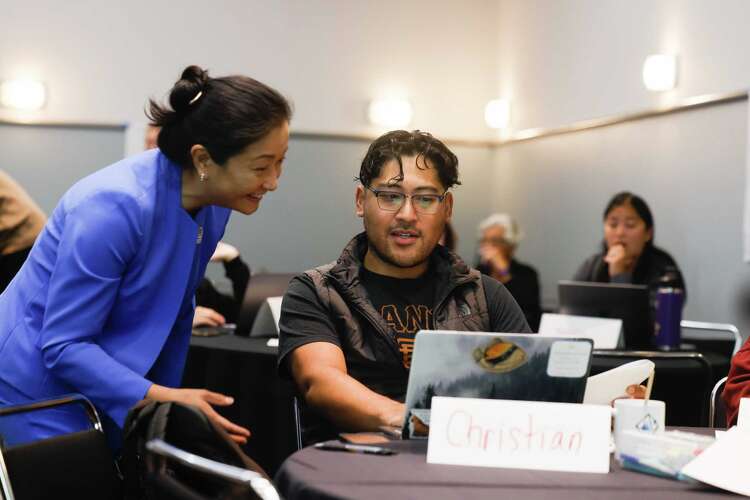
San Francisco Unified School District Superintendent Maria Su observed teachers navigating the new curriculum and noted its interactive nature. She compared it to an online puzzle game rather than a traditional worksheet. Su, who struggled with math as a child, expressed hope that such a program could make math more enjoyable and less intimidating.
Sixth-grade teacher Karena Chiu shared similar sentiments. She recalled her own experiences with math, where she felt confused and intimidated by the subject. With the new curriculum, she noticed increased engagement among her students and found it easier to identify those needing additional support.
Presidio Middle School, one of the pilot sites, saw significant improvements in test scores after implementing the new curriculum. District officials reported promising results, noting that students using the new curriculum performed better on standardized tests than those using the old one.
For Chiu, the goal extends beyond test scores. She aims to break the cycle of math trauma that many adults experience. By making math more accessible and engaging, she hopes to inspire future generations to pursue careers in math-related fields.
The changes in San Francisco’s math education reflect a broader movement toward making learning more interactive, inclusive, and meaningful. As the district continues to refine its approach, the focus remains on helping students understand the relevance of math in their lives and building confidence in their abilities.

Post a Comment for "San Francisco Schools Invest $8 Million in Math Education Overhaul"
Post a Comment