
Starvation in Gaza Sparks Jewish American Division
Growing Divisions Among Jewish Americans Over the Gaza Conflict
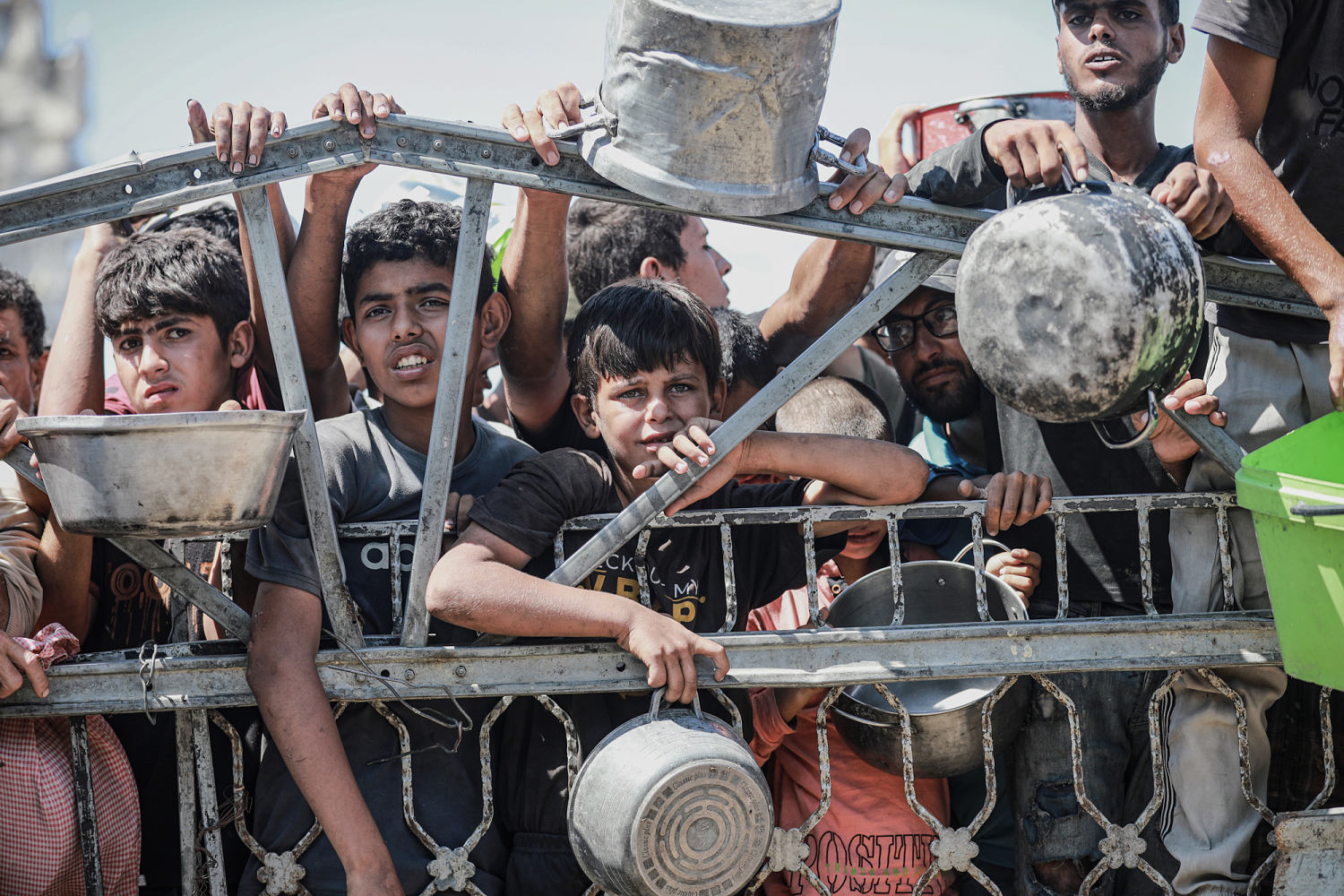
The ongoing conflict in Gaza has created deep divisions among Jewish Americans, with some describing a “rupture” between supporters of Israel’s military actions and those who oppose the current approach taken by Prime Minister Benjamin Netanyahu’s government. Heartbreaking images of starving children have intensified these tensions, prompting calls for the United States and the international community to take a more active role in managing the chaotic food distribution sites.
Rabbi Erez Sherman of Sinai Temple, a Conservative synagogue in Los Angeles, expressed concern over the growing divisiveness and hostility within the Jewish community. “We’re seeing not only divisiveness, but hatred between us, and that’s not a good thing for the future,” he said. He questioned how the community could address these issues and work toward unity.
Despite the concerns, support for Israel remains strong among many American Jewish groups and rabbis. They argue that Hamas is preventing humanitarian aid from reaching civilians in Gaza. Belle Etra Yoeli, spokesperson for the American Jewish Committee, emphasized that Israel has facilitated an extraordinary amount of aid to Palestinians during the war, calling it an unprecedented situation. She added that Palestinian civilians caught in the crossfire due to Hamas’ actions should not be suffering, and that Israel does not want this to happen.
The United Nations reported that nearly 1,400 people have been killed and over 4,000 injured while seeking food in Gaza. At least 859 people have been killed near sites operated by the Gaza Humanitarian Foundation (GHF), a controversial organization backed by both American and Israeli entities. GHF's executive director, Johnnie Moore, claimed that Hamas is responsible for most of the violence and dismissed reports of deaths caused by Israeli gunfire. He argued that Hamas intentionally kills people near aid sites to misattribute the attacks to the Israeli military.
In response to the escalating crisis, synagogues across the U.S. have organized roundtables featuring GHF’s executive director. At one such event hosted by Sinai Temple in Los Angeles, reactions were mixed. Some attendees were surprised that an organization under criticism was allowed to present its case, while others appreciated hearing directly from individuals on the ground. Rabbi Sherman reflected on the challenge of balancing the need to feed the hungry and support the vulnerable with the need to confront evil, quoting Psalm 146.
Polling data suggests that Jewish Americans are divided over Netanyahu’s leadership. A Pew Research Center report indicated that 53% of Jewish Americans lack confidence in his leadership, while 45% express confidence. The poll was conducted before GHF began its operations in Gaza.
Supporters of Netanyahu’s government, including several Jewish American organizations, claim that Hamas is spreading misleading information about the violence at aid sites. They also criticize detractors for losing focus on the remaining Israeli hostages held by Hamas. Orthodox Rabbi Abraham Cooper of the Simon Wiesenthal Center stated that the violence could be stopped if Hamas laid down its weapons.
An emerging concern among various organizations and rabbis is that Netanyahu’s policies are not making Israel or the global Jewish community safer. Jeremy Ben-Ami of J Street, which advocates for a two-state solution, argued that the ongoing violence exposes Israelis and Palestinians to unnecessary bloodshed. He emphasized that labeling people as either pro-Palestinian or pro-Israel leads to an endless conflict.
Rabbi Ari Lev Fornari of Kol Tzedek, a Reconstructionist synagogue in Philadelphia, described the war as creating an “existential rupture” that has pitted friends and family against each other. He called the situation catastrophic, noting that the community is grappling with whether they belong to each other.
Fornari, along with Rabbi Jill Jacobs of T’ruah, was arrested outside Trump Tower in New York City while protesting for the U.S. to stop arming Israel and provide aid to Gaza. Jacobs, who initially supported Israel’s military response to the 2023 attack, began questioning Netanyahu’s strategy as civilian casualties increased. She criticized Jewish leaders for not speaking out against the humanitarian crisis and faced backlash for her stance.
Cultural tensions have spilled into personal relationships, with some Jewish Americans being excluded from family gatherings due to differing opinions on the war. Sonya Meyerson-Knox of Jewish Voice for Peace noted that disagreements are not unique in Jewish history, but the current efforts to weaponize one half of the community against the other are concerning.
As the conflict continues, the Jewish community in the U.S. faces an uncertain future, with deep divisions shaping the discourse around Gaza, Israel, and the broader implications for Jewish identity and solidarity.

Post a Comment for "Starvation in Gaza Sparks Jewish American Division"
Post a Comment