
Top Steakhouses Worth the Splurge in 2025
The Evolution of the American Steakhouse
The American steakhouse is perhaps our best-defined national restaurant genre. A byword for a maximalist experience, powered by meat and liquor, a showstopping bacchanal, a backdrop for business dinners, power lunches and birthdays, it’s the culinary embodiment of the American psyche: large, loud and showy.
Eric Wareheim, the comedian and epicure, has spent much of the last several years crisscrossing the country on a long, carnivorous road trip; his book “Steak House: The People, the Places, the Recipes,” co-authored with Gabe Ulla, will be published in October. “There is this elegance to the steakhouse that takes into account all the Rat Pack stuff, the leather booths and the comfort,” Wareheim said. “I know the Martini is going to be right, and if it’s not right, it doesn’t matter anyway because you’re still in this ice-cold air-conditioned safe zone.”
To Wareheim’s point, one doesn’t typically visit a steakhouse for discovery. An often comically large menu lists a blessedly predictable canon of dishes including raw seafood in various plateau formations; a small selection of salads, anchored by the iceberg wedge; a chorus of sides, of which the potato one is always the best; and, of course, a wide selection of meats, from ribeyes to filets to strips, aged for different durations. Indeed, for many diners a generous cut of animal protein remains a defining feature of any fine-dining experience, steakhouse or not—and a reliable draw. Just this week, chef and restaurateur Daniel Humm announced that after a highly publicized switch to a vegan menu in 2021, his New York restaurant Eleven Madison Park would return to meat, partially for financial reasons. You can bet there will be steak on the new menu.
There is almost always a tableside show: A Caesar salad theatrically tossed. Caramelized bananas, bathed in rum and lit spectacularly aflame. And by the light of the flambée, diners rise to ever greater levels of consumption—even in periods of soaring inflation. At a steakhouse, you know exactly what you’re getting for your money. Where else do you price out your entree by the ounce?
Recently, however, something unusual has been brewing. American steakhouses are getting weirder, more wide-ranging in their inspiration. In New York City alone, just in the past year, among the hottest new openings we’ve seen La Tête d’Or, from Michelin-star-spangled French chef Daniel Boulud; Cuerno, a Mexican steakhouse near Rockefeller Center; and Golden Hof, a Korean steakhouse just around the corner.
Each expands the form of the American steakhouse while capitalizing on what diners love about it. At Cuerno, a roving taquero makes tacos tableside, chopping bone marrow and strip steak before folding them into a freshly pressed tortilla. At Golden Hof, the meal kicks off with a concours d’elegance of galbi, strip steak and picanha for grilling at the table.
Across the country, steakhouses are internationalizing. Later this year, the chef Kwame Onwuachi is opening Maroon, a Caribbean steakhouse in Las Vegas’s Sahara hotel. Not long after, it will be joined by Sartiano’s, an Italianate steakhouse headed by veteran chef Alfred Portale, at the Wynn. For Onwuachi, the choice was easy: Steakhouses “are one of the most fun types of restaurants. It’s a fancy version of going to a diner.” Nor did the Sahara need convincing. “They suggested it and I said, yeah, I was going to do it anyway,” he recalled. Soon the scents of Nigerian-style suya skewers and jerk seasoning from custom-made barrel grills will waft down the Strip.
For the hoteliers and developers whose properties play host to these restaurants, that’s the smell of money. Even with rising meat costs and a general downturn in the restaurant industry, steakhouses remain a bright spot. According to Keith Durst of Friend of Chef, an agency that pairs developers and restaurant concepts, “If you are anchoring a multi-million-square-foot business development, a steakhouse, especially with a high-powered bar, is going to be a staple. It’s something the majority of the people there will want to use, and use often.”
Three Spendworthy Steakhouses to Try Now
Sunny’s Steakhouse | Miami
The Angle
In 2020, at the height of the pandemic, Miami’s Will Thompson and Carey Hynes opened a pop-up called Sunny’s Someday Steakhouse in a former roof-tile factory with a large courtyard in Little River. It was makeshift luxury. Hanger steaks and Parker rolls came out of an outdoor kitchen; diners ate at picnic tables, and the whole thing was packed up at night. For two years, Sunny’s was one of Miami’s buzziest residencies. In 2022, the space closed (as did the group’s other restaurant, Jaguar Sun, in August 2024). But it was a case of reculer pour mieux sauter: When Sunny’s opened in October 2024 as a full-service, permanent restaurant, “someday” had finally arrived.
The raucous 13,000-square-foot restaurant is centered around the same magnificent banyan tree in the courtyard, but the kitchen is permanent and ambitious. The menu observes all the steakhouse mores—but just barely, according to Thompson: “If we didn’t call it a steakhouse, no one would think we are one.” Each part of the menu bears surprises, from the Octopus Ceviche ($22) with grapefruit, cucumber and peanuts (It works!) in the raw bar section to a chile-and-anchovy-rubbed Berkshire Pork Chop ($43). (Get the neon side of pineapple hot sauce.) There’s an unusually muscular pasta section, too. But the steaks are the backbone. At $39, the classic 10-ounce Prime Hanger is shockingly affordable; at $258, the 32-ounce Wagyu Ribeye, less so. “We’re trying to have our cake and eat it too,” said Thompson.
Tableside Showstopper
The ground is too uneven for the traditional gueridons, but this is, after all, Miami, so there’s going to be some razzle-dazzle. The group’s now-closed, beloved Jaguar Sun was known for its elaborate drink presentation. That lives on at Sunny’s, where the Martinis (from $16) are delivered in an elaborate ice-filled vessel flanked by silver elephants. (The exact vessel depends on the size of the party.) Each Martini arrives in its own shaker—in a city this hot, one is advised to replenish as one goes.
Nuri Steakhouse | Dallas
The Angle
When Wan Kim moved to the U.S. from Korea, he immediately began looking for a way to “give back.” After a stint in New Orleans, he settled in Dallas and found his mission: “How do I really bring a different angle to the steakhouse in Dallas, where we’re known for them?”
Nuri, whose name means “whole world,” is one of the most lavish steakhouses in it, reflecting Kim’s wealth as CEO and chairman of the Smoothie King chain. After a $20 million build-out, the restaurant shimmers, an Art Deco-steampunk fever dream covered in hand-painted wallpaper. Like Manhattan’s lauded Cote, Nuri uses the familiarity of the steakhouse format to invite diners to explore Korean cuisine. The Wagyu Steak Tartare ($30) comes two ways: East, with a bright gochujang and a quail egg; and the cayenne-accented West. There’s Grilled Veggie Bibimbap ($29), and Korean Gumbo (essentially the stew budae jjigae, $15), as well as more-standard fare like oysters (with uni and caviar, $36), a full-on Caviar Service (from $160 per ounce) and a Caesar (with black garlic, $18). The steaks, from Oklahoma and Texas ranches, include a 40-ounce Porterhouse ($350) accompanied by kimchi butter, ssamjang and a Wagyu-tallow candle to melt overtop.
Tableside Showstopper
Dallas diners are all atwitter over the Cheesecake Mont Blanc ($21), garnished lavishly by way of a Wonkaesque chocolate extruder hauled over to dispense raspberry white-chocolate ganache in a bright-pink Silly String tangle.
La Tête d’Or | New York
The Angle
Chef and restaurateur Daniel Boulud has tried his hand at so many genres. Besides haute cuisine (Daniel), he’s done burgers (DBGB), brasserie (Le Gratin, db Bistro Moderne), sushi (Jōji) and fast-casual (Épicerie Boulud). But nowhere is his Midas touch more evident than at La Tête d’Or, the massive steakhouse that’s anchored SL Green’s new 1.4-million-square-foot office tower on Park Avenue South since last November. Named after a park in Lyon, where Boulud grew up, this steakhouse Gallicizes the American classics.
The French Wedge ($23) comes studded with roquefort and draped with smoked beef tongue. The smoked mussels on the seafood Plateau (from $130, for 2) brim with rouille, the ruddy Marseillaise mayo. The potato sides ($18) run from purée to frites to tartiflette (read: fancy baked potato).
Tableside Showstopper
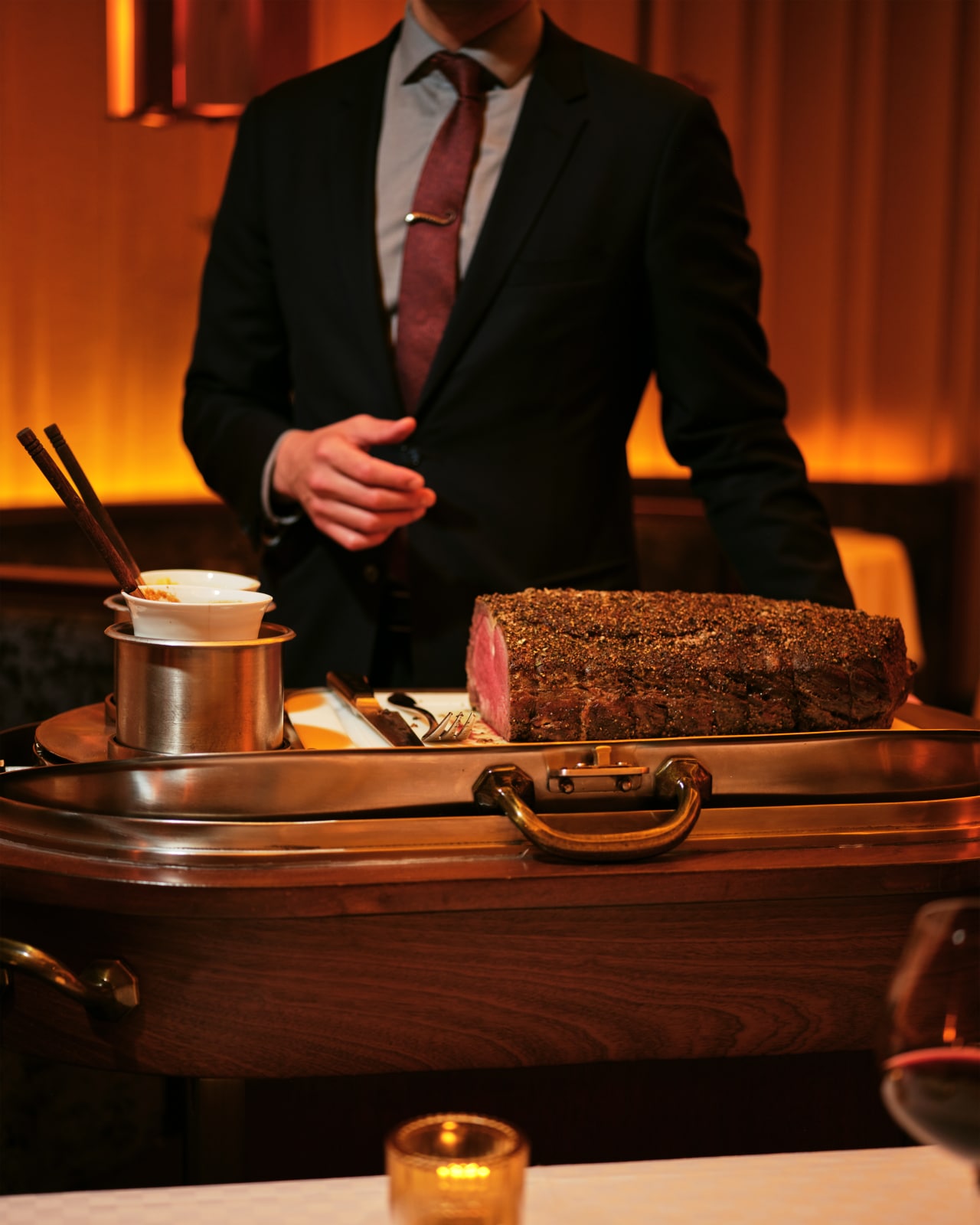
Most tables order the Wagyu Ribeye Prime Rib ($130). A mighty cut of meat from Texas’ Scharbauer Ranch arrives on a tricked-out cart. A silent waiter slices a 10-ounce portion of steak; anoints one side with rich red bordelaise, the other with béarnaise; produces a formidable length of fresh horseradish root and shaves a flurry of it over the beef. Then he discreetly adds to the table a brass ramekin of pommes purée, another of creamy spinach, and a peppered popover with herbed butter.

Post a Comment for "Top Steakhouses Worth the Splurge in 2025"
Post a Comment