
Victory Verticals: A Forgotten WWII Treasure Reclaimed
The Unexpected Role of Pianos in World War II
Pianos are typically associated with music, art, and culture, but during World War II, they played an unexpected role in the military. Steinway & Sons, a renowned piano manufacturer since 1853, was involved in a unique project that saw pianos used as tools to boost morale among troops. These instruments, known as Victory Verticals, were specially designed and transported to war zones, often by parachute. Today, an exhibit at the Museum of Flight in Seattle showcases these remarkable pianos and their historical significance.
The Exhibit at the Museum of Flight
The exhibit, opening on August 9, features three Victory Verticals displayed in the WWII Personal Courage wing. Alongside the pianos, there are photographs and captions that explain their history and use. The idea for the exhibit came from Frank Haude, a Seattle-area resident and aviation enthusiast. He owns several of these pianos and believes there is a strong connection between the instruments and aviation, given their airdrop origins.
Haude, who grew up in Cologne, Germany, has always been interested in the impact of World War I and II on culture. He sees the Victory Verticals as powerful artifacts that tell a complex story. According to him, the military needed sturdy pianos to lift troop morale, and Steinway, which was already producing gliders for the War Department, offered to build pianos as well. The company sent olive drab-painted grand pianos, which were accepted by the Army War Department.
Production and Distribution of Victory Verticals
Between 1942 and 1946, approximately 1,700 Victory Verticals were produced. They were painted olive drab for the Army and Air Corps and light blue for the Navy and Marines. A second batch was made between 1948 and 1953, bringing the total to around 2,436 pianos. These were shipped to the Pacific and European theaters, where they were used in USO canteens and officers’ clubs. They also found their way into the Korean and Vietnam conflicts.
After the war, many of these pianos disappeared into history. Haude first learned about them in 2010 when he saw a social media post about one that had been found on a military base in Alaska. He eventually found his first piano in Kansas City, Missouri, and built a collection that now includes three pianos on display at the Museum of Flight.
Naming the Pianos and Their Significance
Inspired by the tradition of naming aircraft, Haude named the pianos after family members. The USN/USMC piano is named Elisabeth, after his daughter; the Army instrument is Evie; and the concert piano is Louise, after his wife. Each of these pianos has a unique story and is part of a larger narrative about the role of music in wartime.
The Victory Verticals were designed with a boxy look to make them easier to transport in crates. These crates were specially made to protect the pianos during airdrops and featured authentic stenciling. According to Haude, the crates were hand-carried by soldiers using thick rope handles, and some even had markings that indicated how to handle the instruments safely.
The Journey of a Piano Across the Seas
One notable story involves a piano that was sent overseas in 1945 on a troop carrier. A soldier who knew how to play piano was allowed to entertain the troops, and the sailors held onto the piano with ropes due to rough seas. The journey took the piano to Italy, then through the Alps and into Germany.
Each crate contained not only the piano but also tools for tuning, instructions, and sheet music. A vintage advertisement from the time shows a Victory Vertical with a B-17 bomber above it, highlighting the connection between music and military operations.
Collaborations and Preservation Efforts
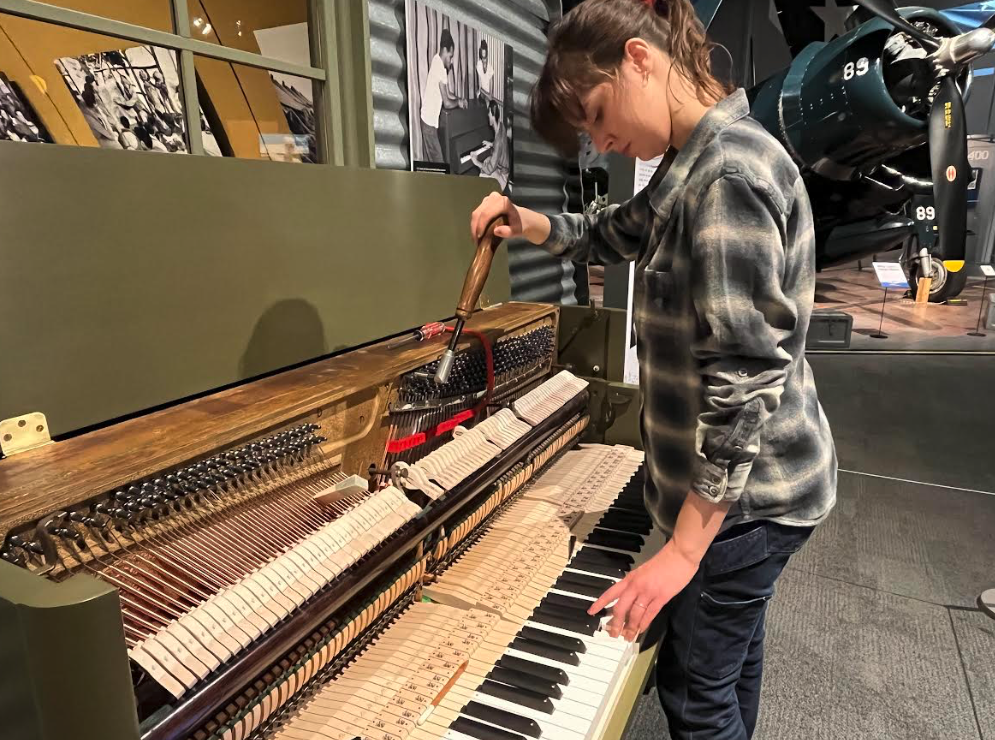
The exhibit would not have been possible without the help of Matthew Burchette, the Museum of Flight’s senior curator, and Steinway & Sons. Jordon Cook, a piano restorer, also played a key role in making the exhibit happen. She has been working on Victory Verticals since 2021 and has her own piano from Florida.
Cook emphasizes the importance of identifying genuine Victory Verticals. She notes that any traces of green paint or specific features like waterfall front keys can help determine if a piano is a Victory. However, serial numbers can be faded or removed, making identification challenging.
The Importance of Preserving History
Despite the thousands of Victory Verticals produced, many are hard to find. Some may have been discarded, while others were preserved by families. Cook hopes that more of these pianos will be discovered and that their stories will continue to be told.
The exhibit at the Museum of Flight includes special programs, such as mini-concerts, that highlight the role of music in winning the war. Visitors can learn more about the history of these unique instruments and their place in military history. For more information, visit museumofflight.org.

Post a Comment for "Victory Verticals: A Forgotten WWII Treasure Reclaimed"
Post a Comment