
China's J-20 vs. F/A-18: Air Superiority Showdown
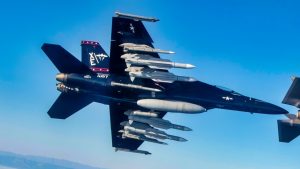
The F/A-18E/F Super Hornet and the J-20S: A Hypothetical Battle Scenario
The F/A-18E/F Super Hornet remains a critical component of the U.S. naval aviation fleet, serving as the backbone of carrier-based operations. Alongside the F-35C, it plays a vital role in maintaining air superiority. However, if a conflict were to arise between the United States and China, the Super Hornet would face a formidable opponent in the form of the J-20S, a fifth-generation fighter developed by China.
In a hypothetical engagement, the question arises: how would the Super Hornet fare against the J-20S? While the Super Hornet has undergone significant upgrades, including the APG-79 AESA radar, IRST Block II, and improved networking capabilities, the J-20S presents a different set of challenges. Its stealth capabilities, advanced sensors, and superior maneuverability could give it a decisive edge in certain scenarios.
Design and Capabilities
The Super Hornet was designed with carrier operations in mind. Its airframe is built for durability, with reinforced landing gear, folding wings, and a tailhook for arrested landings. It also features some radar cross-section reduction measures, such as smoother surfaces and radar-absorbent coatings. However, it is not a true stealth aircraft like the J-20S.
The J-20S, on the other hand, was developed with stealth as a primary design goal. Its angular fuselage, internal weapons bays, and radar-absorbent materials contribute to a low radar cross-section. Additionally, its canard-delta wing configuration enhances lift and maneuverability at high altitudes and speeds. The second seat in the J-20S is not just for training; it allows for more complex missions that require a dedicated systems operator, such as managing drone swarms or coordinating with other assets in a networked battlespace.
Performance Metrics
In terms of performance, the J-20S outclasses the Super Hornet in several key areas. It can reach speeds of Mach 2.0, has a combat radius of over 1,100 nautical miles, and a service ceiling of approximately 66,000 feet. These capabilities allow it to engage targets at longer ranges and higher altitudes than the Super Hornet, which is limited to a top speed of Mach 1.6, a combat radius of about 680 nautical miles, and a service ceiling of 50,000 feet.
The J-20S is powered by two WS-10C or WS-15 engines, which may include thrust-vectoring capabilities. This gives it superior agility in close combat situations. In contrast, the Super Hornet uses two General Electric F414 engines, which are reliable but lack thrust-vectoring. This difference in propulsion technology could be crucial in a dogfight, where maneuverability is critical.
Avionics and Sensor Systems
Avionics and sensor systems further highlight the generational gap between the two aircraft. The J-20S is equipped with a modern active electronically scanned array (AESA) radar, capable of tracking multiple targets at long range. It also features a distributed aperture system (DAS) that provides 360-degree infrared coverage, enhancing situational awareness. The aircraft’s electronic warfare suite is believed to be highly advanced, and the second crew member can manage these systems more effectively.
The Super Hornet, while not lacking in avionics, relies more on external assets such as AWACS and electronic warfare aircraft to maintain situational awareness. It features the AN/APG-79 AESA radar, which is highly capable, and includes the IRST Block II system for detecting stealth aircraft using infrared signatures. Its electronic warfare systems are robust, and it can carry jamming pods to disrupt enemy radar and communications.
Stealth and Survivability
Stealth and survivability are areas where the J-20S has a clear advantage. Its low radar cross-section allows it to operate undetected in contested environments, and its internal weapons bays help maintain that stealth profile. The aircraft’s shaping and coatings are designed to minimize detection from radar and infrared sensors.
In contrast, the Super Hornet’s survivability relies more on speed, agility, and electronic countermeasures. It is not stealthy enough to avoid detection by fifth-generation fighters and must rely on tactics and support assets to survive in high-threat environments.
Conclusion
In a hypothetical one-on-one engagement, the J-20S would likely have the upper hand. Its stealth and superior sensors would allow it to detect and engage the Super Hornet before being seen. The PL-15 missiles carried by the J-20S outrange the AMRAAMs carried by the Super Hornet, giving the J-20S a first-shot advantage. In close combat, the J-20S’s thrust-vectoring engines and high maneuverability would make it difficult to defeat.
While the Super Hornet is agile and well-armed, it lacks the stealth and kinematic performance to match the J-20S. The outcome of a potential conflict would hinge less on 1v1 match-ups and more on who fights as a networked team, manages emissions, and brings the better missiles and tactics to bear.

Post a Comment for "China's J-20 vs. F/A-18: Air Superiority Showdown"
Post a Comment