
NYC Autism School Uses VR to Teach Social Skills and Enhance Learning
The Rise of Virtual Reality in Autism Education
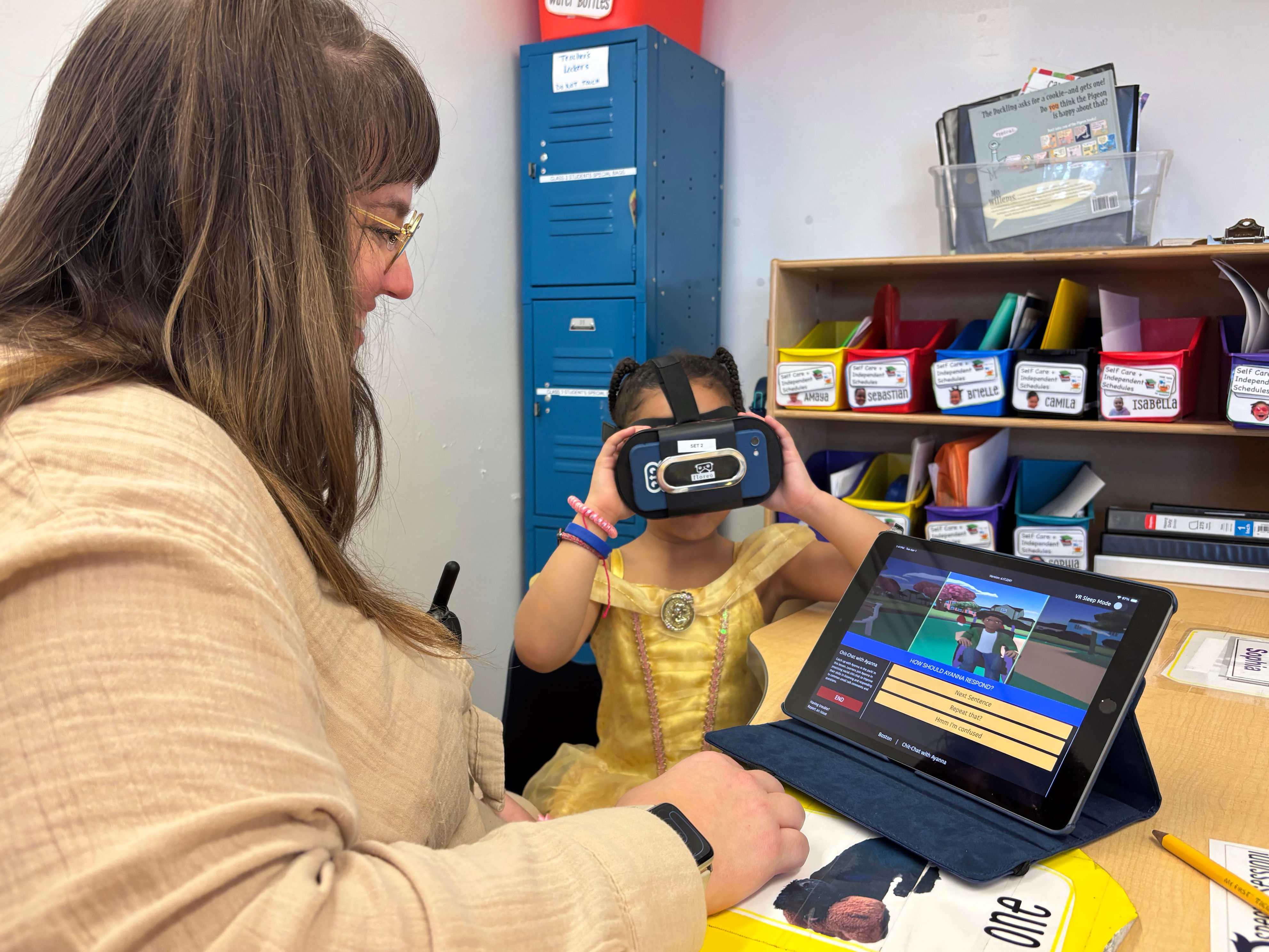
In a bright classroom at the New York City Autism Charter School in the South Bronx, young children eagerly anticipated their turn to experience a digital world. A girl wearing a lavender and pink Disney sweatshirt donned a virtual reality headset, resembling futuristic ski goggles. Through the VR program, she would learn essential social skills such as raising her hand and taking turns.
Heidi Brueckmann, the girl’s teacher and clinical supervisor, watched from across the room using a tablet. She could see what the child was experiencing through the VR program called Floreo, along with prompts to guide the lesson. This technology is increasingly being used as an educational tool for autistic individuals, supported by research indicating its effectiveness in improving social skills.
A study published in the Journal of Internet Medical Research analyzed 14 previous studies on VR's role in autism therapy and found multiple benefits, especially in areas like understanding social cues, interpreting facial expressions, engaging in conversation, and forming relationships. The student’s VR experience included a colorful classroom with a virtual teacher and animated classmates. When the virtual teacher asked about a thermometer, the student answered correctly. Brueckmann then prompted the teacher to remind the girl to raise her hand before asking the question again.
One advantage of this setup is that it allows Brueckmann to work one-on-one with students while also teaching them to interact with peers. In real-world group settings, it can be challenging to coach children through social scenarios when surrounded by others who may have similar difficulties.
Benefits of Virtual Reality as a Teaching Tool
Previously, VR equipment was bulky, expensive, and often restricted to academic or research environments. However, modern, lightweight, and reasonably priced VR headsets have made the technology more accessible. Medical schools use VR to train surgeons, and it is also employed to distract patients with chronic pain. Educators, including those at the New York City Autism Charter School, are increasingly adopting VR to support neurodiverse students.
VR scenarios help autistic individuals build confidence by practicing real-world tasks in a controlled environment. For instance, crossing-the-street simulations teach safety awareness and decision-making, while virtual shopping environments offer opportunities to practice making purchases and interacting with cashiers. Other scenarios focus on navigating public transportation, learning to read signs, and asking for assistance.
Before VR, teaching social skills involved watching videos or using applied behavior analysis (ABA), which has faced criticism for pushing children to suppress comforting behaviors. In contrast, VR is immersive, immediate, and engaging, resembling a video game. Students look forward to their VR sessions, and the low-stakes nature of these experiences means no one is likely to feel embarrassed or teased.
Designing VR Teaching Modules for Neurodiverse Learners
Floreo, the VR program used at the New York City Autism Charter School, teaches skills like crossing streets safely, recognizing bullying, and trick-or-treating. Its creator, Vijay Ravindra, developed the idea after observing his autistic son engage with early VR technology. He noticed how VR sparked social interaction and pretend play, which can be challenging for many autistic youth.
Over 100 schools and therapy offices in the U.S. now use Floreo, which is part of a growing number of VR programs tailored for autistic learners. Others include SocialWiseVR, which helps adolescents navigate social situations, and Blue Room, which focuses on managing phobias.
Some creators of VR apps for autistic individuals aim to avoid the coercive methods of ABA by involving autistic co-researchers in the design process. Nigel Newbutt, an assistant professor at the University of Florida, emphasizes designing VR through a "disability lens," creating inclusive environments that adapt to and support autistic users.
Despite these advancements, implementing VR tools remains a challenge. Cost, technical support, and varying levels of comfort with technology among families and teachers can hinder widespread adoption. However, some schools have overcome these barriers through partnerships and funding. At the New York City Autism Charter School, Floreo is funded by a grant, and the company provided technical expertise and training at no cost.
As the young student in the Bronx completed her weather lesson, she passed the VR headset to a classmate. The next session focused on turn-taking in conversation, featuring a friendly virtual child waiting to be greeted. Another student practiced making friends and inviting others to sit with him in a classroom simulation.
Brueckmann has observed real-life progress in her students, noting that one child who initially avoided peers began sitting closer after practicing social scenarios in VR. Even if she still prefers her own table, she now waves to other kids from across the room. This demonstrates the potential of VR to enhance social development and improve the lives of autistic individuals.

Post a Comment for "NYC Autism School Uses VR to Teach Social Skills and Enhance Learning"
Post a Comment