
The Unsolvable Crime Crisis the National Guard Can't Fix
The Impact of Trump’s Crime-Fighting Strategies on Urban Communities
Justin Fowlkes, a 26-year-old from Baltimore, has experienced the harsh realities of life in a city plagued by violence. His first encounter with gunfire was a stray bullet that hit his ankle while he was waiting at a bus stop. The second time, the bullet struck his shoulder, and this time it was meant for him. Reflecting on his experiences, Fowlkes said, “When you’re out in the streets, you know what you sign up for. You might get shot; you might go to jail. You’re already preparing yourself mentally for these things.”
Fowlkes’ story is not unique. Many individuals in Baltimore have faced similar challenges, often caught in cycles of violence and incarceration. However, a community-violence-intervention program helped him change his trajectory. This initiative, which offered job training and support, was among several that were defunded by the Trump administration earlier this year. Trump’s approach to crime prevention, as described by city leaders and criminal-justice experts, seems to treat people like Fowlkes as irredeemable.
During a press conference, Trump highlighted a group of alleged criminals who had been taken off the streets, stating, “They’re not going to be your local school teacher.” He emphasized a tough-on-crime philosophy reminiscent of the 1980s, when aggressive policing led to a significant increase in incarceration rates. Studies have shown that such tactics are often ineffective and costly, leading many officials to shift toward rehabilitation-focused strategies.
Despite some progressive policies during his first term, such as the First Step Act, Trump’s second term has seen a return to strict penalties and mass incarceration. He has pushed for ending cashless bail, despite evidence showing no correlation with increased crime. Additionally, he has allocated billions to arrest undocumented immigrants, who are no more prone to crime than native-born Americans. Trump has also called for the death penalty for murderers in D.C., contradicting research that shows capital punishment does not deter crime.
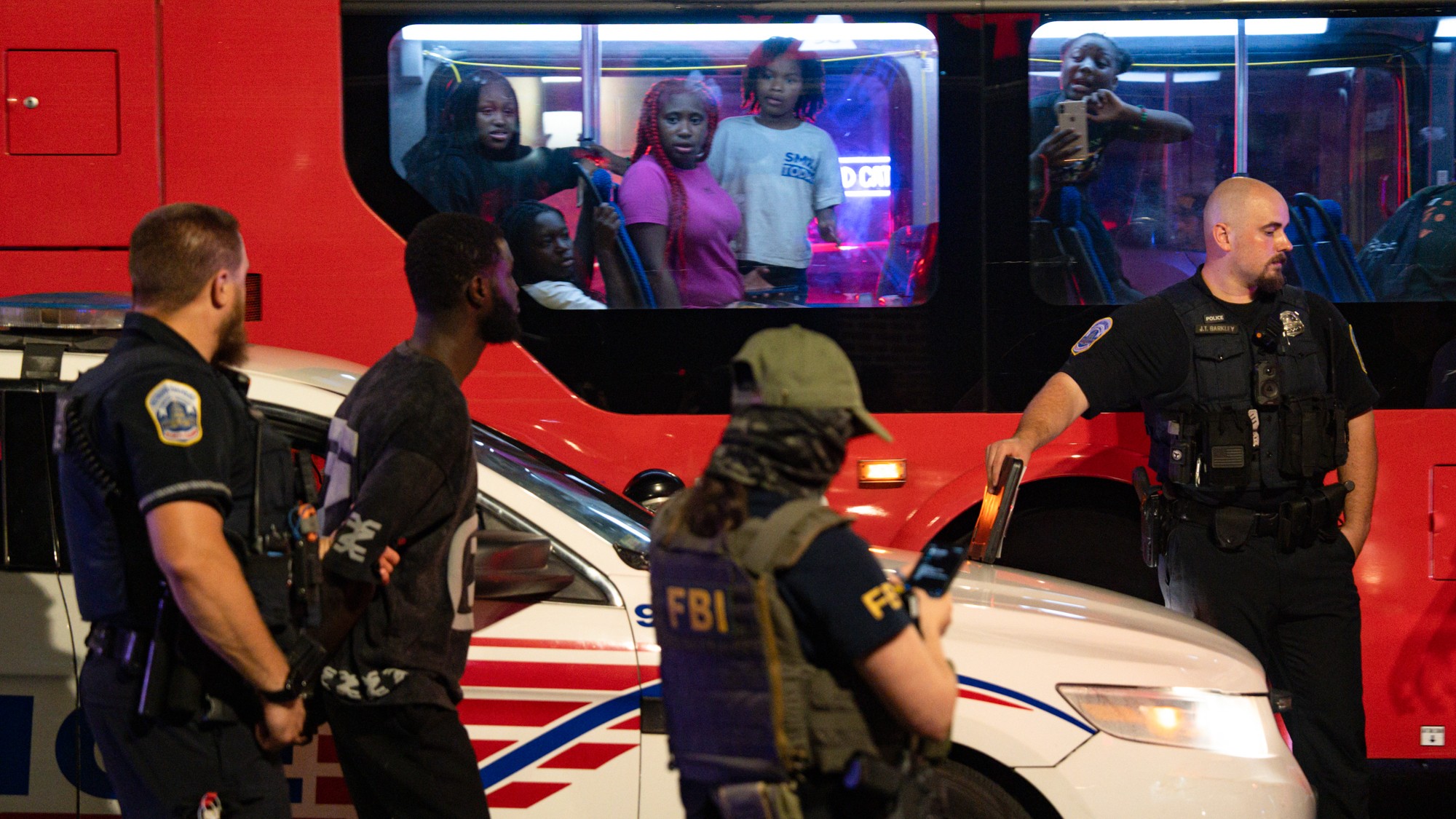
The 30-day window for Trump’s takeover of D.C.’s police department is nearing its end, and there has been a notable reduction in violence in the District. However, whether this decline is sustainable or replicable elsewhere remains a topic of debate. Trump has indicated plans to deploy troops to cities like Chicago, New Orleans, and New York.
Baltimore, just 40 miles north of the White House, offers a useful case study. While federal troops patrolled D.C. last month, Baltimore experienced its lowest number of murders for any August on record. Mayor Brandon Scott, who has closely followed the situation in D.C., argues that relying solely on a “big show of force” is misguided. He recalls his own experiences growing up in West Baltimore, where he dodged bullets and lost friends to gun violence.
Scott emphasizes that mass incarceration has done more harm than good. In 2004, when Baltimore had 270 murders, the city made 91,000 arrests. Last year, with fewer than 18,000 arrests, the city saw 201 homicides. “We had fewer homicides with fewer arrests,” he said, arguing that focusing on rehabilitation and addressing root causes is more effective than dragnet-style policing.
Democrats, who have been targeted by Trump’s threats, have largely moved away from the “Defund the police” rhetoric. Under President Joe Biden, cities have accepted federal grants to bolster their police departments. However, both Democrats and Republicans have paired these investments with support for rehabilitative programs aimed at reducing recidivism.
Mayor Scott sends personal letters to individuals identified as high-risk through data analysis and community policing, offering them a chance to change their lives. If they continue to engage in violence, they are removed from the community. This approach focuses on prosecuting the small group responsible for most of the city’s crime rather than using broad, sweeping tactics.
Wes Moore, Maryland’s Democratic governor, has invested more in local policing than any of his predecessors. He also supports alternative community programs, emphasizing the need for data-backed and effective support rather than what he calls “dumb support.” Moore criticized Trump’s use of the National Guard for landscaping duties, calling it political “theatrics.”
In response to Trump’s actions, Scott and Moore announced plans to boost public-safety efforts in Baltimore using their own resources. They sent Maryland State Police troopers and officers from the Maryland Transportation Authority to high-crime areas and increased efforts to find people with warrants for violent-felony charges.
While Washington’s mayor, Muriel Bowser, has extended cooperation with the Trump administration, she acknowledges the limitations of her authority. Despite legal challenges, the White House points to her support as evidence of the success of Trump’s crime-fighting strategies.
However, criminal-justice experts doubt the long-term impact of Trump’s maximalist strategy. Amy Solomon, a senior fellow at the Council on Criminal Justice, noted that short-term responses may not address root causes, leading to crime shifting to different areas. Programs focused on addressing underlying issues, such as those supported by Congress, have been cut by the Trump administration.
Roca Baltimore, an organization that helped Fowlkes, had its funding canceled. The program targets at-risk young men, offering them educational opportunities, job training, and emotional regulation techniques. Fowlkes, now a father, credits the program with helping him avoid the consequences of rash decisions.
Emma Brown, executive director at Giffords, criticized Trump’s focus on showy tactics over proven programs. She argued that sending the National Guard to lay mulch in Washington is a laughable approach to a serious problem.
As Trump continues to push for deploying the National Guard to additional cities, resistance from governors and mayors is expected. Wes Moore emphasized that the Maryland National Guard will follow legal orders but will not break the law for anyone.

Post a Comment for "The Unsolvable Crime Crisis the National Guard Can't Fix"
Post a Comment