
Trump's Claims Mislead on Climate Science, Experts Warn
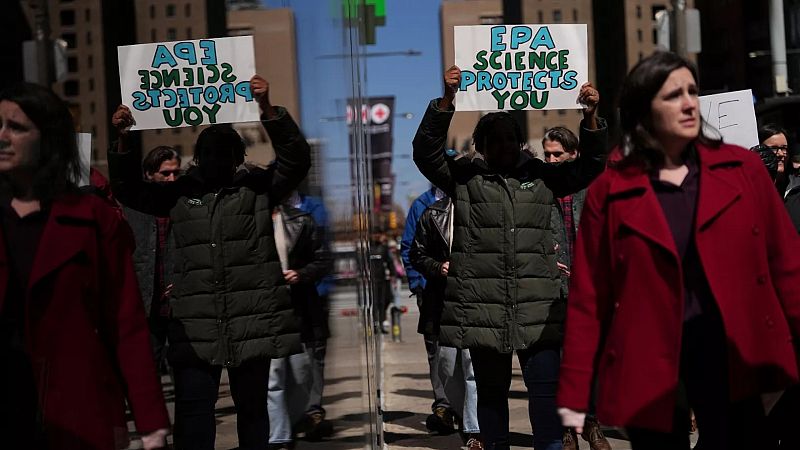
Key Documents from the Trump Administration Under Fire for Scientific Inaccuracy
Two significant documents produced by the Trump administration, aimed at challenging a long-standing scientific consensus on climate change, have been criticized for containing errors, biases, and distortions. According to a survey of dozens of scientists conducted by The Associated Press, these reports were found to misrepresent data and selectively use information to cast doubt on the severity of climate change.
One of the reports claimed that the decline in Arctic sea ice has been minimal, but it used data from the Antarctic to support this claim. This approach was criticized as misleading, given the differences between the two regions. Another section of the report cited a French study on crop losses due to climate change to make a generalization about the United States, an argument that many scientists said didn’t hold up due to differences in climate and agricultural practices.
Additionally, the report dismissed old wildfire statistics as unreliable but then included them in a graphic that suggested wildfires were worse in the past than they are today. Scientists pointed out these basic errors, but the most common criticism was that the Environmental Protection Agency (EPA) and the Department of Energy (DOE) had ignored, twisted, or cherry-picked information to create doubt about the threat of climate change.
What is the "Endangerment" Finding?
In July 2019, the Trump administration proposed revoking a 2009 government finding that climate change poses a threat to public health and welfare. This concept, known as the “endangerment” finding, is supported by mainstream science. If overturned, it could lead to the relaxation of regulations on pollution from cars, power plants, and other sources.
The DOE document argued that climate models overestimate warming, that long-term disaster trends haven’t changed much, and that climate change has little impact on the economy. It also claimed there are benefits to a carbon-rich world, such as increased plant growth.
Scientists Review the Trump Administration's Work
AP reached out to nearly 350 scientists, including lead authors of research cited in the Trump administration’s work, as well as 139 additional experts in climate, health, and economics. Of the 64 scientists who responded, 53 gave negative reviews of the EPA and DOE documents, while seven praised them. Four took no clear position.
In 15 cases, scientists whose work was cited in the reports said it was misused, misinterpreted, or taken out of context. When asked to respond to the critiques, the EPA stated that it considered various sources when evaluating the accuracy of the 2009 endangerment finding. The Energy Department emphasized its commitment to a more thoughtful and science-based conversation.
White House spokesperson Taylor Rogers defended the administration’s work, calling it “Gold Standard Science research driven by verifiable data.” He argued that the endangerment finding had been misused to justify costly regulations that harmed economic and national security.
Overturning the Finding Could Impact Environmental Standards
If the endangerment finding is revoked, it could weaken environmental standards, including rules requiring coal-fired power plants to reduce emissions by 90% and limiting methane releases from oil and gas wells. Another regulation at risk is the requirement that new car emissions be cut by about half by the 2032 model year.
Environmental groups have already filed lawsuits against the documents. The Trump administration argues that climate science is alarmist and claims that U.S. emissions cuts would have little global impact, as the U.S. is the second-largest emitter after China.
Flawed Data and Misinterpretations
Jennifer Marlon, director of data science at the Yale Program on Climate Change Communication, criticized the reports for using flawed data and misrepresenting facts. She noted that the report incorrectly claimed that the area burned by wildfires in the U.S. hadn’t increased since 2007, despite data showing a rise in burn rates. The National Interagency Fire Centre reported that the 10-year average annual burn rate increased from 6.5 million acres in 2007 to nearly 7.6 million acres in 2024.
Another error involved the misuse of data on sea ice. The Energy Department report referenced a chart of Antarctic sea ice instead of Arctic sea ice, which has declined by more than 40% since 1980, compared to a 5% decline in Antarctica.
Report Authors Respond to Criticism
Report authors acknowledged that some errors may have occurred and stated that the documents were not meant to be comprehensive reviews of climate science. Instead, they focused on topics underreported in media and political discussions. They rejected accusations of bias and cherry-picking, arguing that such criticisms hinder serious scientific dialogue.
The EPA’s report heavily relied on the Energy Department’s findings, citing it more frequently than the Intergovernmental Panel on Climate Change (IPCC). The IPCC, which involves hundreds of scientists, produced a major document that was a key source for the 2009 endangerment finding.
Experts Say the Reports Were Biased
Nineteen scientists used the term “cherry-pick” to describe the administration’s reports. Steven Sherwood, a professor at the University of New South Wales, said the reports were biased in their selection of data and failed to present a full picture of climate change. He argued that the reports were designed to minimize concerns about carbon emissions.
Francois Bareille, a French economist whose work was cited in the Energy Department’s report, called the documents fundamentally flawed. He said the report misused his research on French agriculture, which concluded that previous estimates of climate-related crop losses were overly pessimistic. However, he warned that the findings couldn’t be generalized to the U.S., where climate conditions and agricultural systems differ significantly.
Controversial Claims About Ocean Acidification
One section of the Energy Department report argued that ocean acidification should be called “ocean neutralisation,” claiming that marine life is resilient to such changes. However, ocean acidification occurs as water absorbs rising carbon dioxide, harming marine life with shells, such as coral, oysters, and mollusks. This harm risks disrupting food webs.
Stephen Schwartz, a former chief scientist at the Department of Energy’s Atmospheric Science Program, called the term “ludicrous.” Waleed Abdalati, a former NASA chief scientist, agreed that carbon dioxide is making the oceans more acidic, with harmful effects.
Mixed Reactions from Scientists
Many scientists graded the reports harshly. Of the 42 scientists who were asked to grade the documents like undergraduate work, 19 gave them an F, while five received As and an A-minus. Some criticized the grading as silly, with one saying it suggested the goal was “team sport” rather than journalism.
Jennifer Francis of the Woodwell Climate Research Centre gave the EPA report an “R” for ridiculous, while others described the analysis as twisted to support a desired narrative. Zeke Hausfather, a climate scientist cited in the DOE report, criticized the use of his data, saying the report omitted the broader conclusion of his paper that older climate models performed well overall.
Hausfather called the process a “farce” and encouraged the DOE to consider his concerns through the public comment process.

Post a Comment for "Trump's Claims Mislead on Climate Science, Experts Warn"
Post a Comment