
4 Key Lessons from Michigan's Victory Over Washington on 'Big Noon Saturday'
ANN ARBOR, Mich. — The final blow came from Michigan edge rusher Derrick Moore, who charged into the backfield after tackling a Washington tight end and forcing a fourth-down sack on quarterback Demond Williams Jr. It was the last nail in the coffin for Williams, who had already thrown two consecutive interceptions, allowing the Wolverines to build a multi-score lead. His costly fumble resulted in a turnover on downs, sealing the fate of the Huskies.
From there, the Wolverines extended their lead by controlling the clock, moving deeper into field goal range, and scoring another touchdown. Another interception from Williams on the next drive, this time after an unusual deflection on a deep pass, sent fans of maize and blue to the exits, satisfied with their afternoon: Michigan 24, Washington 7.
Here are my takeaways:
This was the response Michigan’s defense needed
For weeks, the Wolverines’ defense and its high-profile coordinator, Don "Wink" Martindale, were under scrutiny following a lackluster performance in the team's heavy loss to USC. That game saw Michigan struggle with tackling (15 missed tackles), stopping the run (36 carries, 224 yards, 2 touchdowns for the Trojans), and aligning properly against the changing tempos used by USC head coach Lincoln Riley.
The pressure on Martindale intensified as speculation about his future spread through local and national discussions. However, when faced with a high-powered Washington offense ranked 16th nationally in scoring (39.2 points per game) and 17th overall (468.5 yards per game), the Wolverines' defense delivered an impressive performance.
Williams, who had thrown for 402 yards and ran for 136 yards with four total touchdowns against Rutgers just days earlier, found that the Wolverines’ defense would offer a stiff challenge. The defense limited his running ability and consistently pressured him as a passer. Washington managed only 249 yards of total offense and lost the turnover battle 4-0, as Martindale's unit regained its confidence entering a favorable stretch of the season.
Wolverines have an emerging star in WR Andrew Marsh
Consider the last Michigan wide receiver to surpass 1,000 yards in a single season. It wasn’t Roman Wilson, who caught 48 passes for 789 yards and 12 touchdowns in the 2023 national championship year. It wasn’t Ronnie Bell, who caught 62 passes for 889 yards and four touchdowns the previous season. It wasn’t Nico Collins, who caught 37 passes for 729 yards and seven touchdowns in his final season.
The answer is Jeremy Gallon, who caught 89 passes for 1,373 yards and nine touchdowns in 2013. For true freshman Andrew Marsh, a highly recruited four-star prospect and the No. 117 overall prospect in the 2025 class, the path to joining Gallon in the 1,000-yard club is long. Midway through the season, Marsh has caught 18 passes for 297 yards and two touchdowns, making it unlikely he’ll reach the milestone this year.
However, if recent performances are any indication, the milestone may be within his reach. He caught four passes for 80 yards against Wisconsin, eight for 138 yards and a touchdown against USC, and five for 49 yards and a touchdown against Washington. On Saturday, Marsh showcased his speed after catching a screen pass that broke through Washington’s corner blitz. He raced past offensive linemen and scored a 22-yard touchdown. Later, he made a highlight-reel catch, snatching a pass with his right hand and celebrating with a wiggling finger gesture.
Marsh is quickly becoming the Wolverines’ top target and a dynamic perimeter threat the team has lacked for years.
Washington’s traditional rushing attack is regressing
Washington tailback Jonah Coleman had a standout junior season in 2024, leading the program under head coach Jedd Fisch. He carried the ball 193 times for 1,053 yards and 10 touchdowns, establishing himself as one of the Big Ten’s top runners. His average of 5.5 yards per carry tied with Ohio State’s Quinshon Judkins, who helped the Buckeyes win the national title.
Coleman’s consistency was evident, with five 100-yard games and five more outings where he rushed for 75 yards or more. However, his 2025 campaign has seen a decline, despite entering the game leading the nation in rushing touchdowns with 11. After strong starts against Colorado State and UC Davis, his production has dropped significantly over the past five games, with opponents holding him to 70 yards or fewer each time.
Some of this decline has been offset by Williams, who added 54 and 136 yards in Washington’s last two games before being held to -19 yards against Michigan. Injuries along the offensive line, including the absence of left tackle Carver Willis and left guard John Mills, have also contributed to the issue.
Pressure on Michigan’s offensive line is intensifying
Last year, during Sherrone Moore’s first season, the Wolverines’ offensive line took a step back from the high standards set during Jim Harbaugh’s tenure. Issues at right tackle and center led Moore to bring in Juan Castillo, a former Philadelphia Eagles offensive line coach, to assist Grant Newsome, who was coaching the line for the first time.
Despite optimism surrounding the group entering 2025, the offensive line has struggled. Key players like Andrew Babalola, a five-star recruit, suffered injuries that disrupted plans. The line’s inefficiency became apparent as conference play accelerated.
During the first quarter of Saturday’s game, Evan Link, the starting right tackle, was carted off with a serious leg injury. He was replaced by Blake Frazier, a sophomore with limited experience. The team provided extra blockers and support to help Frazier adapt during the game.
What's next?
The Wolverines are in a strong position to reach the College Football Playoff. While the score against Washington was lopsided, the game was a significant test before the regular season finale against Ohio State. With a string of manageable opponents ahead, including Michigan State, Purdue, Northwestern, and Maryland, the Wolverines are expected to secure a 9-2 record by November 29.
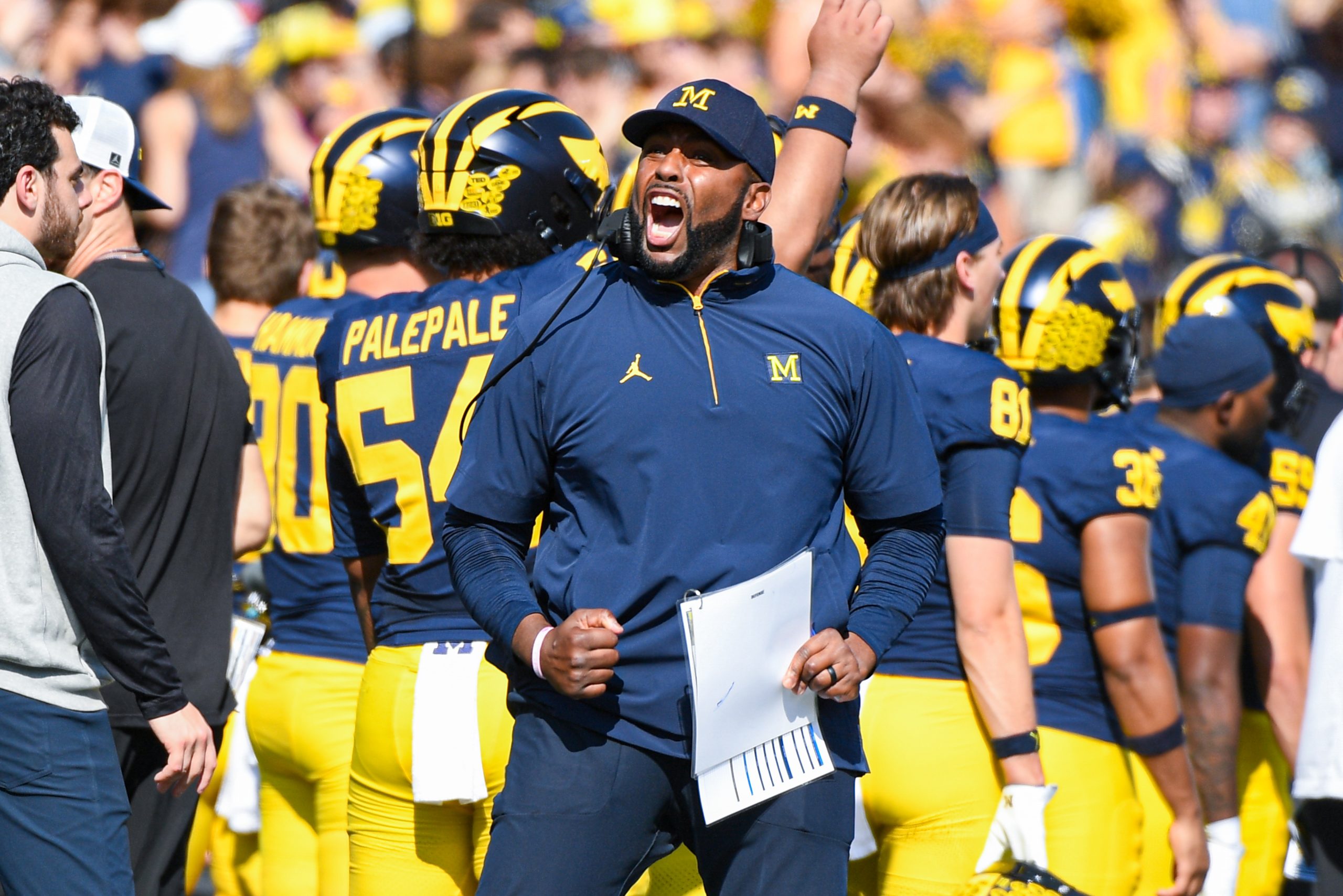
With momentum on their side, the Wolverines are now firmly in control of their own destiny, potentially setting up a trip to the College Football Playoff depending on how they perform against Ohio State.

Post a Comment for "4 Key Lessons from Michigan's Victory Over Washington on 'Big Noon Saturday'"
Post a Comment