
7 Signs Your Dog Is Always Keeping Watch Over You
The Protective Instinct of Dogs: A Deep Bond Between Humans and Canines
Ever get the feeling that your dog has a secret job—maybe as a bodyguard? You're probably not imagining it—despite the wagging tails and happy, lolling tongues, dogs are protective beings, carefully tuning in to subtle changes in the environment, and even your own moods. From how they position themselves to how they bark or shadow your every move, there are tons of protective things dogs do that show they really care, especially when there's an emotional bond between a dog and owner. When they do these things, it's loyal dog behavior. Sometimes, it's just hard to know dog guarding behavior and what a dog's body language means.
Here, we'll explore some human-canine history and discover why dogs are often so protective, list several clear signs that your dog is protecting you and share what you should do if you think your pup is going a bit overboard with the protectiveness.
Why Are Dogs So Protective?
Once upon a time, before the invention of squeaky toys, harnesses, leashes and “puppuccinos,” dogs' ancestors (wolves) roamed the wild with nothing but instinct, hunger and a constant quest for survival. In this world, humans also hunted, but they were lousy hunters by tooth and claw standards. However, they had a peculiar knack for dropping food around their settlements, which the wolves found extra attractive.
Some wolves started sticking near campfires, and humans soon realized that these four-legged freeloaders were actually quite useful: They barked when other predators approached, growled when strangers crept near and occasionally helped chase down dinner. And here’s where the story gets really exciting: The wolves that stuck around gradually morphed into dogs after countless generations, and over time, this mutually beneficial friendship blossomed into the longest and most successful cross-species partnership in history.
Emotional Contagion in Dogs
These dogs didn’t just coexist with humans. They bonded with them, learned to read their facial expressions and tone of voice and also mirrored their emotions. In a nutshell, when humans felt fear, they tensed up; when humans relaxed, they sighed beside them and lay by their feet. This phenomenon is known as emotional contagion and refers to the transfer of emotions from one individual to another, similar to an invisible current.
For dogs, this became a survival advantage. By tuning in to human emotions, they could anticipate danger and strengthen the social bond. In essence, emotional contagion is at the root of their protectiveness. And size doesn’t matter. Even pint-sized Chihuahuas will try to challenge the mail carrier with the bravado of a lion if they feel threatened enough to need to defend their social group.
7 Signs Your Dog Is Protecting You
As you can see, dogs are blessed with an instinctive desire to guard and be vigilant. This desire was inherited from their ancestors, who survived by standing between their humans and the dark. While our dogs' jobs as guardians have largely been replaced by technology, we must consider that evolution doesn't simply retire because society has moved on.
A dog’s protective circuitry still hums quietly beneath the surface, meaning that nowadays, we can still observe our dog’s guarding instincts through a variety of protective behaviors. However, there are some protective signs in dogs you might not notice. To help with that, the following are several protective behaviors in dogs you can look out for. These dog behaviors shows loyalty and love.
-
They Keenly Observe You
Ever felt observed? Some dogs will intently stare at you like a hawk as a way to interpret your feelings and detect warning signs of danger as early as possible. In addition to observing you, they may constantly maintain a visual and emotional “radar” on windows and doors if anything suspicious occurs. These hypervigilant dogs are conducting surveillance and evaluating threats with the precision of a four-legged FBI agent. -
They Have Hyper-Auditory Awareness
Your dog’s ears are much more powerful than yours in detecting noises from a distance. This trait has been cherished in dogs through the centuries. Sure, dogs can hear the crinkle of a suspicious treat bag from many meters away, which may trigger them to rush towards you begging, but that random thump? It could be the apocalypse, or maybe just a leaf. Either way, their instinct is to investigate and alert. You might roll your eyes, but your dog is channeling centuries of evolutionary training. -
They Maintain Physical Contact
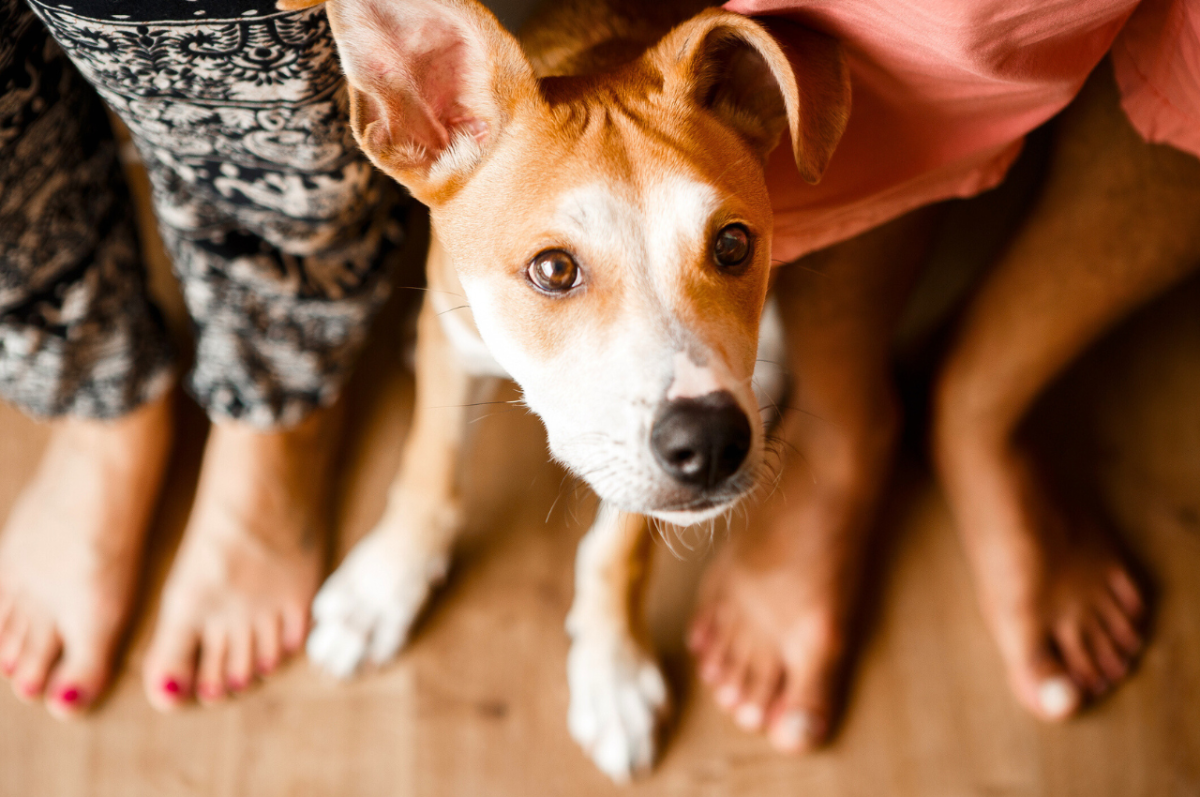
Does your dog sleep on your feet? Does he lay his head on your lap? If so, this may be his way of feeling connected, but it may also be his way of protecting you like a prized bone. By maintaining physical contact, your dog can monitor your emotional state and ensure they can intervene immediately as needed in case of a threat. -
They Take a Strategic Position
Dogs are blessed with the uncanny ability to insert themselves physically between you and the perceived danger. A stranger rings the doorbell? The dog will move between you and the intruder. A person approaches you on a walk? He'll stand in front of you, carefully gauging his intent. Living with a protective dog may sometimes feel like living with a furry medieval knight in no armor, and with significantly more shedding involved. -
They Shadow Your Every Move
Is your dog’s nickname “Velcro dog” because he sticks to you all the time? That’s your dog on duty. From room to room, they’ll shadow you around like a furry bodyguard, always making sure to watch for dangers potentially lurking behind your back. -
They Give Out Vocal Warnings
Dogs have perfected a vocal triage system consisting of a soft warning bark that may escalate to a growl, and in extreme emergencies, a full-blown siren. These vocalizations are distance-increasing behaviors meant to send potential intruders away, whether it’s a thief or the pizza delivery guy. -
They Try to Redirect You
Protective dogs may sometimes try to steer you away from perceived dangers. For instance, a dog might place a toy at your feet, bark insistently, pull you toward safety or maybe try to drag your arms or feet outside of a pool. These likely aren’t random antics. They may be attempts to redirect you from a situation they instinctively sense could be risky.
Can a Dog Be Too Protective?
Some dogs may take their protective role too seriously and start guarding their humans as they do with bones, toys and food bowls. These dogs may react aggressively by barking, growling and lunging when people or other animals approach their "favorite human." In these cases, it's important to take the issue seriously. These dogs may bite given the opportunity.
If your dog is aggressively guarding you or a family member, please seek help from a dog behavior professional such as a board-certified veterinary behaviorist (DACVB) or certified applied animal behaviorist (CAAB).
The Bottom Line
Dogs’ protective behaviors are rooted in attachment and emotional contagion. Long ago, dogs survived by bonding with humans and acting when danger appeared. Modern dogs may no longer face enemies at the door, but that protective wiring remains. The only difference is that now, it’s directed at mail carriers, pizza delivery guys and vacuum cleaners.
Being attuned to human emotions such as fear or anxiety is embedded in a dog’s nervous system. Every nudge, bark or shadowing behavior is a coded message meant to say something like, “I see you. I feel you. I’ve got your back.” So, the next time your dog shadows you around the house, growls at a suspicious noise or leans against you when strangers are near, recognize it for what it is: a profound job driven by devotion, loyalty and a centuries-old instinct to protect the ones they cherish most.

Post a Comment for "7 Signs Your Dog Is Always Keeping Watch Over You"
Post a Comment