
"Disappointing": Ohio's Reading Reform Fails to Deliver Results
Ohio's initiative to enhance reading scores through the science of reading has faced challenges in its initial two years, despite Governor Mike DeWine's efforts to implement the change. The third-grade English Language Arts proficiency rate dropped from 62% in spring 2023 to 61% earlier this year. A temporary increase to 65% in 2024 turned out to be a fleeting improvement, as scores declined again last school year.
It remains uncertain whether these results signal cause for concern or are simply part of the transition as Ohio joins other states shifting toward phonics-heavy lessons. Some advocates of the science of reading believe that small gains should be visible almost immediately, even if larger improvements take time. Chad Aldis of the Fordham Institute, an advocate for the science of reading, expressed disappointment, stating, "We haven’t seen much progress yet."
However, others encourage patience, noting that some districts that adopted the science of reading early are beginning to see improvements. In the Elyria school district, about 30 miles west of Cleveland, educators are hopeful that their patience will soon yield results.
Andrea McKenzie, Elyria’s literacy specialist, acknowledged that scores have not improved since the district switched to the science of reading in 2022. However, she noted that this year’s third graders, the first to use the new curriculum since kindergarten, are on track for an 11-point jump in proficiency rates based on standardized progress tests.
“This is the moment I have been waiting for,” McKenzie said. “I’ve been waiting for these students to get to third grade to see this through, so I feel like this is the year.”
Most schools adopted the science of reading after DeWine began his push in 2023, but Ohio law allowed schools until this fall to fully make the switch. Teachers need time to adjust and embrace a new approach. Mississippi, which serves as a model for Ohio and other states, took a few years before achieving noticeable gains.
Chris Woolard, chief integration officer of the Ohio Department of Education and Workforce, emphasized that this ongoing school year is the first where all schools must fully use the science of reading. He noted that some districts had been implementing the changes for a few years, while others were still in the early stages.
Melissa Weber-Mayrer, Ohio’s chief of literacy, described this year as pivotal since schools now must fully adopt the science of reading. However, she cautioned that it could take three to five years for statewide score improvements.
“Looking locally, we will see things start to move,” she said. “But it might be in a grade level, in a school, maybe in one elementary building within a larger district.”
Elyria, a district with just under 6,000 students, could be one of those pockets. The district’s four elementary schools were named Science of Reading Champions by DeWine last spring for quickly adopting materials and instruction. However, the district’s reading scores are still not rising. Third-grade reading proficiency fell from 45.8% in 2023 to 43.8% this spring.
Despite this, the district has been pushing hard to adopt the science of reading. The school board voted in 2022 to shift to the Core Knowledge Language Arts curriculum and begin using it that fall. The district also started 34 teachers in a two-year Language Essentials for Teachers of Reading (LETRS) training program in 2022, with 30 more starting in 2024 and another 22 starting this school year.
The district also hired two literacy specialists in 2022 to assist the existing one in working with teachers on reading lessons and supporting students who need extra help.
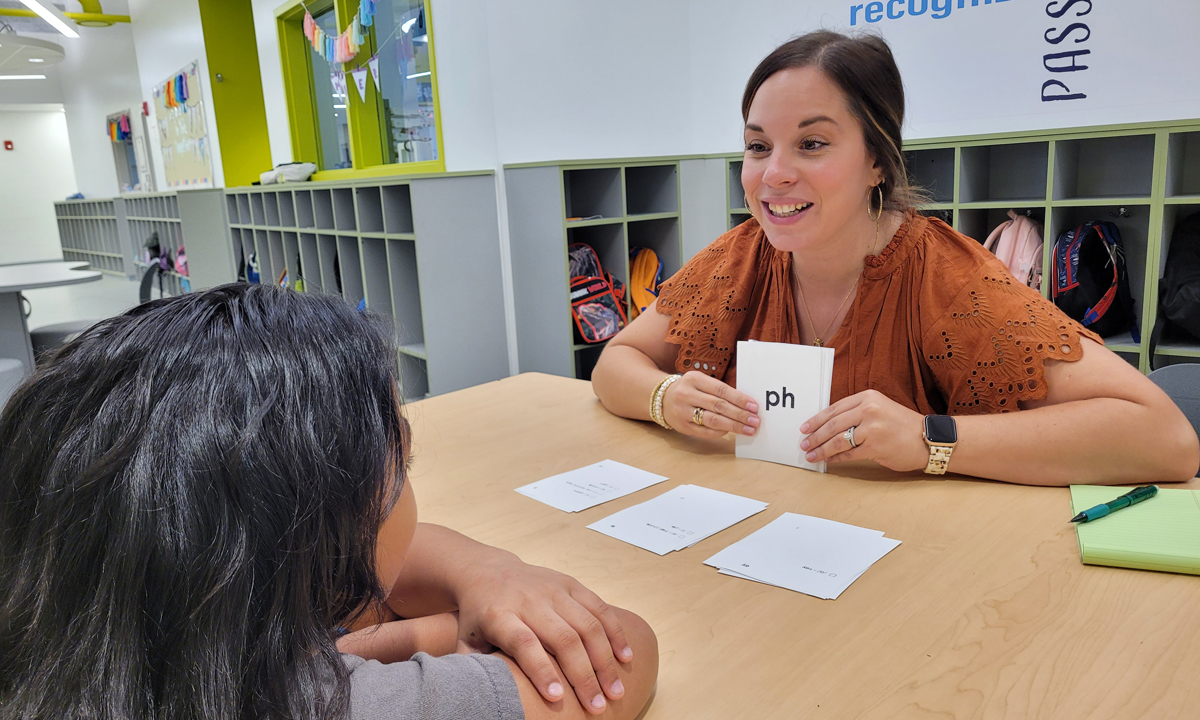
Kindergarten teacher Lindsay DeCoster now gives focused lessons on letters, their sounds, and how to pronounce them. She explained that in the past, certain aspects of teaching reading were overlooked.
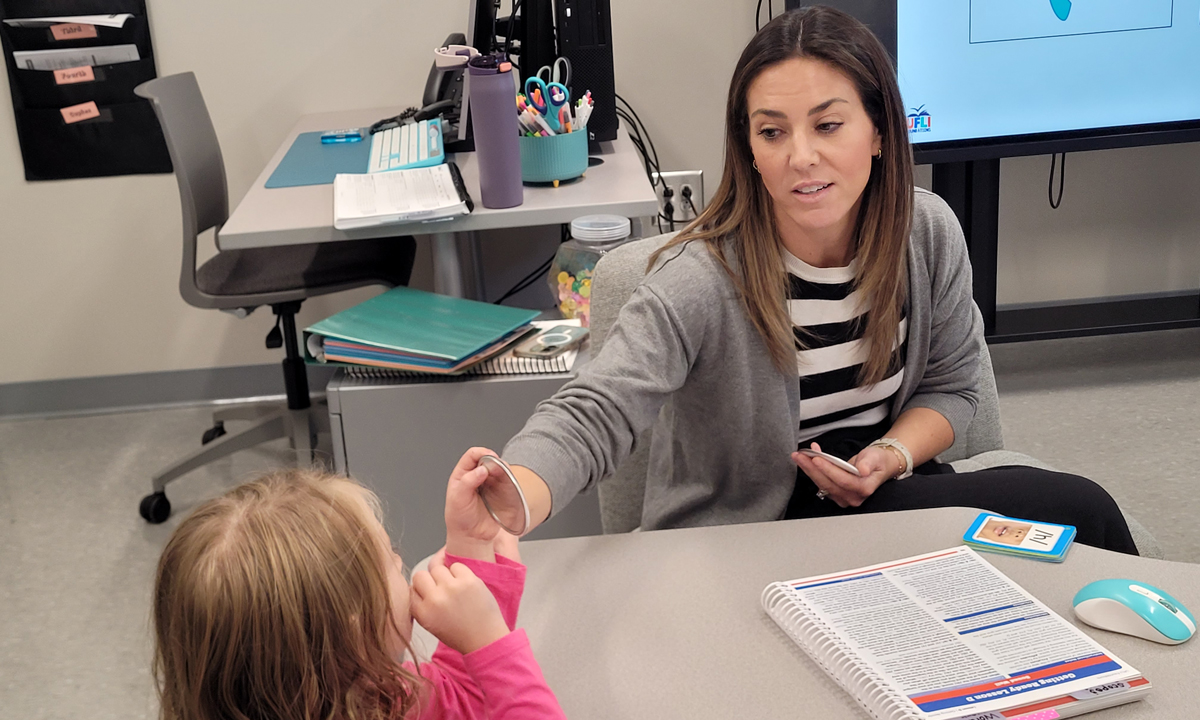
“In the past, we have been skipping over this part… like they don’t need to know how to rhyme, they don’t need to know initial sounds and things like that,” DeCoster said. “If you don’t understand how your mouth needs to look and what your mouth needs to do to make those sounds, then you’re not gonna be able to.”
DeCoster, now in her 17th year as a teacher, said LETRS training significantly improved her teaching. “I just didn’t know what I didn’t know as far as everything that really goes into teaching a child how to read,” she said. “We’ve now broken it down to the smallest, smallest component.”
With many states adopting the science of reading in recent years, experts have struggled to find strong studies showing how quickly scores improve after implementation. This is partly due to varying speeds and intensities of curriculum adoption, teacher training, and coach integration across different schools.
Stanford University professor Thomas Dee, who studied how low-performing schools in California improved using Early Literacy Block Grants, found that changes can happen quickly if classroom methods truly change. He observed that low-performing California students improved by about a third of a year’s worth of learning over two years after changing the curriculum, training teachers, and adding tutoring and afterschool programs.
“I think it’s reasonable to expect measurable improvements in student literacy to follow fairly quickly on the heels of evidence-aligned changes in teacher pedagogy,” Dee said. “The major concern I have is that state declarations for the Science of Reading may not translate quickly—or indeed ever—into responsive changes in classroom practices.”
Teachers, he added, can fall back into old practices of having students guess at words using context or pictures, which Ohio banned in its 2023 state reading law. However, these practices are difficult to track.
Aldis also noted that Ohio is not seeing progress in another important area—whether lower-scoring students are improving and closing the gap to becoming proficient. Fordham reported that more third graders are scoring as “limited,” the state’s lowest rating, than before.
One factor, Aldis said, could be Ohio dropping its requirement in 2023 that third graders must read well to advance to fourth grade, which previously motivated students and teachers to show gains on a deadline.
Casey Taylor, the literacy policy director for ExcelinEd, worked on reading efforts in the early days of Mississippi’s shift, as well as in North Carolina, which started a similar push in 2021. She noted that Mississippi saw some gains in schools that used literacy coaches extensively within two years but cautioned that it took several years before broader performance levels shifted.
Mississippi, the second-worst state in reading when its literacy campaign launched in 2013, did not excel for six years. “We saw some gains in the 2015 NAEP, but it wasn’t until 2019 that the nation really took note, because that was the first time we reached the national average on fourth-grade reading,” she said.
North Carolina, she said, has started seeing gains on standardized progress tests but not on tests like the National Assessment of Educational Progress (NAEP) yet.
Though he wants to see faster improvement in Ohio, Fordham’s Aldis agreed with Taylor in one major way—making real gains takes a long-term commitment. Ohio, he said, has a history of abandoning improvement projects that don’t show quick results and moving on to something else.
“These reforms are just too important to follow that same path,” Aldis said. “We need to stick with it.”

Post a Comment for ""Disappointing": Ohio's Reading Reform Fails to Deliver Results"
Post a Comment