
The $6.50 OJ That Explains Sky-High Grocery Prices
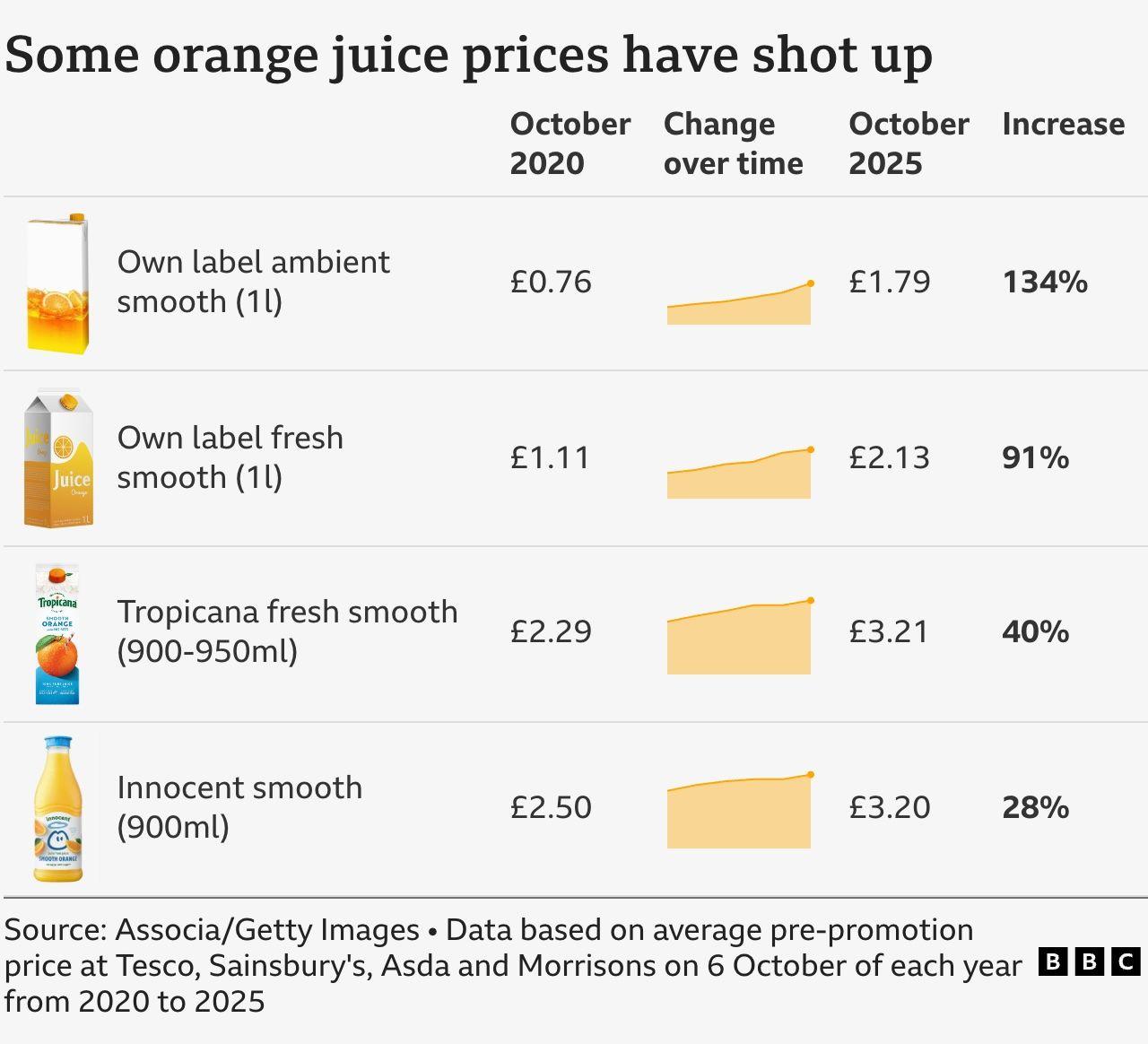
There has been a noticeable shift in the price of orange juice, a staple that once graced British breakfast tables at an affordable rate. Five years ago, a typical supermarket own-label carton of orange juice could be purchased for 76p per liter. Now, it costs £1.79. This represents a staggering increase of 134% since 2020, with a 29% rise just in the past year.
In cafes and restaurants, the situation is similar. A basic glass of orange juice now typically ranges from £3.50 to £4. One colleague was shocked to receive a bill for £9 for a glass of hangover-busting orange juice and lemonade at a small restaurant in Kent. Upon inquiry, she was informed that the orange juice alone accounted for £5.30 of the total cost. As prices have surged, the taste of orange juice has also changed, with some manufacturers substituting oranges for mandarins to cut costs. The public, it seems, is being freshly squeezed.
The reasons behind this surge are multifaceted. Crop diseases, extreme weather events, over-reliance on supply from a single nation, new packaging regulations, and complexities surrounding trade wars and Brexit all contribute to the current situation. These factors create what can be described as a perfect storm, compounded by grocery price inflation. While inflation hit 17.5% in 2023, it has since dropped to around 5.7% in August, though it is rising again. New inflation figures will be released later today.
The problem is not isolated to orange juice. Tracking the prices of other groceries in supermarket aisles reveals a similar pattern. Understanding what has happened to orange juice offers a glimpse into how overall grocery bills have suddenly become so expensive. This raises the question: is this price surge a temporary phenomenon, or are prices set to remain stubbornly high?
The Bing Crosby Effect
To understand the current situation, one must start in the orange groves of Florida, where the industrialization of orange juice began during World War Two. The U.S. government sought a source of transportable Vitamin C for troops that didn’t taste like turpentine. Orange juice is nearly 90% water, so gently evaporating the water off the juice and freezing the concentrate allowed for transportability of a much better-tasting product when water was later re-added.
World War II ended before the troops got to try it, but the concept was commercialized by what became the American soft drink giant, Minute Maid. It was popularized by Bing Crosby, who, as a significant shareholder, would sing in ads and radio show jingles about frozen orange juice being "better for your health." Western consumption of orange juice surged.
Today, an estimated 2.5 billion gallons of orange juice are consumed each year, with about a tenth of that in the UK, where the market is still growing.
Drought, Disease, and Flooding
At an industrial unit in the Essex town of Basildon, green steel drums of frozen orange concentrate arrive from Brazil, overseen by Maxim McDonald. His firm, Gerald McDonald and Co., is named after his grandfather, a pioneer who was importing orange concentrate as far back as the 1940s from what was then British-mandate Palestine. Today, the company produces juices and blends them, then sells them to supermarkets and restaurant suppliers.
Prices reached extraordinary heights in global markets, rising from $1 (75p) to $1.50 (£1.12) per lb over the last decade, to a record $5.30 per lb by the end of last year. This followed five years of poor crops, due to severe drought and a disease called citrus greening (caused by a bacteria spread by insects). Brazil had its worst crop since 1988. In some parts of its citrus belt, two-thirds of orange trees are affected.
"Around September of last year, the price shot up to crazy levels," Maxim tells me. "At the worst time, I was being offered $7 a kilo."
Even within Brazil, the market is concentrated in the hands of huge industrialized conglomerates. In a truly competitive market, the price would settle again—but it hasn't, nor does the industry expect it to. This is a phenomenon common to many other ordinary groceries whose prices have risen.
Oranges Becoming Less Sweet
Florida is another traditional exporter of oranges, but output from the Sunshine State over the past year has been the lowest since the Great Depression, amid a high number of hurricanes and long-term problems caused by citrus greening. One problem with greening is that it reduces sugar content, making oranges less sweet.
"Not many are buying Florida oranges any more unless it is a requirement to label the juice 'Florida Orange'," says Maxim McDonald. "It's very difficult to get oranges out of Florida [because of the shortages], and it's too expensive."

Tariffs: War on the Orange
Then there is the added impact of recent trade tensions with the U.S. since President Trump introduced new tariffs. Oranges have been at the center of this. U.S. exports of orange juice to Canada have slumped to a 20-year low after Canada put counter-tariffs on U.S. exports. The former Prime Minister Justin Trudeau warned that Canadians might have to "forgo Florida orange juice."
The Trump administration has also settled on a 10% tariff on orange juice coming from Brazil, which will feed into U.S. supermarket prices. In 2024, the UK eliminated tariffs on some imports produced from fruit grown outside Britain. But tariffs on certain sweeter, cheaper varieties and blends were not part of this. While the tariff cuts might have helped, they were vastly outweighed by the increase in the underlying price.
New Regulations Around Packaging
New regulations around packaging, known as Extended Producer Responsibility, are aimed at improving recycling rates, with a weight-based fee. All juice producers will be impacted, especially those still using glass bottles. In August, a Bank of England report said that high food price inflation is driven partly—among other things—by these regulations.
Did the West Fall Out of Love with OJ?
In Brazil, the orange harvest has recovered somewhat, which is the greatest hope for a return to normal prices. However, this coincides with sinking demand: global consumption of orange juice is now down 30% from a peak two decades ago. Though this may be partly due to high prices, in certain parts of the world, there has also been a shift in perception about the sugar content and health benefits or otherwise of fruit juice.
"When young children are not regularly given juice from an early age, they are less likely to be regular juice drinkers in later years," suggests Philip Coverdale at GlobalData. Demand is increasing in countries with growing middle classes, such as China, South Africa, and India. But elsewhere, other more exotic fruit juices such as mango, pear, and pomegranate are gaining popularity.

Ultimately, however, orange juice is a staple that supermarkets have long been used to selling at low prices. And the price spikes to £2 a carton could, with for example, better weather, simply reverse. "The volatility in the harvest appears to have reduced," says Giles Hurley, UK CEO of Aldi. "Our buying team are doing everything they can to ensure that that saving is passed on to consumers."
Others in the supply chain are less convinced, given that much of the frozen concentrate was bought at last year's high prices. Plus, the stranglehold of the small number of giant producers who control the market remains.
As for citrus greening, some major commercial producers, including Coca-Cola, which owns Minute Maid and Innocent, have contributed to a project to Save the Orange, using artificial intelligence to find a way to combat it. It's a long-term project—and even if fruitful, it may be some time before the effect, if at all, filters through to grocery bills.
But the story of orange prices does also show how an upward price shock gets transmitted around the world far more quickly than a downward one.
Chocolate, Coffee, Butter, and Beef
Oranges are not the only food that has seen a price spike. The price of beef and veal is up almost 25% in a year. Butter is up almost 19%, and chocolate and coffee 15% and milk over 12%, all according to the Office for National Statistics. This all suggests that, more generally, there may be something else at play. And that for all the food and drink spikes, the consumer was actually protected from the worst of it for a period—and now it is payback time.
"It might be the retailers didn't fully pass through the cost increase in the first place and therefore it's a way of recouping some of the margin they would otherwise have got," says Steve McCorriston, Professor of Agricultural Economics at the University of Exeter.
Ultimately, though, trying to unpick the precise reason for why our food and drink costs what it does is very difficult—other factors that influence price can go undetected.
"What we don't know much about is how these supply chains tend to work in practice. It's difficult to uncover relationships between retailers and manufacturers or farmers and the use of contracts."
There is also a broader question that goes well beyond orange juice: do consumers in the UK need to simply accept the fact that as a densely populated small country with limited agriculture, a changing climate means the UK will be increasingly exposed to food price shocks?
A 2024 government report on food security noted: "The UK continues to be highly dependent on imports to meet consumer demand for fruit, vegetables and seafood... Many of the countries the UK imports these foods from are subject to their own climate-related challenges and sustainability risks."
And so it could be that this is only the start of a wild ride on what we pay for our food and drink.

The News PulseDepth is the home on the website and app for the best analysis, with fresh perspectives that challenge assumptions and deep reporting on the biggest issues of the day. You can now sign up for notifications that will alert you whenever an InDepth story is published—click here to find out how.
More from InDepth
The true cost of cyber attacks - and the business weak spots that allow them to happen
Why luxury cheese is being targeted by black market criminals
How weight-loss injections are turning obesity into a wealth issue


Post a Comment for "The $6.50 OJ That Explains Sky-High Grocery Prices"
Post a Comment