
The Amazon: Peruvian Artist's Home, Inspiration, and Global Gallery
A New Chapter for Indigenous Art
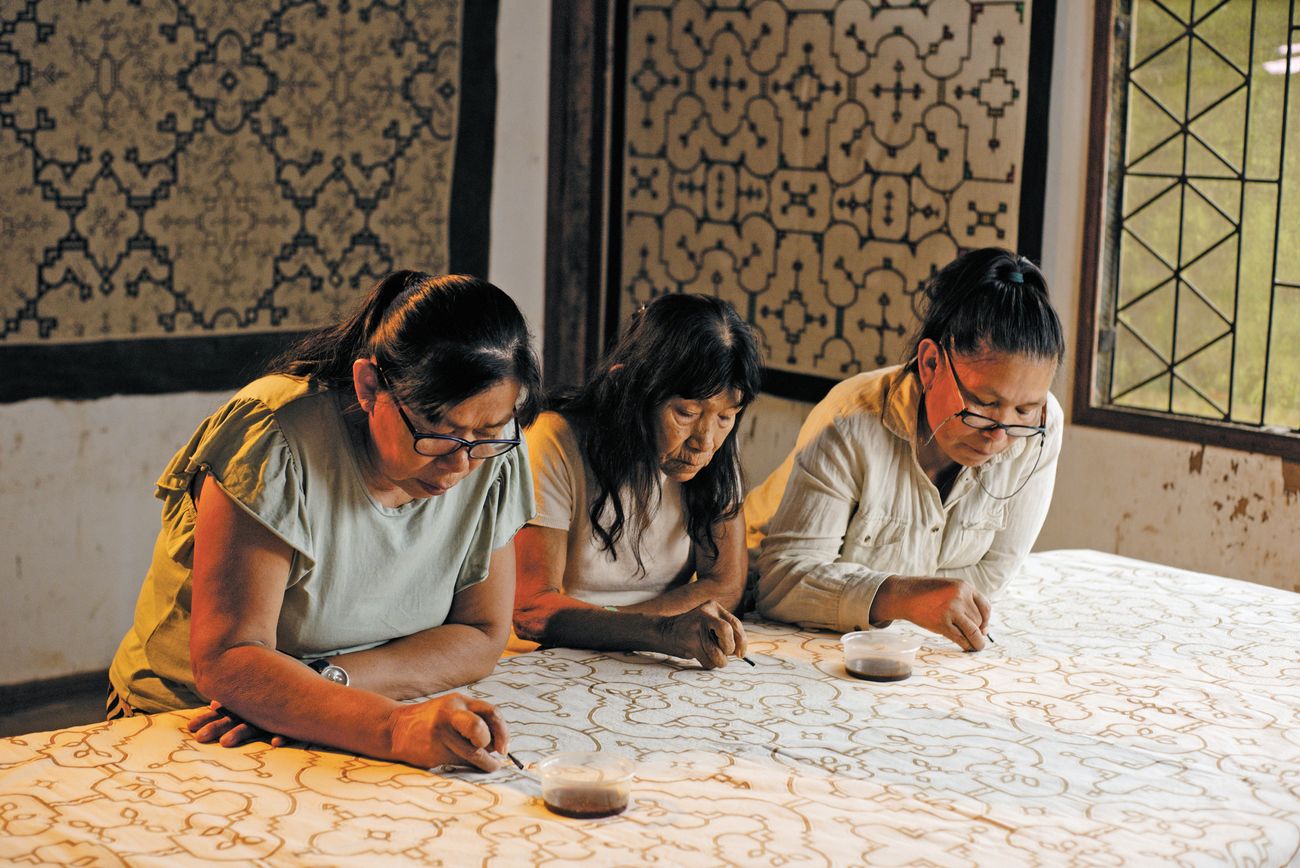
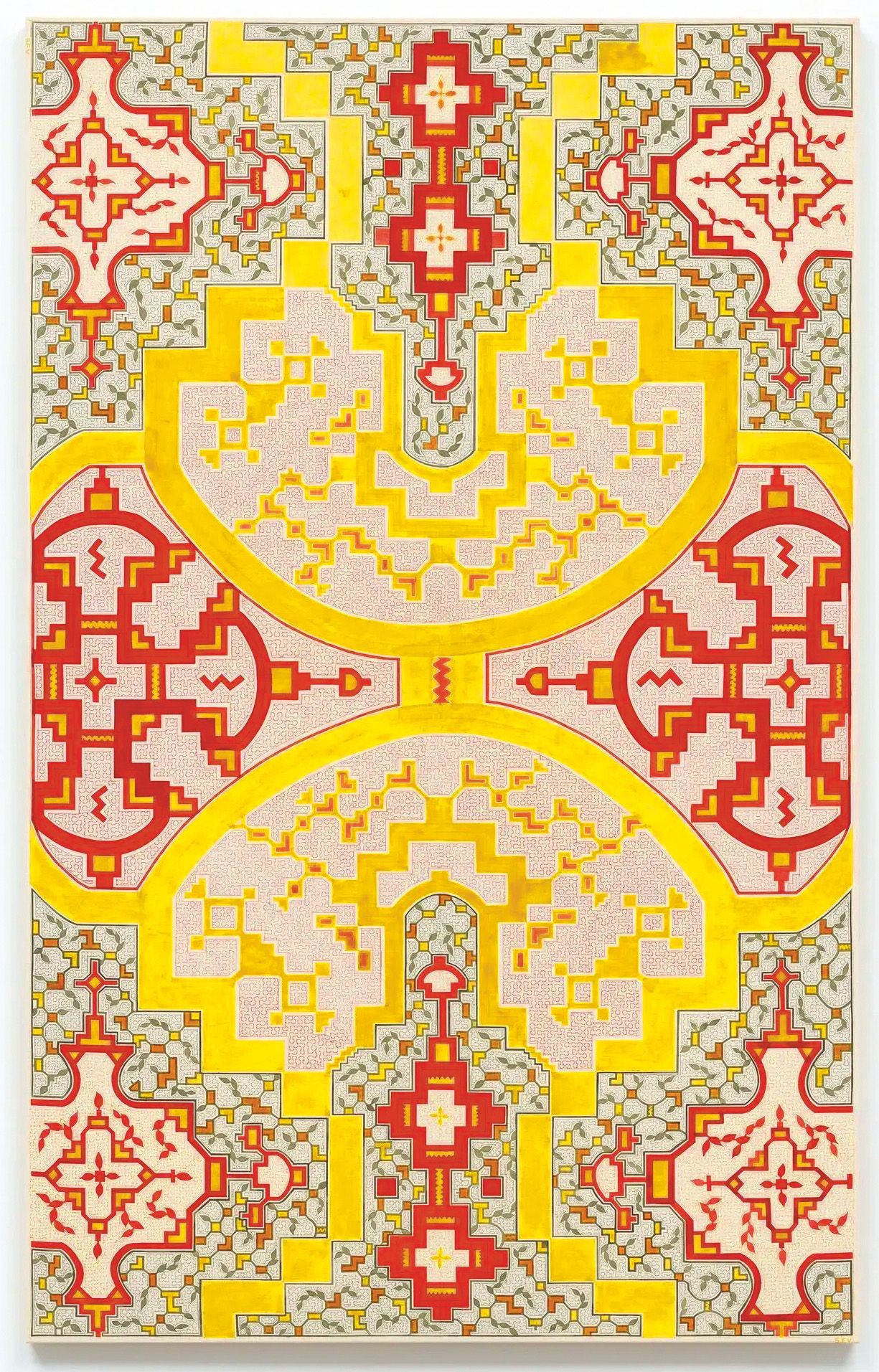
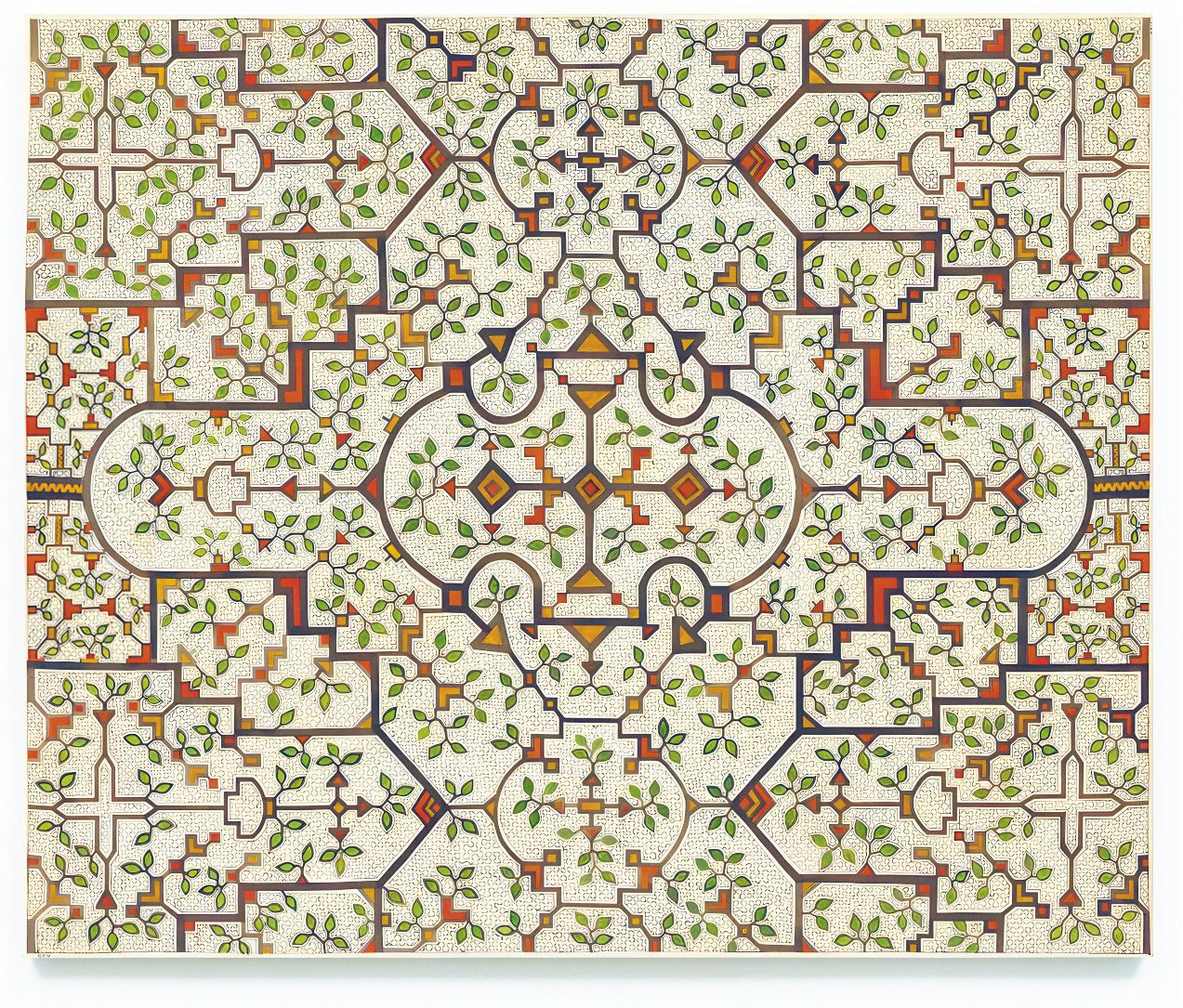
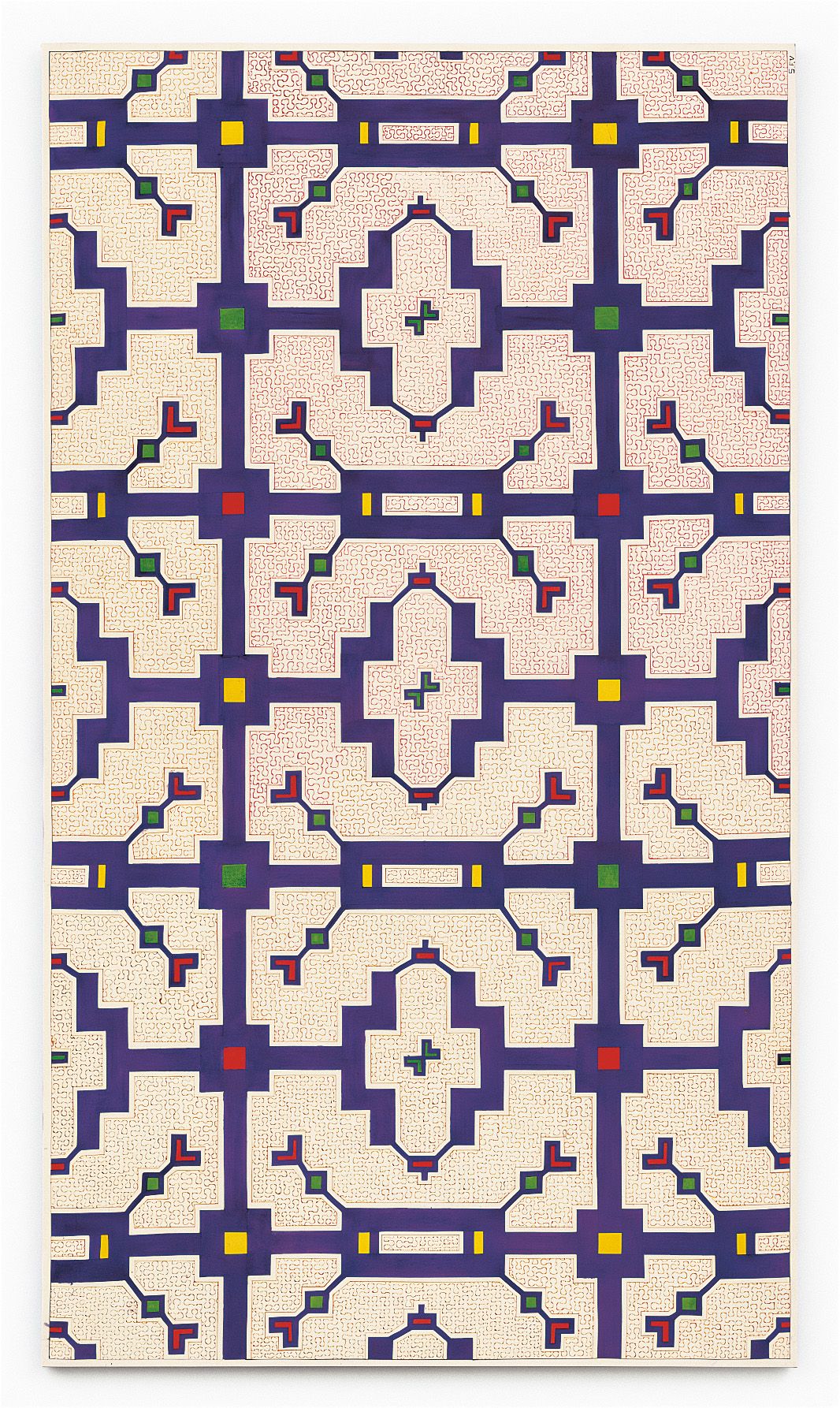
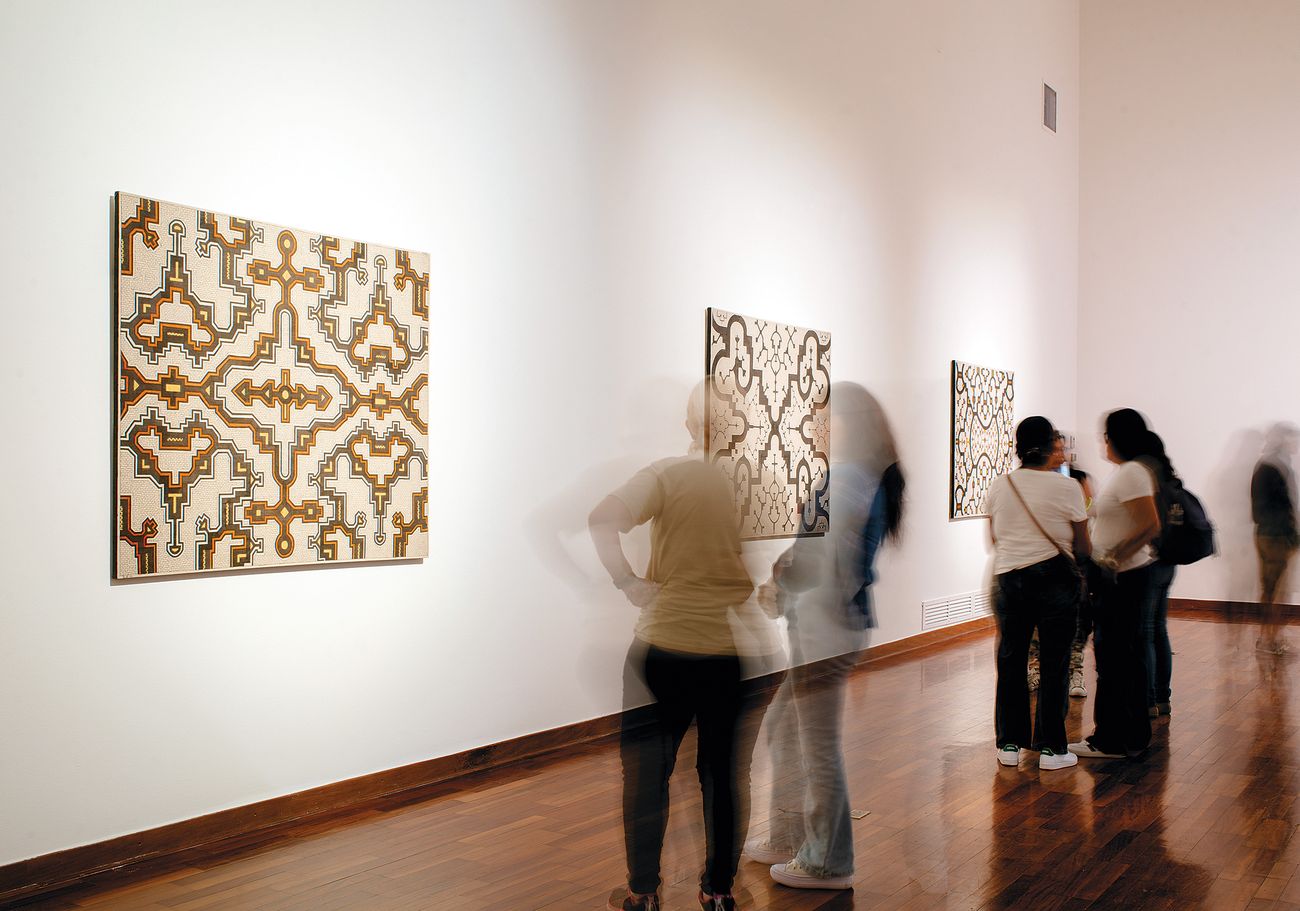
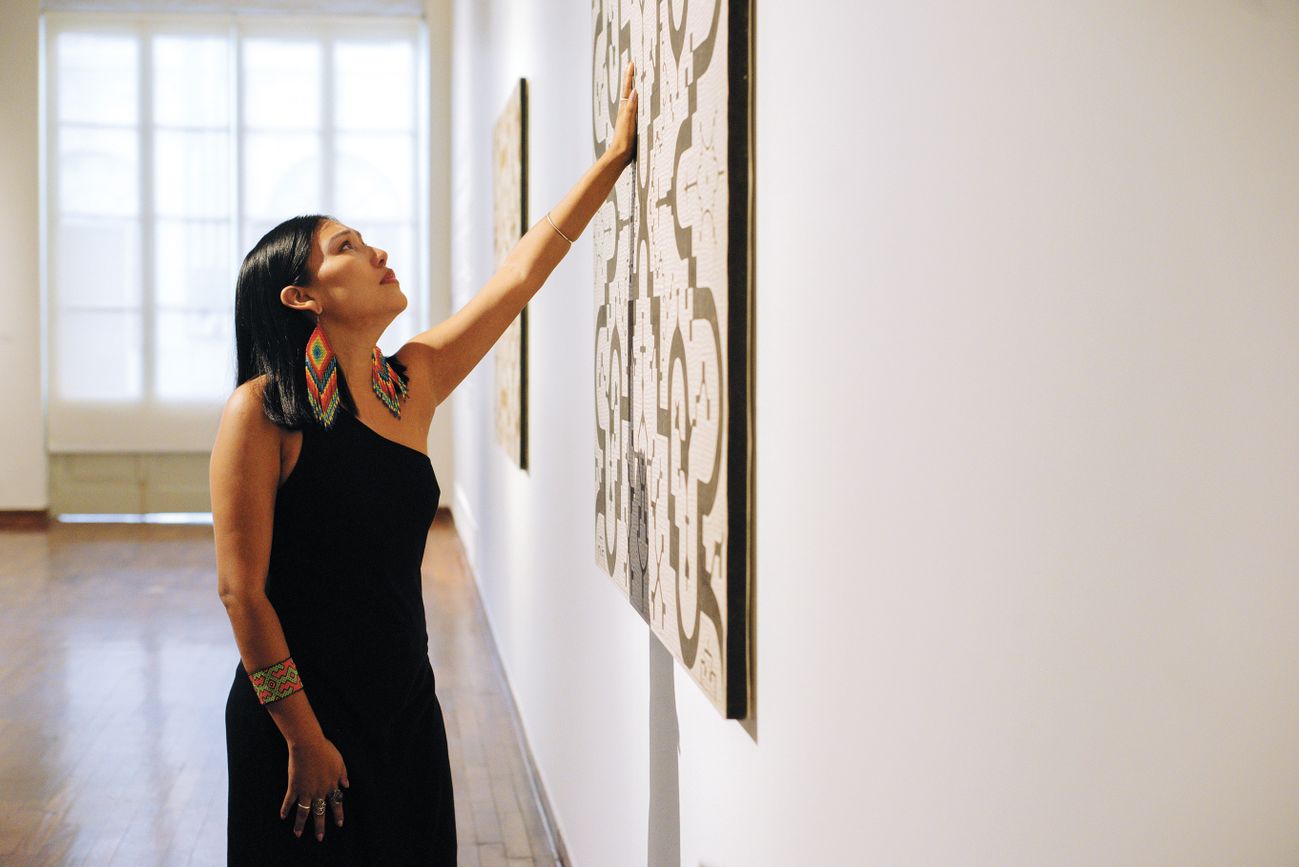
Sara Flores sat against the wall, flanked by family, in a traditional Shipibo-Conibo wrap skirt and blouse. She was attending the opening of her solo show “Sara Flores. Non Nete. A Dream for an Indigenous Nation,” and she was overwhelmed with attention, swarmed by well-wishers. The exhibition was the first devoted to a contemporary Indigenous artist in the 64-year history of the Lima Art Museum, one of Peru’s premier cultural institutions. The museum’s permanent collection, spanning 3,000 years, includes Inca treasures and Spanish colonial masterworks but virtually nothing at all from the Amazon region where Flores, a member of the Shipibo-Conibo community, lives and works. Now Flores’ hypnotic abstractions covered the gallery’s walls: geometric labyrinths meticulously painted on stretched cotton fabric using natural pigments she makes from plants she gathers from the rainforest. Some of the interlocking patterns were monochrome, others a riot of color, the optical effect almost electric.
Before Flores entered her 60s, her name was almost entirely unknown outside her own community. Her work is steeped in the ancient Shipibo-Conibo tradition of patternmaking known as kené. The art form is communal and typically anonymous. Historically, few practitioners signed their work. Kené’s unwritten rules and precise, symmetrical visual language have been passed down for generations along matrilineal lines. Most Shipibo-Conibo art was long dismissed as folkloric by the cultural establishment. But in 2011, an Italian-born artist named Matteo Norzi came across Flores’ work at a handicrafts shop in Peru, and, after years of trying to find her, he finally tracked her down in the jungle. He helped her secure her first public presentation, in a 2018 group show with international artists in New York. “That was a really important moment, because the work had really not been shown by anyone,” Brett Littman, the show’s curator, told me recently. “And it was really good for Sara, and it opened up her work to a lot of contemporary artists and curators.”
Flores’ profile soared after that: Her work was shown in Paris, Miami, Madrid and Hong Kong. Earlier this year, the Guggenheim Museum in New York acquired one of her pieces. The London gallery White Cube signed her in 2023 and began planning a big exhibition. Flores’ lack of recognition in her own country began to seem like a glaring omission. “There has been a lot of buzz around the work of Sara lately,” said Sharon Lerner, the director of the Lima Art Museum. “But she had never shown in a museum in Peru.”
At the opening, John Alfredo Davis, an authority on Peruvian painting and textiles and a longtime champion of Shipibo-Conibo art, told me that he’d approached the museum about hosting a Shipibo-Conibo exhibition more than 20 years earlier. “They told us, ‘Folk art is not coming to this museum, ever,’” he recalled. But since that time, curators and collectors all over the world have sought to expand the definition of fine art. Indigenous art was a major focus at the last Venice Art Biennale, in 2024.
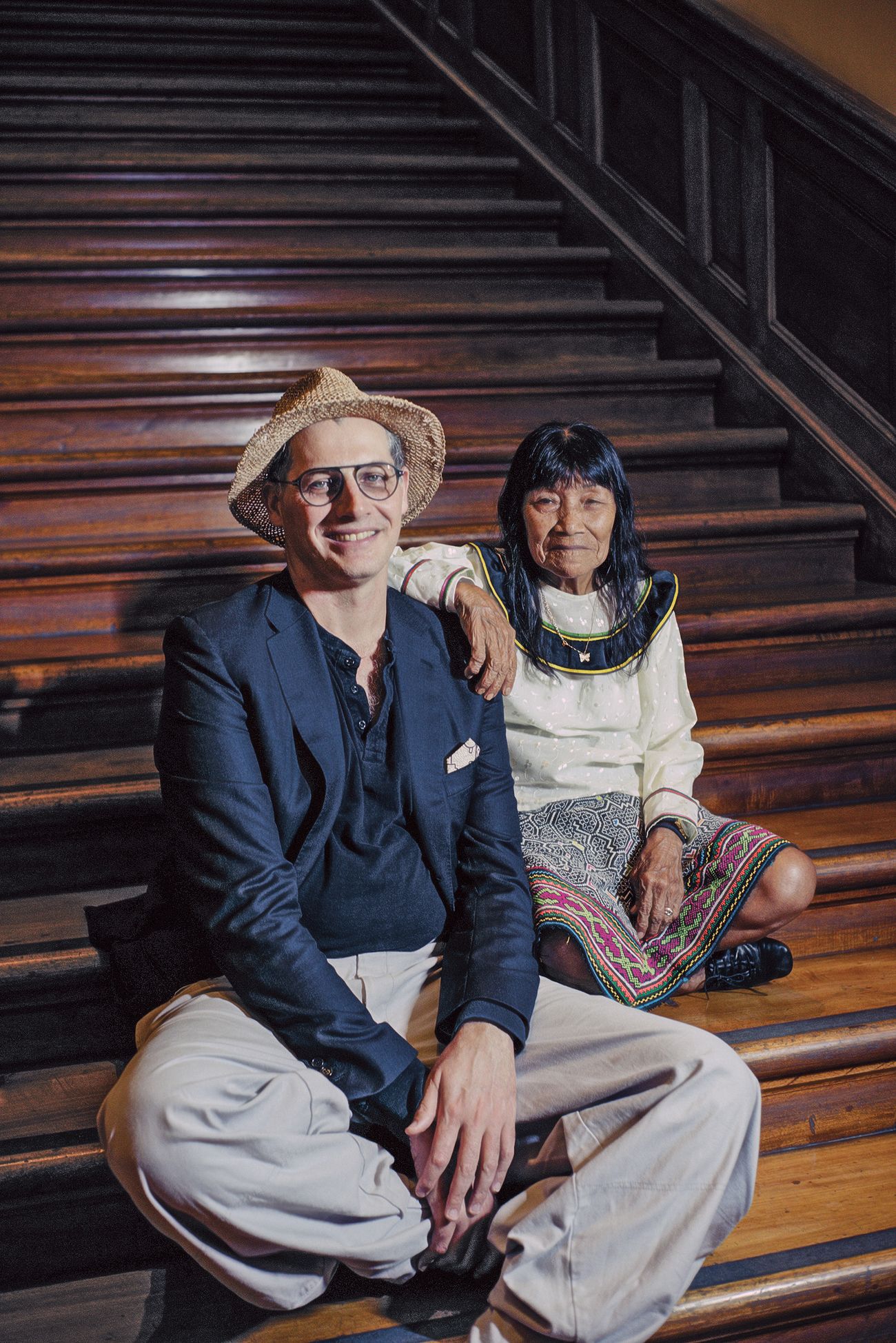
Flores, who turned 75 just before the Lima exhibit opened, now sat silently under a boom mic while collectors, patrons and art writers circled the gallery, admiring her work. A documentary crew was capturing the moment on film. Norzi, who helped bring her work to the wider world, sat beside her, affectionately clutching her hand. The Italian agent, advocate and art dealer is also her biographer. For the past three years, he and filmmaker Èlia Gasull Balada have been chronicling Flores’ journey for a documentary, The Hummingbird Paints Fragrant Songs, the title taken from a Shipibo-Conibo song. “It’s the story of a late bloom, and the psychological implications,” Norzi said of the film, which he’s planning to release in 2026. “And then it’s very much about taking a stand against the inevitable: life passing, death, the destruction of the Amazon, you name it.”
Norzi’s cameras followed Flores to New York, where she visited the United Nations with the elected leader of the Shipibo-Conibo, Lizardo Cauper Pezo, for a discussion about Indigenous approaches to conservation. They followed the diminutive artist to the Brooklyn Museum for a Dior fashion show, capturing Flores as a wide-eyed outsider taking in the glitz and glamour. By then, she’d become an unlikely addition to the Dior payroll, as one of 11 contemporary artists invited to reimagine the iconic Lady Dior handbag, best known for its association with Princess Diana. Flores added her own black-and-white kené design to a pair of limited-edition models, a medium size priced at more than $22,000 and a mini size priced at more than $19,000. Both sold out quickly. Prices for Flores’ textile work, meanwhile, recently exceeded $100,000, a remarkable achievement for an Indigenous artist from the Amazon. This past summer, she was chosen to represent her country at the next Venice Biennale, opening in May 2026.
A striking scene in the film captures Flores on her first flight to Europe, sipping champagne in a business-class seat as she soars over the Atlantic for a gallery show in Paris. “My work took me far,” she says, reflecting on the change in her life. “I arrived at faraway places, places I never thought I’d reach.”
Flores still lives modestly, as she always has. A few days before the Lima show opened, I visited her at home in Yarinacocha, the main Indigenous precinct of Pucallpa, the second-largest city in the Peruvian Amazon. Cut from the jungle along the Ucayali River, the city emerged during a rubber boom more than a century ago. Flores lives in a muddy compound where three generations—five families—are packed into a dense collection of homes.
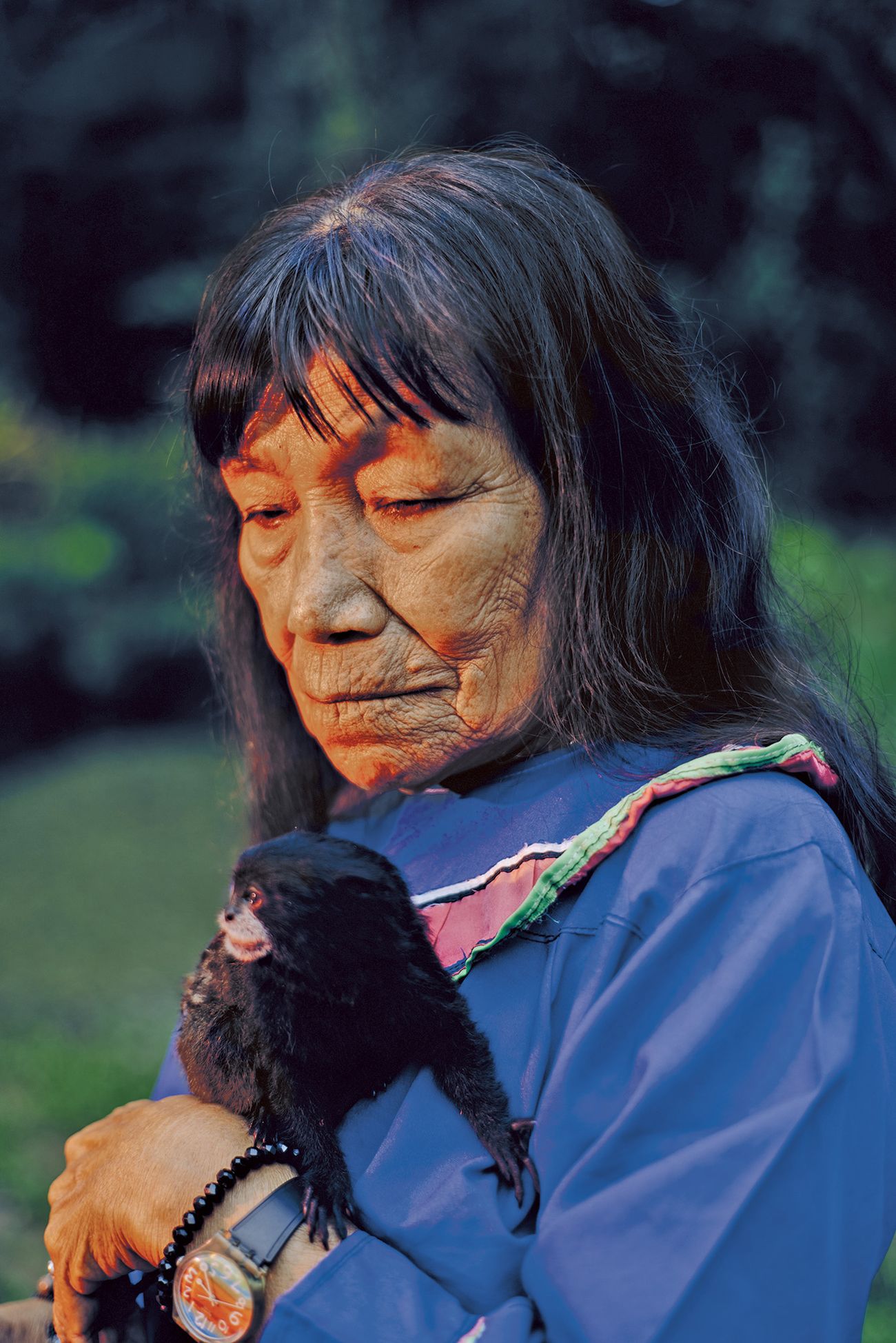
When I visited the compound, Flores’ pet tamarin, Aminish, clung to her head as she bent over her cotton canvas, known as a tocuyo. She was hard at work, her weathered hands stained red from pigment she’d pried from achiote pods piled in a stack on the dirt floor. Her daughters, Deysi and Pilar Ramírez, sat beside her, filling in blank geometric patterns. Flores looked on approvingly. “So that it doesn’t look empty, you have to fill it in,” she said of the designs. “When you fill it in, everything looks complete, more beautiful.”
Traditional Shipibo-Conibo art-making is collaborative, family work. Flores’ daughters and granddaughters play a role in what they call “Mama Sara’s” art. Some might one day build their own reputations as artists. “We’re born with the knowledge we’re going to make art,” Deysi, her younger daughter, told me. “We say it’s in our blood; it’s in our hands. Mama Sara is like a guide.”
The Shipibo and the Conibo were once two distinct tribes that merged over time to become one of the largest Indigenous groups in the Peruvian Amazon. Their territory spread across nearly 20 million acres of dense jungle, resisting waves of Inca and Spanish invasion. The culture developed its own rich mythology, deeply rooted in the harsh jungle environment, and in blurred perceptions of the real and supernatural worlds. Kené was central to Shipibo-Conibo life, a sacred and decorative art form, imbued with magic. Patterns were etched, painted and sewn on clothing, jewelry, pottery and wood buildings. There was even kené as ceremonial body paint. The people believed the patterns had the power to heal. And they told stories in an esoteric visual language that anthropologists have worked to decipher.
The approach to symmetrical designs—“one of the most complex functioning art styles in the aboriginal New World,” as the anthropologist Peter Roe described them in 1979—draws inspiration from patterns in nature, rippling across snakeskins, fish heads and tropical plants. The Shipibo-Conibo believe that all the patterns in the world reside on one magical creature: the cosmic serpent, the Great World Boa or Ronin, as they call it. Kené artists often use recurring motifs, with stylistic differences that sometimes vary from one village to the next. “Upriver tends to be more curvilinear, and downriver more rectilinear,” said Peter Koepke, a former dealer in Shipibo-Conibo art, who spent many years buying work along the Ucayali River.
There are two complementary aspects to kené: the craft side, menin, learned by watching and honed through years of practice, and the creative side, shinan, particular to every practitioner. Typically, work begins without preliminary sketching or advance planning, pouring out in a rush of inspiration.
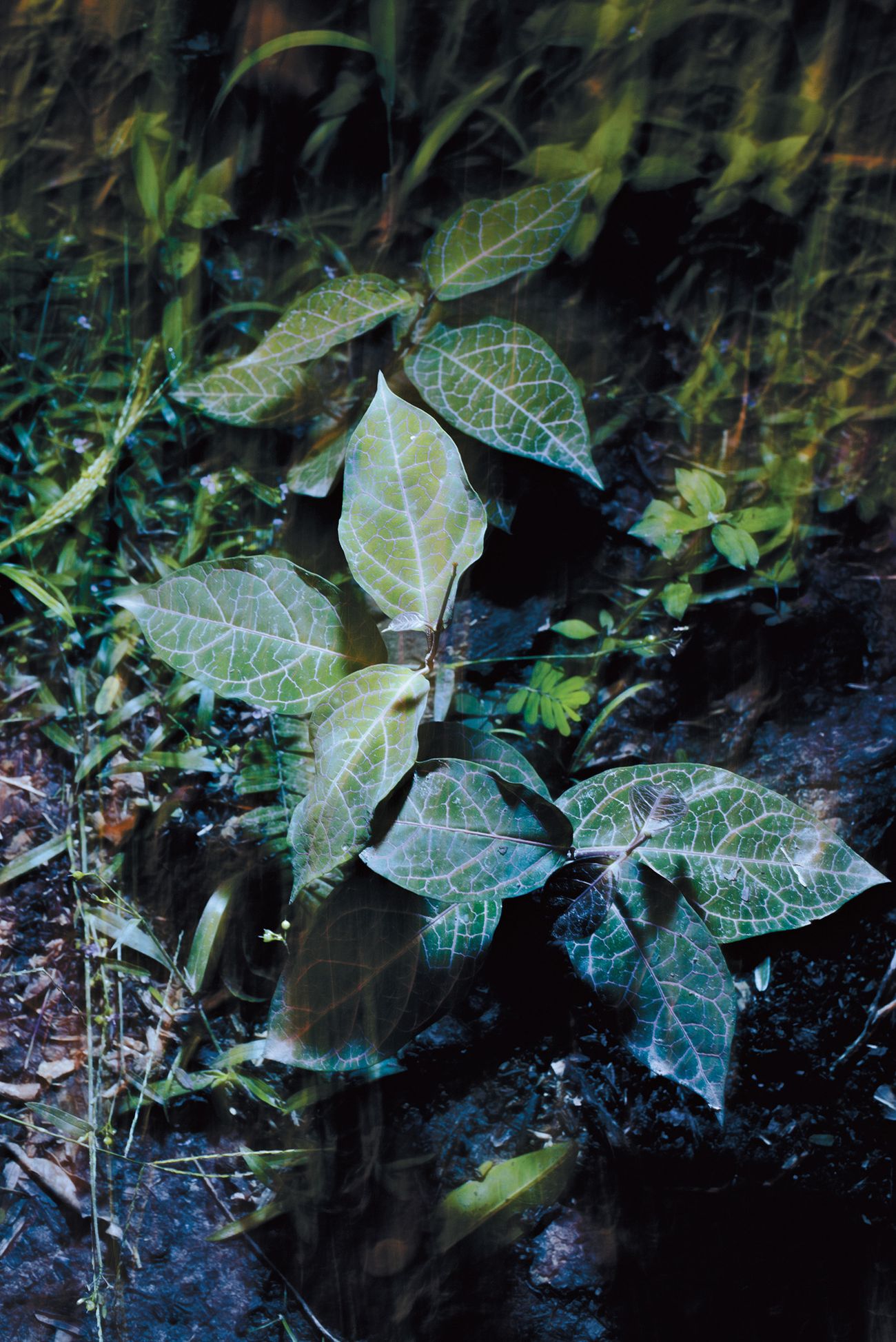
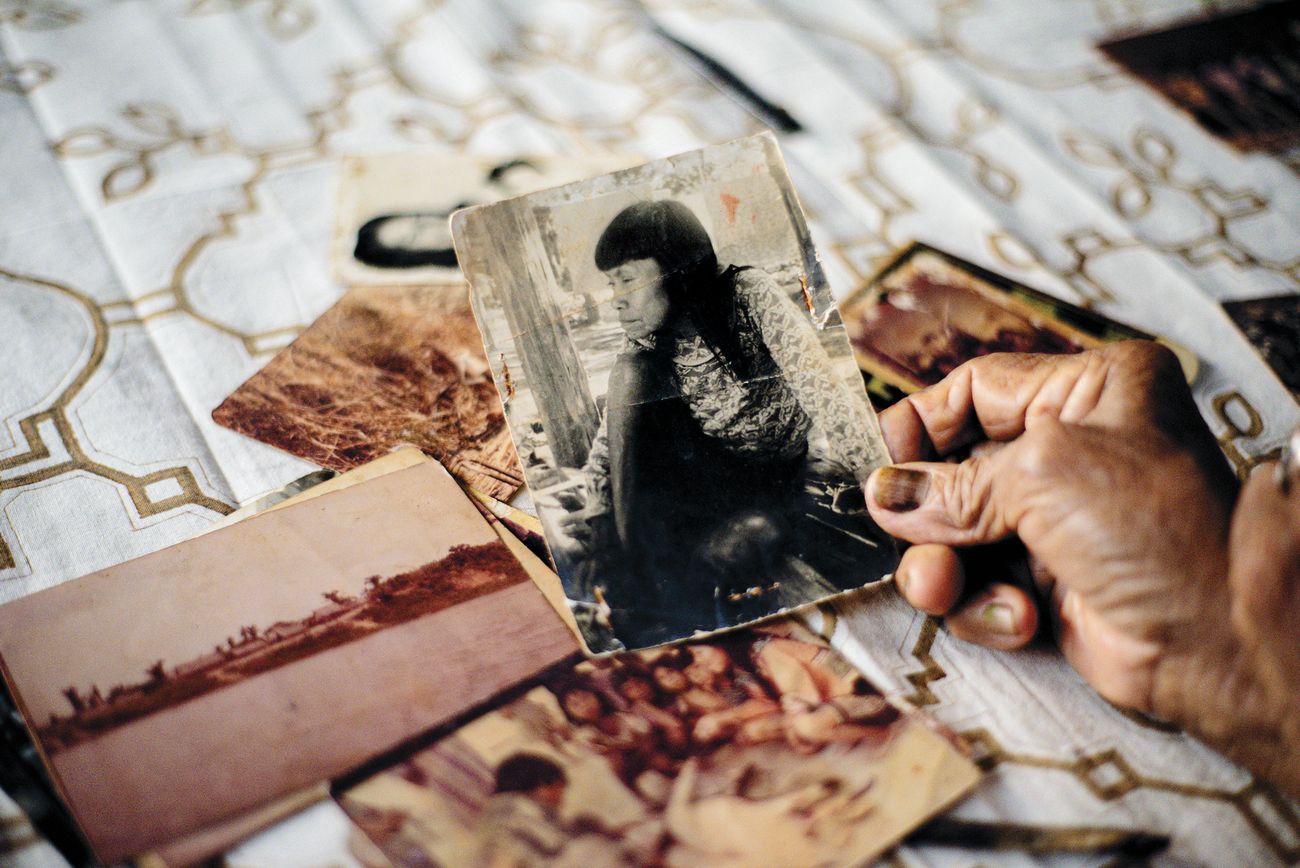
From the moment she was born, in a remote village in the Amazon, Flores seemed destined to make art. Her Shipibo-Conibo name, Soi Biri, which loosely translates as “well drawn,” foreshadowed her future. When she was a child, her grandmother used to rub leaves from the ipo kené plant on Flores’ eyelids, as if she might transfer their lattice patterns onto her granddaughter’s soul. “From that moment on I would look up at the mosquito net and see the designs,” Flores said in a conversation filmed by Norzi’s team. “In my mind, I’d say, ‘This is kené.’”
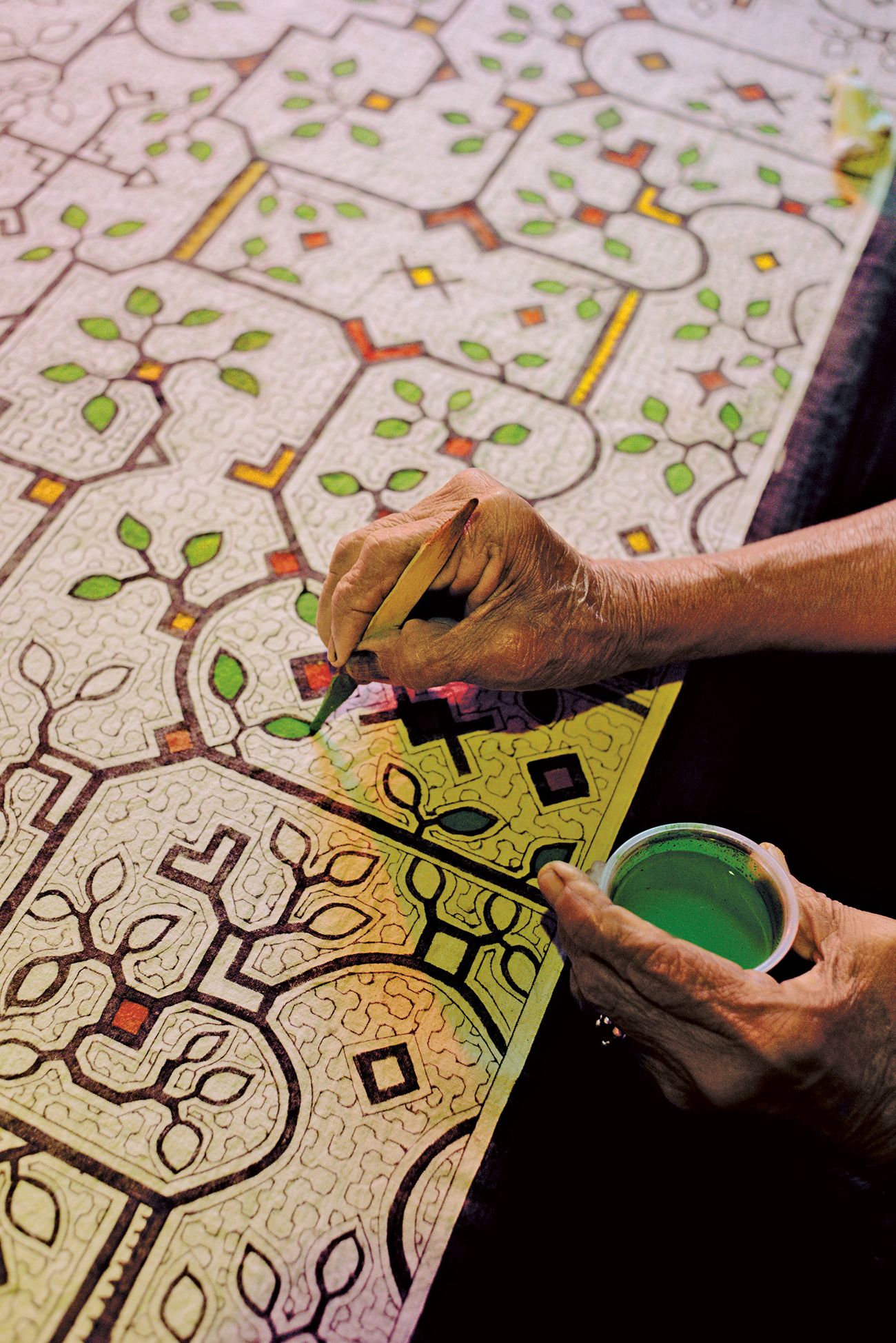
Like her daughters, Flores began her art education alongside her mother, Virginia Valera Sanansino. She learned which plants to collect and process into pigments. Along with achiote for her reds and turmeric root for her yellows, she cut bark from three different trees to produce a brown dye that turned black when you applied a clay solution to the cotton canvas. “My mother used to tell me, ‘Keep practicing; that’s how you will learn,’” Flores said. “Kené is our custom, our design. We don’t learn it any other way. It comes from the mind. When you see how to make kené, you just paint. You trace the drawing, the design, because you already have it in your head.”
When Flores was a child, her mother didn’t sell her own art. “She only made clothing for our personal use,” Flores said. That changed when Flores was 8 years old and her mother fell gravely ill. To seek treatment, they moved from their small village, Paoyan, six hours downriver to Pucallpa, where they settled into a Shipibo-Conibo encampment on the grounds of the newly established regional hospital. Valera Sanansino was diagnosed with tuberculosis.
To support the family, Flores helped her mother make decorative work that might appeal to foreign clients. They painted on the same white cotton fabric that covered the hospital beds, selling the textiles to the German hospital director’s wife and to occasional tourists.
At 16, Flores had an arranged marriage to Julio Ramírez Soria, a 23-year-old Shipibo-Conibo man who was just back from a stint in the army. After the wedding, Flores sat down with her new father-in-law, a shaman. “He drank ayahuasca,” she recalled. “And then he told me, ‘I’m going to look at you, and I’m going to give you a crown, a kené crown. You’re going to have that crown. That crown will serve you for the rest of your life.’ Thanks to him, I guess, I don’t need any model. I don’t look at any sketchbook, nothing. I just lay the fabric, and there it appears.”
Flores and Ramírez Soria had four children, two girls and two boys. Working with a team of cartographers for the oil industry, Ramírez Soria would disappear into the jungle for months at a time. Flores helped keep food on the table by traveling between Pucallpa and Paoyan and selling her textile work.
In the 1970s, she met a British expat named Carolyn Heath who had a profound impact on her life as an artist. Heath had been working with Shipibo-Conibo communities to develop an Indigenous art cooperative, the first in the Peruvian Amazon. They called it Maroti Shobo, a “place for buying and selling,” pooling their resources to raise prices and reach new clientele. “Everybody agreed Sara was the best painter in the region,” Heath recalled from her current home in Oxford.
Flores began selling her work through the cooperative, which set up a showroom in Yarinacocha that’s still open today. Her husband became involved both with the cooperative and with Heath herself: As he helped collect work from up and down the river, he and Heath began a relationship and had twins together. (Shipibo-Conibo culture is historically polygynous, though the practice is less common today.)
At the time, nobody was signing their kené work. At Heath’s suggestion, Flores began adding her initials, SFV—for Sara Flores Valera—to her textiles. Some of that work eventually reached a shop selling handicrafts from across the Amazon in the affluent Barranco section of Lima.
That’s where Norzi initially encountered her art, while rifling through a stack of textiles on his first trip to Peru. Struck by “the precision, the quality of the natural dyes, the inventiveness and the optical quality,” he paid $90 or so for his first Flores piece. When he asked the shop owner about the initials in the corner, she shared little information. “She was telling me, ‘Actually, she doesn’t paint anymore,’” he recalled. “She didn’t want to tell me the source. She wanted to keep Sara to herself.”
Norzi spent the next five years consumed with tracking her down. Eventually, a local filmmaker and activist named Ronald Suarez helped him trace the initials SFV to Flores’ front door. Norzi showed up at the compound in 2016. “I remember my brother said, ‘Mama, there’s a very big man here to see you, a gringo,’” Deysi recalled of the day he strolled into their lives. “It was a Sunday in September. He said, ‘Oh, you are Sara! I’ve been trying so hard to find you.’”
He asked Flores how much she’d charge for the fabric she was painting. She told him $30, or its equivalent in Peruvian soles. “And I said, ‘Sara, look, I won’t give you $30. I will give you $1,000,’” Norzi recalled. “‘But you need to sell them all to me only.’ And then I started to explain why. And she was understanding of my theory that I had to control the price, to lift it up, present it in a different way.”
Norzi had been inspired by a book about Australia’s Aboriginal art that described how a few art-world players had helped reposition the traditional form in public consciousness. What had once been “ethnographic art” shown only in natural history museums migrated to the contemporary art scene, with specific artists earning renown. Norzi hoped to accomplish the same thing for Shipibo-Conibo art.
Together, they reached an agreement. As Norzi sold Flores’ work on the art market, 25 percent of the income would go directly to Flores, 25 percent would go to support her daughters as they taught the art to other local girls, and 25 percent would go to Indigenous groups, including a community-led corps of 300 sentries who patrol Shipibo-Conibo lands, protecting them from logging, fishing and other illegal outsider activity.
The final 25 percent would go to a new nonprofit organization that would support advocacy and legal aid for Shipibo-Conibo artists. Shortly after his first meeting with Flores, Norzi opened the Shipibo-Conibo Center, with an office in Pucallpa and headquarters in New York. The center went on to add two other artists from Pucallpa, ceramist Celia Vasquez Yui and rapper Wihtner FaGo. Flores’ first solo show overseas soon followed, in 2022 in New York.
As Flores’ art has reached new audiences, it’s begun to change. Her cotton canvases have grown larger, her designs more intricate. “She keeps on evolving,” Norzi said. “Just because of the demand, she started expanding in complexity and bringing the medium forward.”
She introduced a new plant motif, a vine with green leaves, that became her signature. It was inspired by visions from an ayahuasca experience. The plant-based concentrate is an important part of Indigenous rainforest culture, traditionally used by shamans. Flores has taken the hallucinogen only a few times, but it has influenced the way she creates art. “The visions come to you like a movie. You’re watching, you’re watching, and the leaves appear,” she said. “The leaves let you know this work is from the Amazon.”
Today, the quarter of the proceeds that Flores sets aside to protect her people is helping fund the Shipibo-Conibo Xetebo Council, a political body pushing for greater autonomy. Current estimates place the number of Shipibo-Conibo people between 25,000 and 35,000, many of whom live under threat of industry incursions and eviction. Illegal coca leaf plantations and timber poaching encroach on the areas where they live.
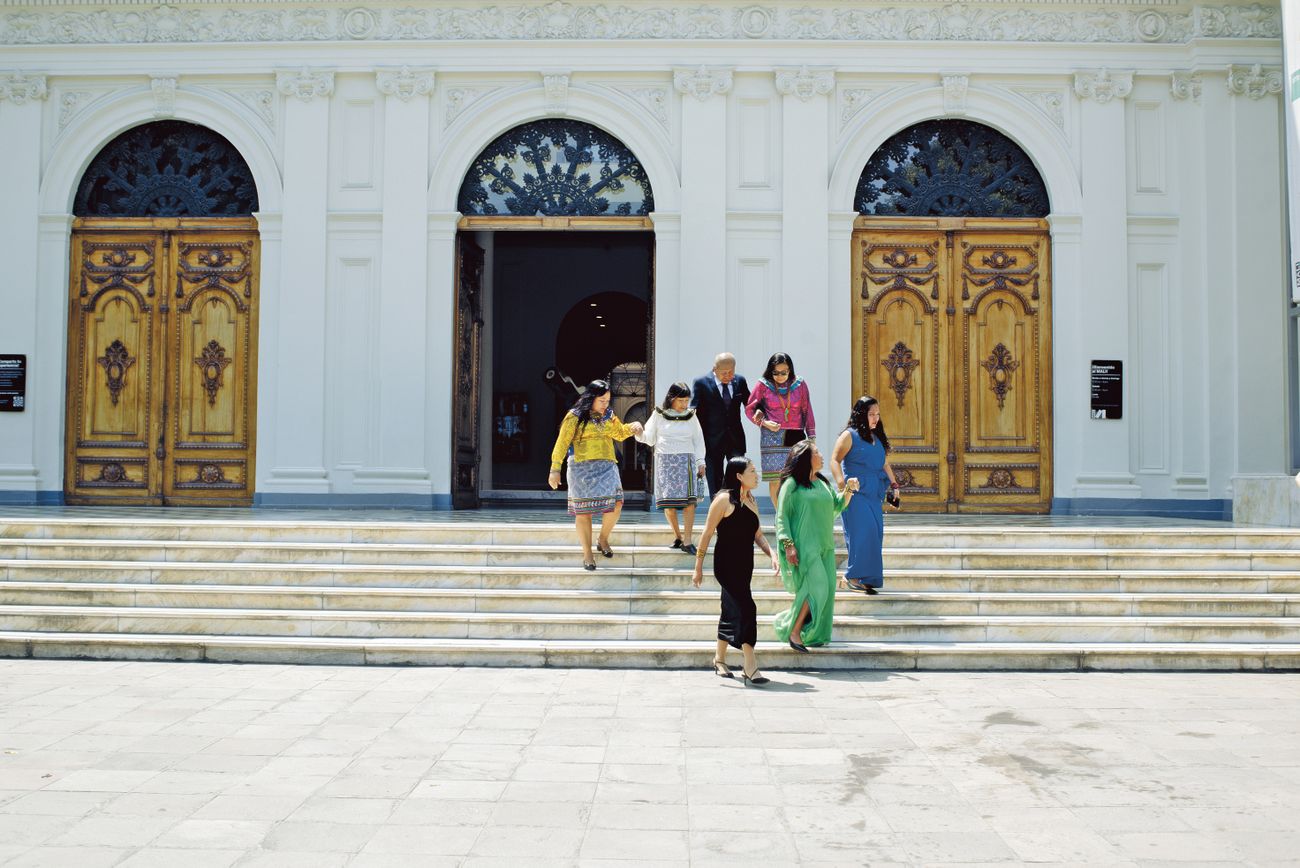
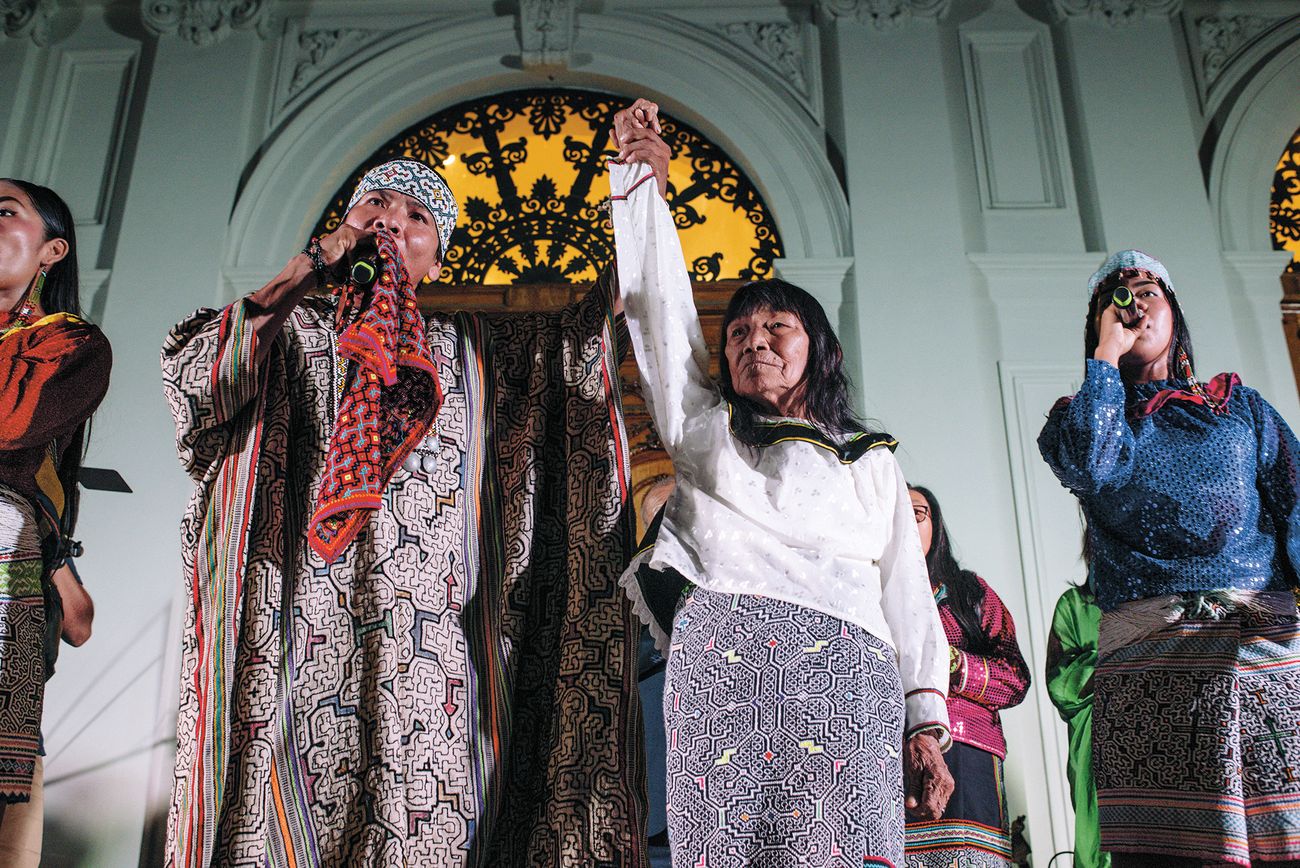
By the time Flores’ museum show opened in Lima, funds from her artwork were also supporting a legal assistance program for her people. The opening itself turned into a political and cultural showcase for the Shipibo-Conibo, who sent a full delegation to the city, including their elected leader, Cauper Pezo, and a musical group that performed on the museum steps.
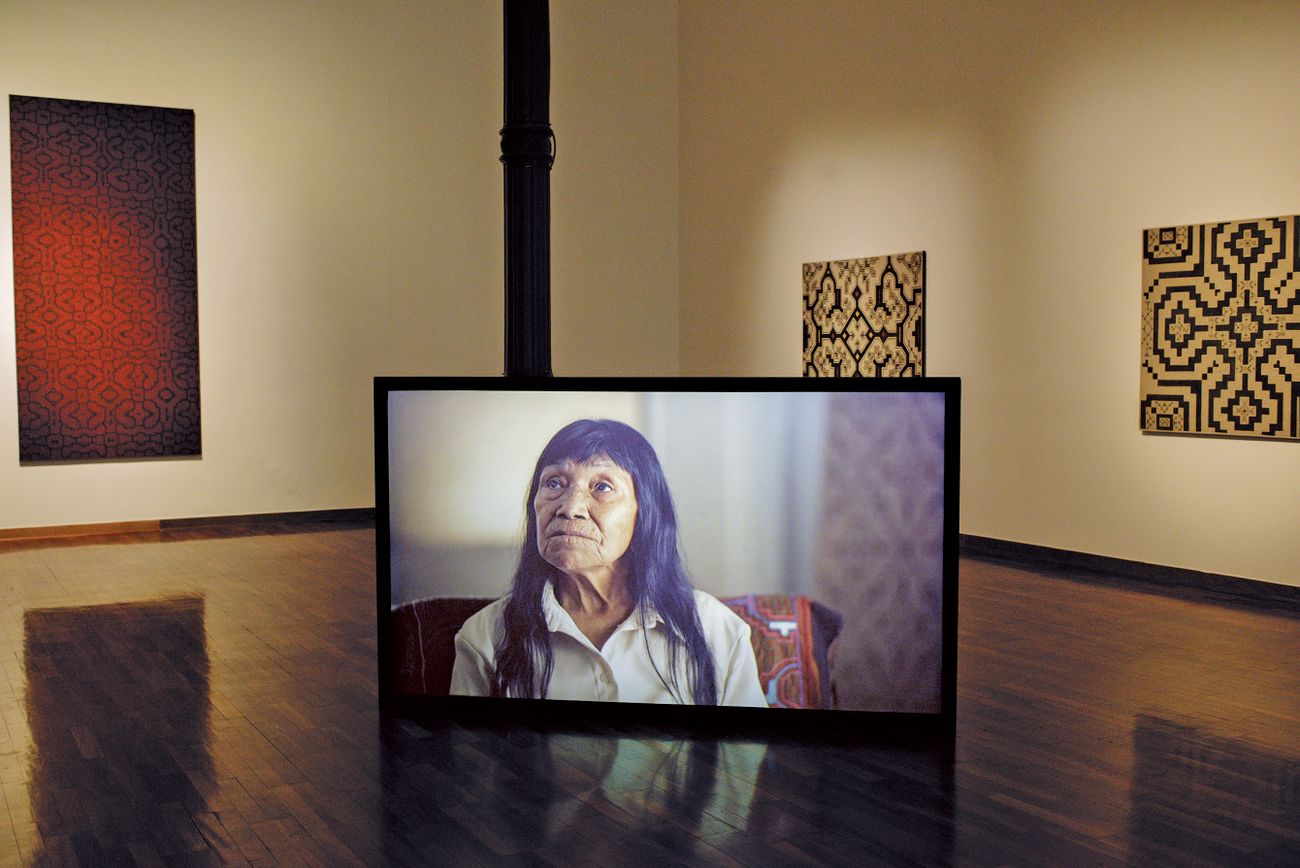
Inside the gallery, a flag Flores designed for a dreamed-of Shipibo-Conibo nation hung from the ceiling—two interconnected shapes on earth-toned fabric, woven through with kené patterns. On a video monitor in the center of the room, Flores spoke about threats to the Peruvian rainforest that was so integral to her life and work.
“As artists, we know which plants are good to prepare the dyes,” she said, in deliberative Spanish. “The tree I’m looking for, its bark is named yunshin. It has a spirit of strength. To not kill the tree, we don’t take all its bark out at once. You always need to leave some on it so it can grow back. Timber companies cut the trees, take them to the sawmill, and there they just slice them into planks. They discard the bark. But it is very useful for us.”
In the years since she and Norzi met, they have grown so close that he’s become like an adopted son. He advises her on finances and health issues. When her vision began failing, he arranged cataract surgery. A few years ago, they started a new project together, launching a nonprofit cultural center on a former ayahuasca retreat in the Amazon. The center, known as Bakish Mai, focuses on preserving traditional knowledge now that oral transmission is vanishing as more Shipibo-Conibo people move to cities and assimilate. “We must not abandon our customs,” said Flores. “Even if we no longer wear patterned, embroidered skirts, our customs and our designs are in our minds. And we live with them. People from other places buy these designs. They buy cloth and hang it where they sleep, so they can contemplate its beauty. Sometimes, our cloths with designs are like medicine.”

The center offers workshops on art, ancestral agriculture and plant medicine to the surrounding communities. Its name refers to the fluid concept of time among the Shipibo-Conibo. “Bakish means both yesterday and tomorrow,” Norzi explained. “Mai means land.” The overall goal, he said, is “using the ancestral past to inspire the future.”
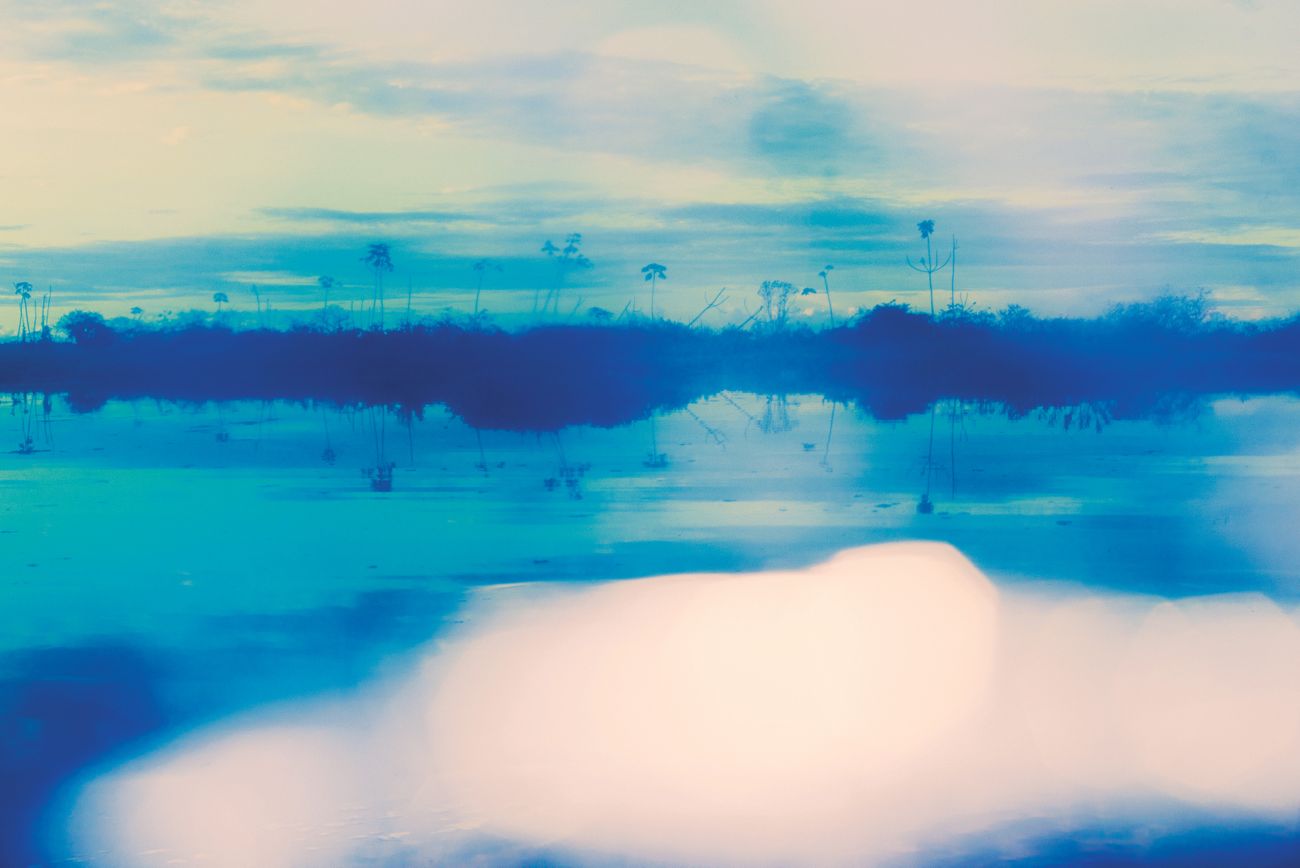
Dark storm clouds loomed late one morning as we set out in a big group to spend a few days at the center: Flores and her family, Norzi and his six-person film crew. That spring had been the heaviest recorded rainy season in more than a decade. The Ucayali River had risen above its banks. Up and down the river, homes had been lost. Muddy roads connecting networks of villages were entirely flooded.
From the Flores family compound, so far undamaged by the deluge, we piled into a caravan of sputtering tuk-tuks, the preferred mode of transport in the region: Honda motorbikes welded to passenger carriages. Dirt roads gave way to muddy tracks. Those paths soon became streams, though they were shallow enough to drive through without getting stuck. At the edge of the Ucayali, we transferred our bags to wooden canoes propelled by rusty motors. We navigated gently upriver and then across it, cutting through tall reeds buzzing with mosquitoes and dragonflies. The trees along the water’s edge were thronged with large white birds. In the black depths hid piranhas, caimans, river dolphins and paiches, the enormous, meaty fish that are a staple of the Amazonian diet.
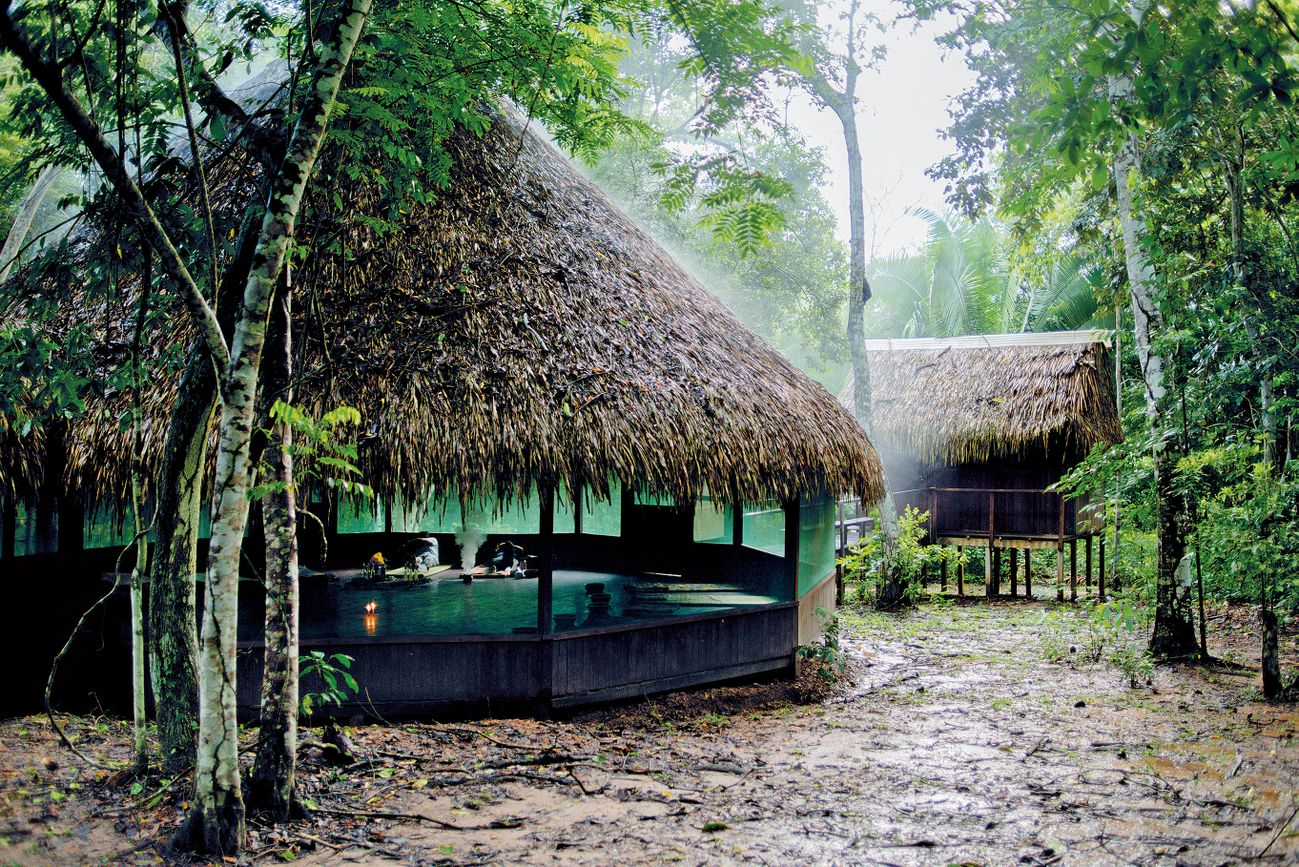
Eventually, Bakish Mai appeared through the reeds, a collection of thatch-roofed bungalows along the shoreline—our accommodations for the next few days, sparsely furnished with mosquito nets hung over bare beds and cold-water showers. As the river encroached, some could be reached only by walking across suspended wood planks. A few were entirely flooded.
Norzi, who trained as an architect in Italy, has been overseeing renovations, with plans to eventually add solar power. For now, only the communal dining hall had power, fed by a generator running solely at night.
I huddled there with Flores after lunch one afternoon, her husband, daughters and granddaughters gathered in a circle around her. The night before, we’d all been together deep in the forest in a ceremonial space as a shaman lit candles that surrounded him on the wood floor. Flores refrained from drinking ayahuasca that night, but she crouched in front of the shaman, whispering out of earshot, seeking advice. In the dining hall, I asked her what they’d discussed.
“I told him that my body, my spirit, my energy felt off,” she said. “I asked him what he saw in my energy. I was worried about it.”
And what did the shaman say? I asked.
“These days my brain is not working that well. I’m 75 years old. There’s so much I can’t remember,” she said. “I can’t remember what he told me, so I’m asking my daughter.”
Deysi chimed in: “He said not to worry about the future. You have so many people supporting you. Everything is going to be OK.”
A conflict with another artist in Yarinacocha had been weighing on her. “I’m worried not about what people say, but what people do,” Flores said. “I have neighbors who are jealous of my success. I worry about a shaman sending me bad energy. I ask myself, ‘Why should I worry when I have so many friends, family members, supporting me?’ And Matteo. I’m so thankful for Matteo. Since I met Matteo, I have been very happy.”
As we sat talking, she handed me a green leaf with red veins from the ipo kené plant, the same leaf her grandmother had once rubbed on her eyelids to bring out visions of kené, plucked from the jungle around us. “Hold it in the palm of your hand to improve your writing,” she instructed. “To make yourself stronger. So you will write good things.”

Post a Comment for "The Amazon: Peruvian Artist's Home, Inspiration, and Global Gallery"
Post a Comment