
What If Trump Controls Science?
A Town Hall with a Twist
As Andrea Baccarelli, the dean of Harvard’s School of Public Health (HSPH), prepared to open a virtual town hall earlier this month, members of the university’s graduate-student union gathered for a watch party with “Baccarelli Bingo” cards. The game boards were filled with phrases the dean was expected to use: “these are difficult times”; “I know it’s not a satisfying answer but we don’t know”; “… which is why we must be innovative!” At the center of the grid was a free space, bedazzled with emojis, that read, “no meaningful commitments made.”
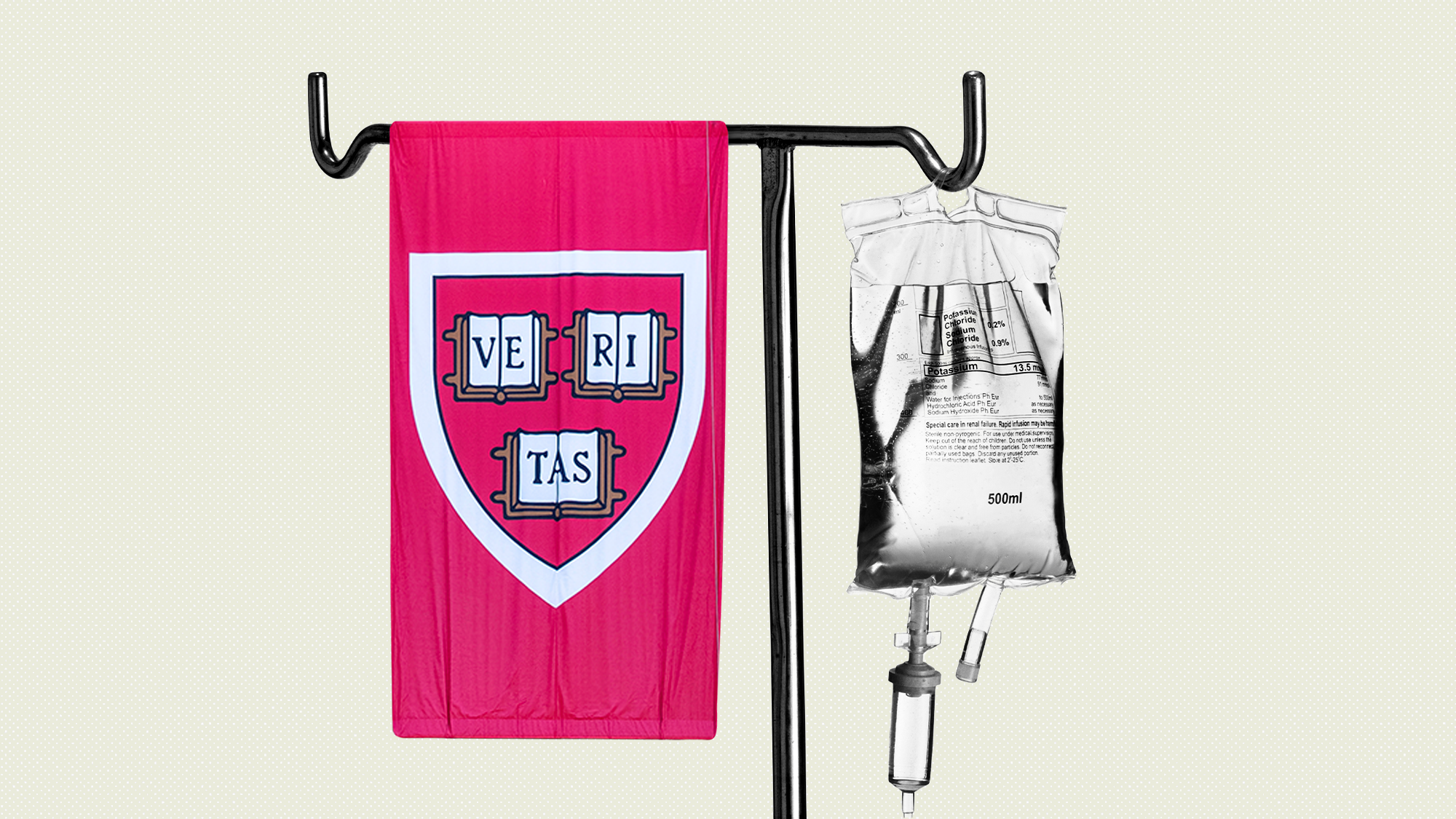
Baccarelli’s stated goal was to provide an update on the school’s financial crisis. Of Harvard’s schools, HSPH has been by far the most reliant on government grants—and so was the hardest hit by the Trump administration’s cuts to federal research funding. In the spring, essentially overnight, the school lost about $200 million in support. Although a federal judge has ruled that those grant terminations were illegal, the school’s future relationship with the federal government remains uncertain. Long-term survival for HSPH would require dramatic change, Baccarelli said at the town hall: It needed to become less dependent on federal funds. In the process, it would have to cut $30 million in operations costs by mid-2027 and potentially slash up to half of its scientific research.
HSPH is one of the most consequential public-health institutions in America: The school once contributed to the eradication of smallpox and the development of the polio vaccine, led breakthroughs linking air pollution to lung and heart disease, and helped demonstrate the harms of trans fats. If the Trump administration’s aim has been to upend American science, HSPH is a prime example of what that looks like.
A Dean Under Scrutiny
But the school’s dean, too, has become something of an emblem—of how unprepared many scientists are to face this new political reality. At the town hall, Baccarelli had to address his controversial work linking acetaminophen—Tylenol—to autism and answer for how he’d communicated with the Trump administration about it. (Another Baccarelli Bingo square: “acetaminophen mentioned.”) At a press conference in late September, Donald Trump and several of his top officials announced that they would update Tylenol’s labeling to discourage its use during pregnancy, leaning heavily on Baccarelli’s research on the subject and on expert witness testimony he’d given.
“To quote the dean of the Harvard School of Public Health,” FDA Commissioner Marty Makary said, “‘There is a causal relationship between prenatal acetaminophen use and neurodevelopmental disorders of ADHD and autism spectrum disorder.’”
Plenty of the school’s faculty were taken aback to hear Trump officials warmly referencing their dean, especially given that Tylenol’s connection to autism—a complex condition with many contributing factors—is shaky at best. Karen Emmons, an interim co-chair of HSPH’s department of social and behavioral sciences, told me she almost crashed her car when she heard Makary quoting Baccarelli on the radio. Many were also surprised to learn, from press reports, that Baccarelli had fielded calls about his research from Health and Human Services Secretary Robert F. Kennedy Jr. and National Institutes of Health Director Jay Bhattacharya earlier in September.
The dean’s interactions with the administration quickly became a new vulnerability for the school. As other experts criticized the methodology of Baccarelli’s work on Tylenol and called his claims about causality unfounded, Baccarelli began to look like a biased researcher, allied with the same political leaders “who are starving us of our funding and basically killing the school,” Erica Kenney, a nutrition researcher at the school, told me. In the view of many faculty members, Baccarelli had undermined the public position Harvard spent months cultivating—as a beacon of academic integrity, unwilling to bend to the administration’s political pressure.
Facing the Consequences
At the town hall, Baccarelli seemed to recognize these consequences. “I’m really sorry about the impact this has had on our school,” he said. But he was also defensive, describing himself as a researcher who wanted to explain the value of his work and help set evidence-based policy. He had spoken with the administration as a scientist, not as a Harvard dean, he said, and hadn’t anticipated that Trump officials would focus so pointedly on his affiliation with the school. His instinct, in other words, was to treat science as severed from politics. He seemed unaware of how unrealistic that split now is for American scientists.
Some nine months into the Trump administration’s assault on academic science, Harvard’s public-health school has just about everything going against it that an American academic institution can. It is part of Harvard, which the administration has accused of failing to protect students from anti-Semitism. It has excelled in several fields that the administration has declared unworthy of federal funds: infectious disease, health equity, climate change, global health. About half of the school’s faculty contributes in some way to international research, which the administration has also taken a stand against. Many HSPH researchers are themselves from other countries—including roughly 40 percent of the school’s students—and their ability to stay here is uncertain under the Trump administration’s immigration policies.
Historically, nearly half of HSPH’s revenue and 70 percent of its research funding have come from federal grants. And unlike academics supported largely by tuition or endowments, HSPH researchers typically have had to bring in nearly all of their own research funds, including to cover their own salaries and those of staff and trainees. “Faculty members essentially function as a small business,” Jorge Chavarro, HSPH’s dean for academic affairs, told me. When researchers’ federal income dried up, they had to shrink those businesses.
A Struggle for Survival
When the funding crisis hit, Harvard distributed emergency funding across its schools. But what reached HSPH faculty offered little relief—in Christiani’s case, it was “too small to have kept anything going other than literally the freezers and some data management,” he told me. (The office of the Harvard University president did not respond to a request for comment.) The public-health school has put limits on the amount of discretionary funds that faculty can spend to keep their research going, to ensure the longevity of those resources during the crisis. “This is supposed to be the most flexible amount of money you have, so people try to save it for as long as possible,” one faculty member, who requested anonymity because they are not a U.S. citizen, told me. To plug the gaps, faculty have been frantically applying for nonfederal sources of money. But whereas grants from the NIH could total millions of dollars, many foundation grants come in the tens of thousands, not even enough to sustain a single postdoctoral fellow for a year.
As their professional world fell apart, many staff, students, and faculty waited for Baccarelli to articulate a clear path forward. He left the task of divvying up emergency funds to HSPH’s nine department chairs, and many researchers grew frustrated as different parts of the school scrambled to make ends meet in different ways. In one department, at least one faculty member has used personal funds to cover trainees’ travel expenses; the biostatistics department has pushed at least 10 Ph.D. students to do data-analysis externships in exchange for coverage of stipends. Across the school, three senior lecturers and three tenure-track junior faculty members have been notified that they will likely be terminated in 12 months, unless they secure alternative funding.
A New Era of Uncertainty
This was the path forward. In the brief statement he sent in response to my questions, Baccarelli said that he had “developed and communicated a strong vision for the future of the school.” The statement linked to a strategic vision on the HSPH website, which acknowledged that the school “cannot maintain the status quo” but asserted that it would emerge as “a focused, resilient, and unambiguously world-class school of public health.” Left unsaid was that it would almost certainly be a smaller, less enterprising one.
In many ways, Baccarelli, who assumed the deanship at the start of 2024, has limited power: He can’t force the Trump administration to relinquish funds, or raid the pool of money that Harvard University holds centrally. Still, for months, many trainees and faculty have been calling for their dean to “stand up more forcefully” to the administration’s siege on science and defend his school’s most vulnerable researchers.
A Tenuous Future
Prior to this year, many HSPH researchers saw the school’s reliance on federal funds as a strength. Government support was exceptionally stable, and HSPH researchers were exceptionally good at winning it. By Harvard’s standards, the school’s endowment was not its primary boasting point—public-health alumni don’t tend to become billionaires—and in times of wider financial turmoil, HSPH remained well insulated. Now, for the first time, the school is confronting the risks of sourcing half of its operating budget from a single entity.
The government was public health’s ideal funder in part because it could play science’s long game: funding research that might not be immediately profitable or even beneficial. That pact is now broken, and as the school seeks alternative routes, several researchers worry that some of the most important science will be the fastest to fall by the wayside. If, as some faculty suspect, more commercializable research is likelier to survive at the school, HSPH also risks abandoning a core public-health mission—meeting the needs of the underserved—and detracting from Baccarelli’s own strategic vision of building “a world where everyone can thrive.”

Post a Comment for "What If Trump Controls Science?"
Post a Comment