
Where AI Meets the Windshield: Smarter Safety with VUEROID
The Evolution of Dash Cams: From Passive to Intelligent
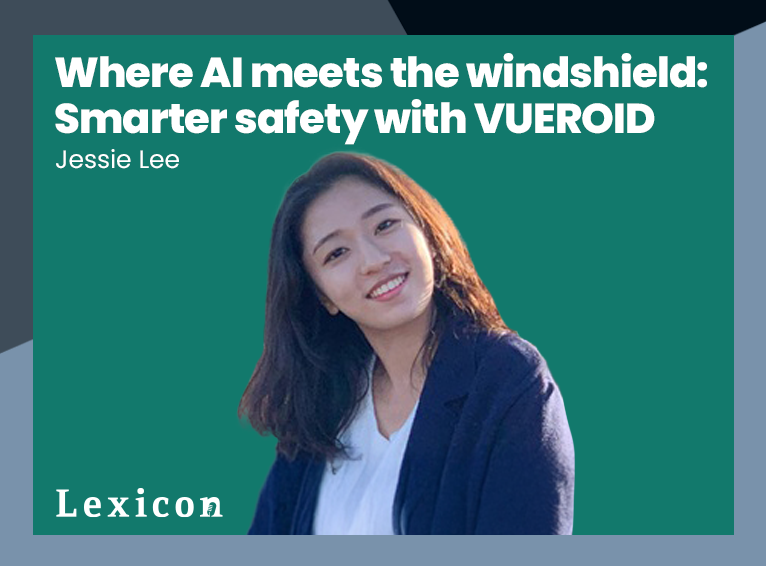
In our latest episode of Lexicon, we had the opportunity to speak with Jessie Lee, a product planner at VUEROID, about how the company is redefining the role of dash cams. Once considered mere passive recorders, these in-vehicle cameras are now evolving into intelligent, AI-powered safety tools that can make a significant difference in road safety.
Dash cams have traditionally occupied an odd space in the automotive technology landscape—often overlooked until they are desperately needed. Jessie Lee, who works at VUEROID, aims to change this perception and elevate the importance of these devices in everyday driving.
The Problem with Most Dash Cams
“A dash cam should be like a fire extinguisher,” Jessie explains. “You don’t think about it until you really need it. And when that moment comes, it must work without fail.” This sentiment highlights the critical role that dash cams play in ensuring driver safety and providing evidence when accidents occur.
Despite the growing popularity of dash cams, especially in Asia, many consumers still settle for devices that promise advanced features but fall short on the basics. Clear, stable video recording remains a fundamental requirement, yet many products fail to deliver on this front.
Jessie emphasizes that while some companies focus on features like LTE or ADAS (Advanced Driver Assistance Systems), VUEROID takes a different approach. Their priority is getting the fundamentals right, such as stable recording, high-quality footage, and reliable file storage.
What Makes a Dash Cam "Smart"?
While many manufacturers use the term "AI," VUEROID’s application of artificial intelligence is targeted and practical. Rather than trying to prevent accidents, which is increasingly the role of in-car systems like lane assist and adaptive cruise control, VUEROID focuses on post-incident clarity.
One notable feature is their AI-powered license plate restoration. In the chaos of a collision, capturing a clear license plate is often impossible. VUEROID’s system allows users to upload footage through the VUEROID Hub app, where cloud-based AI can attempt to enhance and recover plate details.
“It might not give you a perfect result,” Jessie notes, “but even a few characters or numbers can help identify the vehicle that hit you and fled.”
Privacy features, such as facial and license plate masking for shared clips, are also powered by AI on the cloud, ensuring sensitive data can be anonymized before being passed on to insurers or social media.
Why Image Signal Processing Matters
One of VUEROID’s most valuable technical assets is its deep experience in ISP tuning, a critical but often underappreciated part of digital imaging. ISP, or Image Signal Processor, is responsible for converting raw sensor data into a viewable image. This includes balancing light and color, sharpening details, and reducing noise.
“Every dash cam company uses similar image sensors and ISPs,” Jessie explains. “But how you tune them makes all the difference.” In VUEROID’s case, that tuning includes two specialized modes: HDR mode for general image quality and HDR+ Infinite Plate Capture mode, optimized to extract license plates from high-speed or low-light environments.
“To get accurate license plates, especially at night or in motion, we have to close the sensor’s aperture quickly to get more frames,” she adds. “It’s a completely different tuning process than just making a pretty video.”
SoC: The Brain Inside the Box
In addition to ISP tuning, VUEROID benefits from its parent company NC&’s experience developing SoCs, or Systems-on-Chip. An SoC combines multiple components, including CPU, GPU, memory, and signal processors, into a single integrated chip. This enables devices like dash cams to be smaller, more efficient, and more capable of handling complex tasks like AI processing or fast boot-up times.
“We don’t always use our own ISPs or SoCs,” Jessie says. “But our experience in designing them gives us a serious edge, especially when we need to customize features for specific markets or price points.” One example of that edge is Extreme Low Power Mode, which allows VUEROID dash cams to consume just 0.01 watts, remaining in a near-dormant state while the car is off and springing to life within one second of detecting an impact.
Why "Parking Mode" Is a Priority
VUEROID has placed particular emphasis on what happens when you’re not in the car. Accidents and vandalism in parking lots often go unnoticed until it’s too late, but the dash cam doesn’t sleep. “We include motion detection, impact triggers, time-lapse recording, and battery protection,” Jessie says. “And if the system senses a battery drain risk, it shuts off automatically.”
While AI isn’t yet integrated directly into parking mode, Jessie hints at what’s coming. On-device facial recognition or real-time cloud alerts for suspicious activity could soon become part of the standard feature set.
Why the West Is Lagging
In countries like South Korea and China, dash cam saturation is near-universal. But in the U.S. and Europe, adoption lags. Jessie believes this will change soon, not only due to consumer interest, but because insurers and regulators will push for it. “In Korea, just having a dash cam can lower your insurance premium,” she says. “But in other markets, that link hasn’t been made yet.”
The implications are clear: If a dash cam can help resolve claims faster, prove innocence, and deter fraud, why shouldn’t it become as standard as ABS or airbags?
The Road Ahead
Looking forward, Jessie sees dash cams evolving in two key directions. First, deeper integration with vehicle ecosystems using connected cloud services to offer real-time alerts and fleet-wide monitoring. Second, a shift from aftermarket to OEM partnerships, where dash cams become factory-installed as part of the car’s sensor suite.
“The future lies in combining AI with connectivity,” Jessie says. “Cloud-based AI can help prevent drowsy driving, monitor vehicle health, and share critical data like speed and location in real time.”
This is already happening in fleet management, where companies are moving from basic telematics (data from OBD ports) to videomatics, using visual AI to monitor driver behavior, route performance, and safety compliance.
VUEROID’s story is more than just better cameras; it’s about trust, designing for crisis, and making invisible tech that works when it matters most. “It doesn’t have to be fancy,” Jessie concludes. “It just has to work, every time.”
With the S1 4K Infinite, VUEROID may have just created the gold standard for that quiet kind of reliability.

Post a Comment for "Where AI Meets the Windshield: Smarter Safety with VUEROID"
Post a Comment