
5 Cars That Don't Get the Credit They Deserve
Classic Cars That Need a Second Look
Classic car collectors can be a tribal bunch. This works out well when the community closes ranks in support of each other, but it’s a little less helpful when groupthink translates into perceived wisdom that tarnishes the lore surrounding certain models. Over time, negative opinions can calcify into “fact,” and occasionally lead to the excommunication of some really cool cars from the community for reasons that, in retrospect, seem more than a little silly.
Taken to its most extreme, there are even some vehicles whose reputations among collectors have been tainted by details that deem them unworthy in the eyes of the cognoscenti. It’s time to rehabilitate the reputations of five such victims and explain why these vehicles are well worth your time—and maybe even a space in your garage—despite their common characterization.
1987-1995 Jeep Wrangler YJ
By all accounts, the YJ-generation Jeep Wrangler was a roaring success. Its predecessor, the CJ-5, had been in production since the mid-1950s, with incremental upgrades, various special models, and a stretched-wheelbase edition (the CJ-7) keeping it going as parent company AMC’s attention was diverted by one financial crisis after another. By the mid-1980s, it was long past time for a new entry-level 4×4 for Jeep, and SUV shoppers soaked up the newly-named Wrangler by the hundreds of thousands.
When the YJ arrived in 1987, it brought with it more than a new badge. It also featured a long list of design improvements and creature comforts that, if not thoroughly modernizing the off-road 4×4, certainly helped bring it a little closer to the engineering era it was being sold in. Not only that, but the YJ remained almost entirely faithful to the same old school styling that had been a hallmark of Jeep’s efforts for decades.
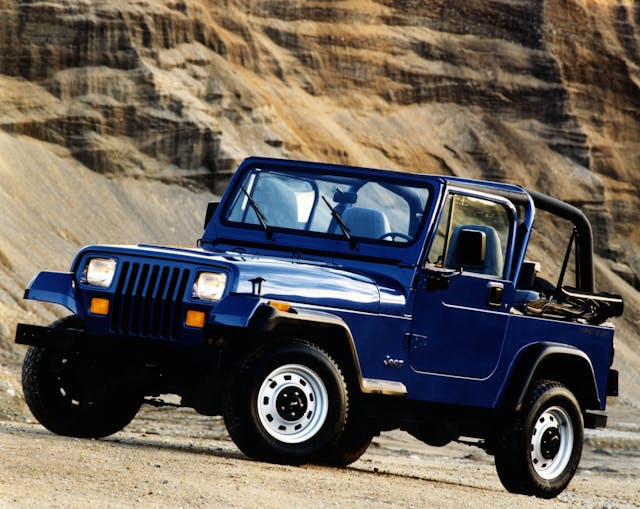
Almost. You see, there was one wrinkle in the Wrangler YJ’s design that sparked an unexpected wildfire of outright anger among longtime Jeep enthusiasts. Framing the vehicle’s traditional seven-slot grille were—travesty of travesties!—a set of rectangular headlights replacing the round units of old.
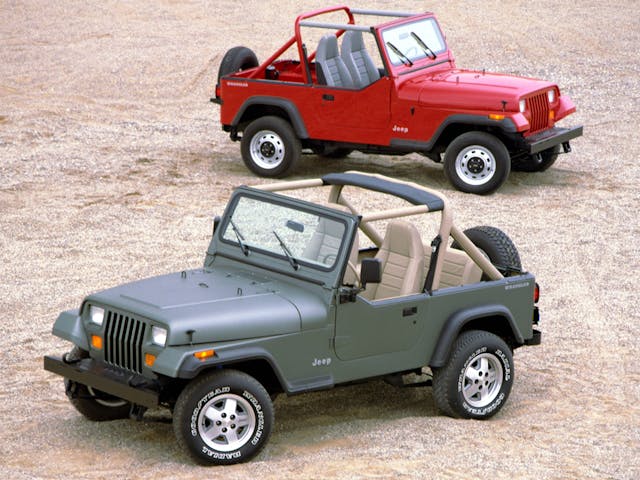
No, we’re not being facetious. The decision to go with the same rectangular sealed beams found on dozens of other 80s-era rigs was a move that Jeep hoped would help bring the Wrangler’s looks more in line with the current era while preserving its classic shape. And yet, it was tantamount to heresy for CJ lovers who felt abandoned by the brand. Throw in the fact that the YJ was lower and wider than the vehicle it replaced (an effort to improve on-pavement handling), and this generation of Jeep quickly became an outcast among hardcore fans. The backlash was so severe that, despite its sales success, the YJ’s 1996 replacement (the TJ) went back to the round-eye look.
In the long run, that bad blood has carried through to the present day. In our recent look at the hottest Jeeps in terms of value-added over the last five years, you won’t find the YJ—but you will see the CJ that preceded it and the TJ that followed it. That’s as good an indicator as any of the first Wrangler’s status among collectors. (In fairness, YJ values are up, just not nearly as much as its siblings.)
How Illogical Was This?
Very. Rectangles instead of ovals don’t do any damage to the Wrangler’s face, and they’re period-correct from a time when almost every truck on the market was featuring similarly square lighting setups.
Have We Gotten Over It Yet?
Judging by the YJ’s modest valuations, definitely not.
Should You Buy One?
Definitely. Then, 10 years from now, when no one can find a classic Jeep for less than a single semester’s college tuition payment, you can casually drop how little you paid for yours and watch traditionalists’ eyes glaze over.
1998-2004 Porsche 911 996
When Porsche introduced the 996-generation of its long-running 911 sports car at the end of the 90s, it marked a tectonic shift for the model away from a past ruled by air-cooled engines and into a water-cooled future.
Even if the engineering decision was inevitable—it would have been impossible for Porsche to keep the 911 at the forefront of performance without moving to liquid-cooled motors—it immediately put the 996 under the microscope among the automaker’s partisans. Eager to pick the model apart, despite it being the quickest and best-handling edition of the automobile to date, it wasn’t long before the new 911’s looks became a target of scorn.
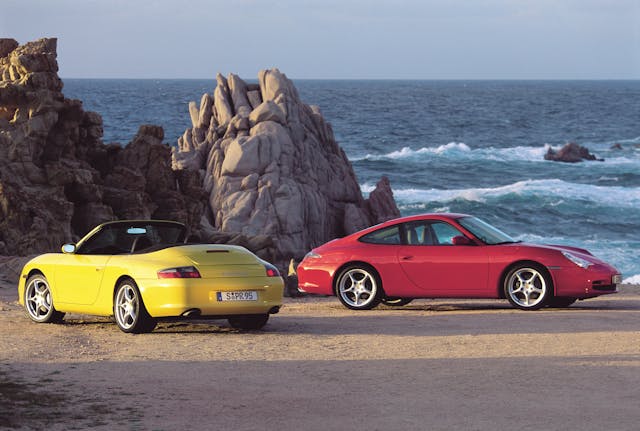
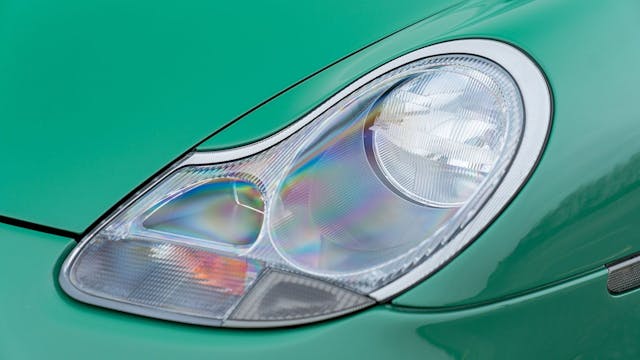
While the convertible’s hump saw its fair share of abuse, most of the vitriol was aimed at the 996’s headlights. For starters, they bore more than a passing resemblance to the lamps found on the more affordable Boxster roadster (released shortly beforehand), which the more snobbish saw as the taint of affordability. Then there was the shape, which was compared most often to a fried egg (with the yolk running out the bottom to the amber turn signal). The outcry was strong enough that Porsche evolved the 911’s headlights to be distinct from the Boxster for the 2002 model year, and pivoted to oval units for the 997 generation in 2005.
We know what you’re thinking: another headlight controversy? How much spare time did we have back in the 90s? The answers to those questions are “yes,” and “a lot, apparently.” The bottom line on the 996 is that you can’t see the headlights from the driver’s seat, so even if they bother you—or if you manage to let the comments from Porschephiles get under your skin—they’re easy enough to ignore. More to the point, they in no way affect the incredible driving experience offered by nearly every flavor of 911 from this era.
Despite all of the above, the 996 remains the cheapest way to get behind the wheel of a 911. The 997’s shift to a look more in line with 911s of the past has created a valley in valuations that’s stranded the 996 like some kind of Porsche pariah.
How Illogical Was This?
About as illogical as the YJ. Though to be fair, the pivot to water cooling, the runny headlights, and the 996’s interior design departure made for a trifecta of significant changes. And as we know, change is hard. When placed in the broader context of the generations preceding and succeeding it, the prevailing sentiment is that the 996 was too much of a departure.
Have We Gotten Over It Yet?
You can pick up a ’99 Porsche 911 Carrera 4 cabriolet for nearly the same money as a brand-new Nissan Versa, so the situation hasn’t yet gone sunny-side up in terms of values.
Should You Buy One?
If you love driving more than complaining, there’s absolutely no reason not to buy a 996-generation Porsche 911, especially since its valuation curve has troughed.
1995-1999 BMW M3
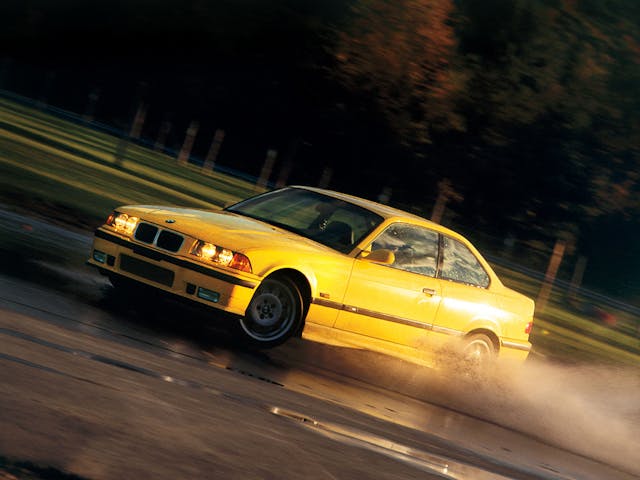
The E36 M3, BMW’s second iteration of its performance-oriented sports coupe, arrived in America in 1995. Trading box flares and homologation-special rawness for more mass-market appeal (including the availability of four doors out of the gate and a convertible option in 1998), this M3 was a massive departure from its E30 predecessor. There’s no question that it has always been a popular and sought-after car, but one thing in particular has held this car back.
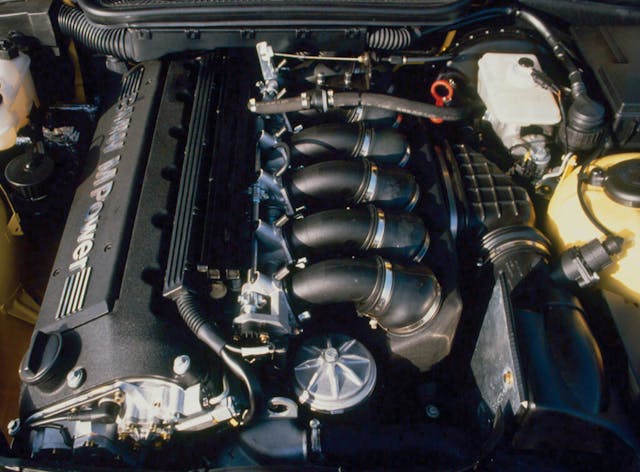
Wait, what? It turns out that BMW, unconvinced it could justify the high price tag of the Euro-market E36 M3’s exotic drivetrain on the other side of the Atlantic, decided to fudge things just a little bit. Okay, a lotta-bit: rather than the 286-horsepower, S50B30 inline-six cylinder engine it launched with at home back in 1992, the United States got a hopped-up version of the same-displacement, but more pedestrian M50 good for 240 horsepower.
Dubbed the S50B30US, and missing the individual throttle bodies of its European cousin, it was the end result of a compromise with BMW’s American execs, who had initially rejected the E36 M3 at its original price of more than $50,000. Even though the German brain trust urged U.S. operations to refer to the car as the “M330i,” the M3 badge was attached to the deck lid.
Given the modest sales numbers associated with the still-expensive BMW, the controversy at the time was somewhat muted. The American E36 M3 remains a popular choice among enthusiasts, though its reputation (and values) aren’t helped by being sandwiched between two “genuine” M cars in the E30 and E46, each of which received a full-bore M drivetrain in the United States. Adding insult to injury is the fact that the Canadian market received a very low production run of the European E36 M3, allowing cross-border comparisons without having to stump for an intercontinental ticket.
How Illogical Was This?
Of all the reasons to ignore a classic we’ve seen so far, the E36 argument is at least rooted in logic. The American edition wasn’t as quick or “special” as the Euro model, and it’s understandable that many BMW fans skip it in favor of the E46. Ignoring a car because it’s not the quickest of its breed, however, is a disservice to the lighter E36’s sublime handling and sleek, Q-ship styling.
Have We Gotten Over It Yet?
Valuation data for these cars suggests the market for these cars is mature, which is to say that we think opinions of this car are pretty much baked in at this point. To be fair, these are no longer dirt-cheap cars: A good-condition (#3) example is closing in on $30K, and a #2 excellent one is worth nearly 60 grand. Euro-spec E36 M3s are worth 50% more than those in U.S. trim, and E36 M3 prices have been falling slightly across all conditions—consistent with the market writ large—over the course of the last year. Values are less than half of what you’d pay for an E30 M3 in similar shape. That said, in most conditions, E36 values do have a slight edge against E46 models, which are still emerging as collector cars.
Should You Buy One?
Few cars of its era can tackle a corner like the E36 M3. Absolutely none of them have four doors, which makes the sedan version of this model a practical performer, too. There are plenty of engine mod options available if you aren’t excited by its 240 horses, and all the parts shared with lesser E36 models under the hood make the M3 fairly affordable to maintain, to boot.
1969-1976 Porsche 914 / 1977-1988 Porsche 924
Long before the Boxster was a hit, Porsche suffered two major stumbles in trying to drum up business with an entry-level model. It’s important to understand, however, that the problems were tied to branding, not the vehicles themselves.
The first victim of circumstance was the Porsche 914, a low-slung mid-engine soap bar of a roadster that weighed in at just a few pounds over the ton mark. It looked like nothing else Porsche had ever put on the road because it wasn’t initially intended for that brand’s showrooms. Instead, Porsche designers had put it together as an option for Volkswagen to replace the Karmann Ghia.
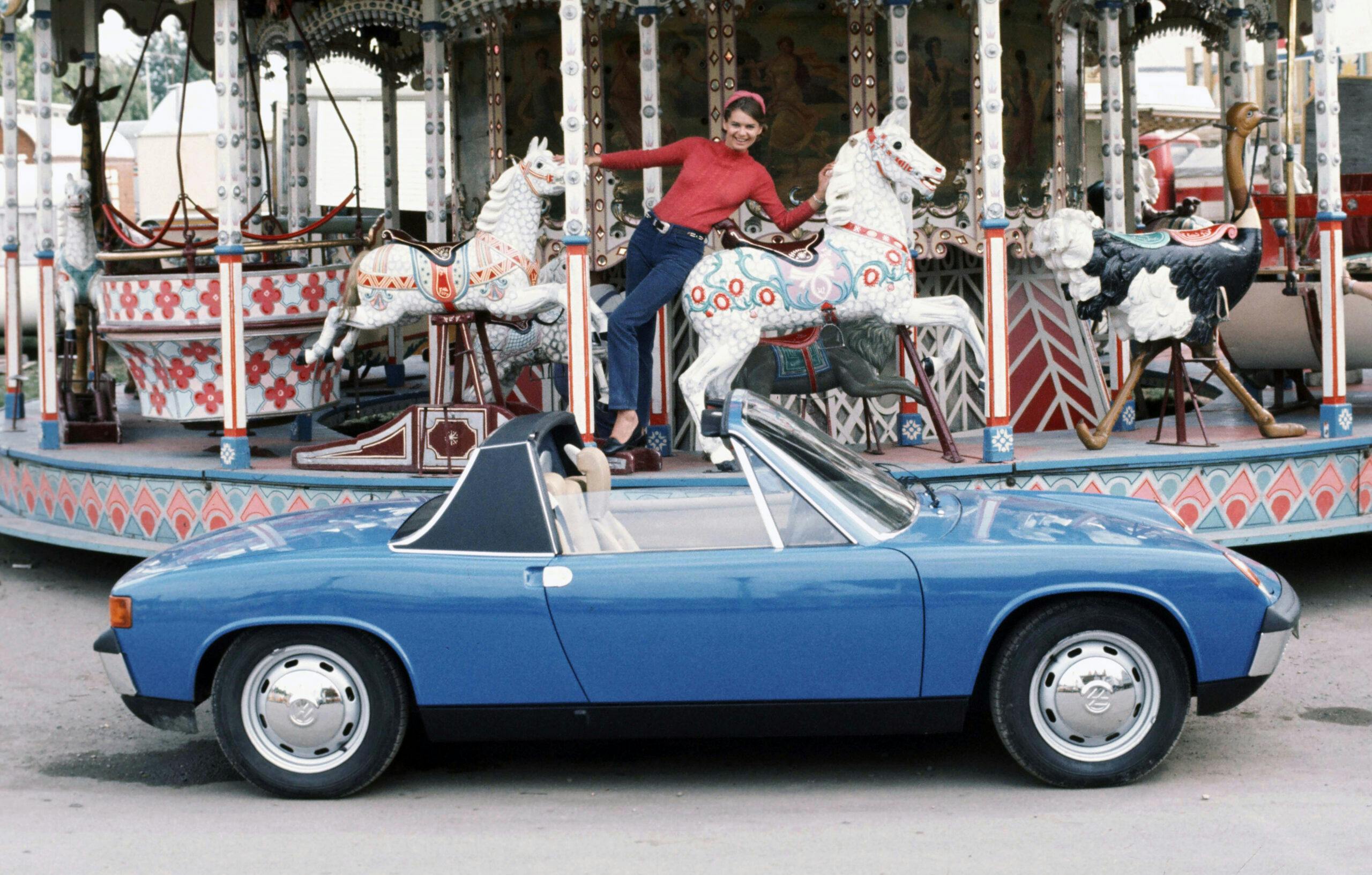
After convoluted corporate planning proposed a four-cylinder model for VW and a six-cylinder edition for Porsche, the Volkswagen side of the equation was scuttled and the 914 emerged into the world with a Porsche badge. Sadly, its reputation would soon be sunk by the VW engine it hid under its rear deck.
That 4/6 split was maintained under the Porsche umbrella, but while the sports car company designed and built the flat-six found in the (up to) 125-horsepower 914-6, the four-cylinder in the base 914 was pure Volkswagen. At around 85 horsepower, and with fairly meager torque, it wasn’t exactly quick, but it did offer the same excellent handling found in its mightier sibling.
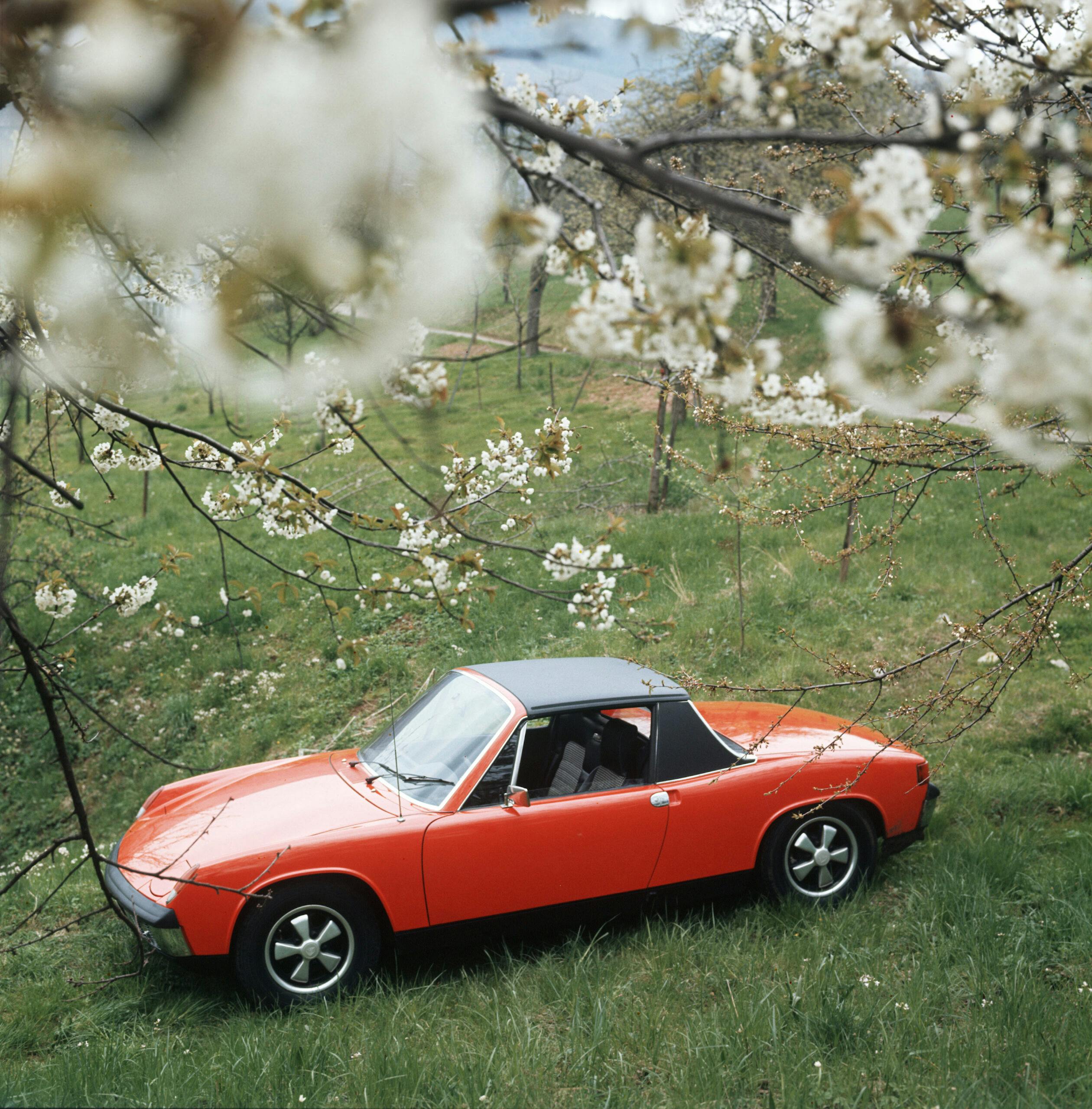
Ultimately, that didn’t matter much for its reputation. Porsche fans felt smeared by Volkswagen’s presence in the design and production process of the 914 (it was built by Karmann, not Porsche). The car became the brand’s first “outside” model, one that didn’t enjoy the same halo as the 911 of the same era. That disinterest extends to the present day, where the four-cylinder car remains the cheapest air-cooled Porsche money can buy, enjoying only a portion of the reappraisal afforded the six-cylinder.
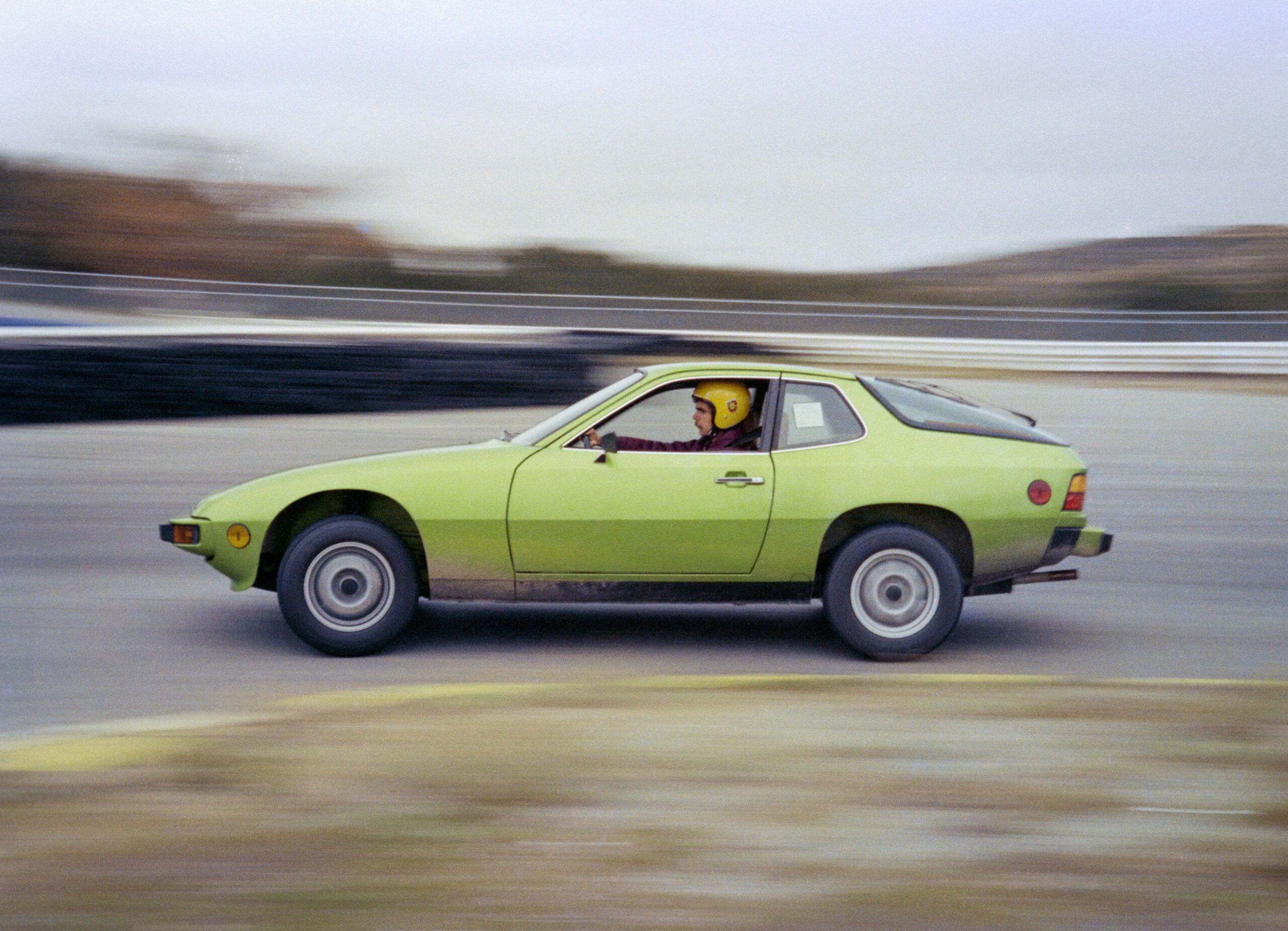
A very similar scenario played out again just a few years later. The 914’s replacement was the 924, a car that broke new ground (for Porsche, anyway) by putting the engine up front and cooling it with water, not air, which was tantamount to a capital offense among the Porsche crowd when it appeared in 1977.
Since the 924 was designed as a VW product (till they pulled out, and Porsche decided to buy the design back), it came with a VW-sourced four-cylinder engine and a host of other VW and Audi parts. Naturally aspirated, the car wasn’t all that exciting in straight line, but its chassis was a joy in the corners. Porsche continued to evolve the car, eventually offering livelier engines, including a turbocharged model.
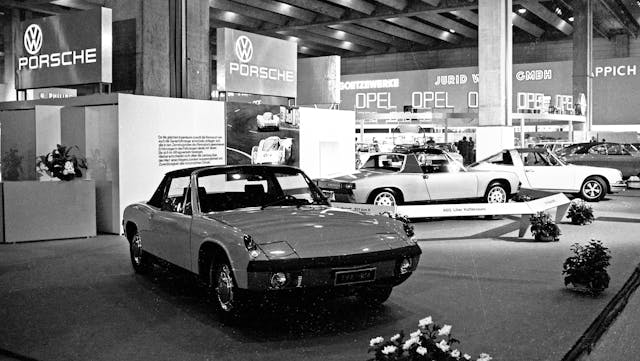
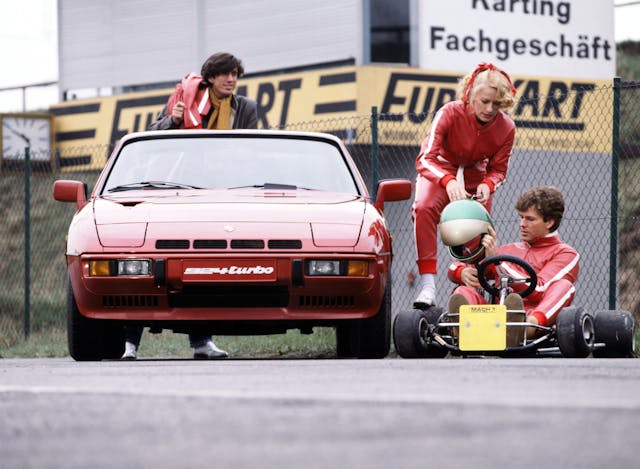
Neither of those details mattered—though it sold in reasonably healthy numbers in its early years, the 924 still carried its not-a-Porsche reputation. As a result, Porsche redesigned the car with bulging fenders, a wider track, and a more aggressive aero package, calling it the 944 when it arrived in 1983. It also made sure to install its own engine under the hood, creating a vehicle that, if not exactly beloved by the Porsche crowd, was certainly accepted as a true P-car (especially later turbocharged editions).
The pair were sold alongside each other until the 924 was shelved after the 1988 model year. Sports car fans weren’t impressed with the price-to-performance ratio at the time, and decades later, the 924 is still largely forgotten among collectors who are wary of its VW pedigree.
How Illogical Was This?
Both the Porsche 914 and the Porsche 924 are fun to drive, a fact that’s easily lost in the fog of recrimination about their mechanical origin stories. It might have made sense to be upset about a Volkswagen motor at Porsche prices when shopping new in the 1970s, but to overlook either of these models for that reason today is (similar to the E36 M3) simply depriving yourself of an accessible and enjoyable experience behind the wheel.
Have We Gotten Over It Yet?
The 914 has spent the past decade gradually climbing in value. The 914-6 is through the roof if you can find a nice one, and even average cars are priced in the $80,000 range. An equivalent 914-4, on the other hand, costs a quarter of that amount, and while some conditions have doubled in value, they haven’t appreciated as fast as their stablemates.
The Porsche 924 has yet to have its day. Whether you snag a base model or a turbo, chances are you won’t be paying more than $15,000, and in many cases, less than $10K will snag you a decent example. That’s a sharp contrast to more robust values for its 944 contemporary.
Should You Buy One?
Both the Porsche 914 and the Porsche 924 are snapshots of a brand in transition. Despite not having quite locked down the formula, each of these autos is interesting out on the road, and reasonably affordable to maintain. Outside of the 914-6, it’s unlikely that either will become truly expensive, but that doesn’t change the fact that they remain excellent gateways into classic Porsche ownership for anyone undeterred by their Volkswagen roots.
The post 5 Unfairly Maligned Cars That Deserve Your Attention appeared first on Hagerty Media.
Looking to purchase a car? Find your match on the MSN Autos Marketplace

Post a Comment for "5 Cars That Don't Get the Credit They Deserve"
Post a Comment