
Inside the Battle Shattering the Heritage Foundation and the American Right
Key Takeaways
The internal Republican fight over Nick Fuentes and Tucker Carlson is a sign of the right’s most controversial internal debates breaching containment and going public. The diverging interests of different factions in the GOP, together with Trump’s looming lame duck status, means that this sort of divisive infighting is likely to get worse rather than better. This dynamic has been ongoing since 2016, but Israel and antisemitism are such divisive topics that they have sparked a civil war.
For the past several weeks, the American conservative movement has been publicly embroiled in a bitter, existential conflict between factions seeking to win control of its future. And after speaking with a number of people on the right, including a well-placed source who describes seeing some ugly events at the Heritage Foundation, one of the most influential think tanks in the conservative movement, I’ve come to think this is not a one-off struggle. Rather, it’s a harbinger of the post-Trump future to come.
The Fort Sumter Moment of This Civil War
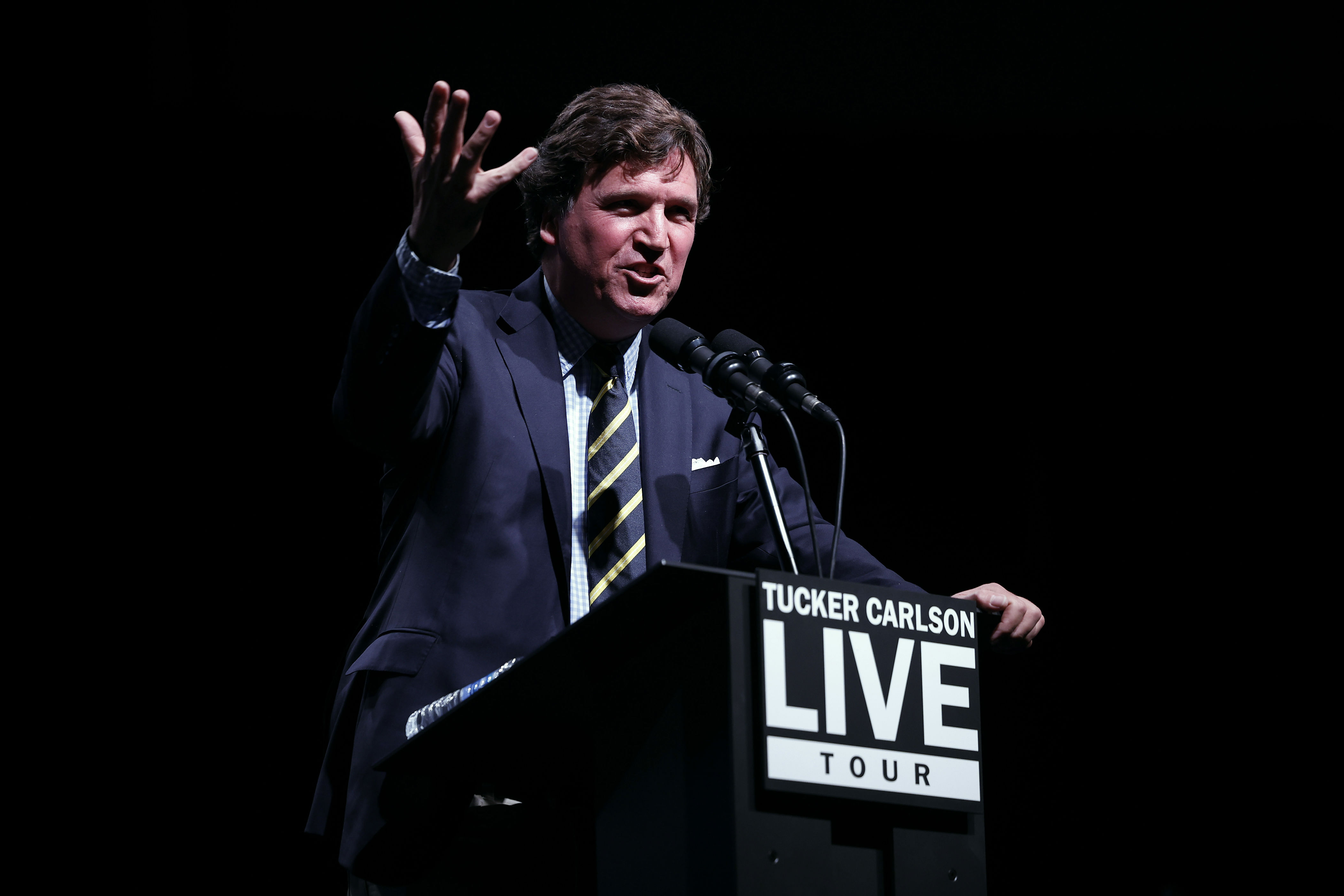
The Fort Sumter moment of this particular civil war came in late October, when Tucker Carlson — arguably the MAGA right’s most influential journalist — hosted Nick Fuentes, a gutter antisemite with a large online following, on his podcast for a friendly interview. The subsequent attacks on Carlson pulled in his ally Kevin Roberts, Heritage’s president, who vehemently defended Carlson and his decision to platform Fuentes from the “venomous coalition” on the right attacking him.
Then the backlash began in earnest, with some Heritage scholars and even Republican senators speaking out publicly. Chris DeMuth, one of Heritage’s most prominent recent hires, quit in protest. In a November staff meeting, video of which leaked to the press, more than one staff member told Roberts to his face that they expected him to resign.
And the conflict is escalating well beyond Heritage. In early November, two board members of the Intercollegiate Studies Institute — the oldest right-wing campus organization in America — resigned in protest over what they saw as an unacceptable drift toward Carlson-style politics. Afterward, the two men published a letter calling on conservatives to “choose to fight on the side of William F. Buckley, Jr. and give no corner to those preaching white supremacy, antisemitism, eugenics, and bigotry.”
The New Divide on the Right
When you hear this rhetoric, you may think that this is a simple struggle between the honorable conservative old guard and the insurgent online right. And yet, there is an obvious problem with this framework: The remaining “old guard” on the right today is almost uniformly pro-Trump. Those Buckleyite conservatives who opposed him, warning of precisely the kind of degradation we’re seeing today, have functionally left the movement; their institutions-in-exile, like The Bulwark, now make up the right flank of American liberalism.
What is happening now, then, is less about preserving the genteel Buckley-and-Reagan right (which itself was always more dependent on extremists than many conservatives are willing to admit). Rather, it is about defining what comes next — or, more precisely, what comes next after Trump. And the leaders of right-wing institutions no longer have the power to police their own and say, “We will go this far, but no farther.”
The “Rot” at Heritage
Given the anti-Roberts furor among some of Heritage’s staff, you might think that the organization is a bastion of principled conservatism reflecting on its recent choices. But one Heritage insider I spoke to painted a different, and more worrying, picture of its internal culture. This person is quite familiar with both Roberts and Heritage’s upper echelons; were I to publish their name, there is a very real chance their career would be over. But nonetheless, they felt the need to speak out, so we’re not disclosing their name in order to protect them from retaliation.
The source had only kind words for Kevin Roberts as a person — “nothing but a gentleman” — and professed deep appreciation for the organization Roberts leads and its importance for the American right. “If I didn’t care about Heritage,” they said, “I would not be doing this at all.” But they were deeply alarmed at what had happened to the place, warning of extremist “counter-culture thinking [that] has seeped in” among a portion (though not all) of the staff.
The Quiet Part Out Loud
For all its notable issues, it is important not to treat Heritage in isolation. When you spend enough time talking with people on the broader right, it becomes clear that the line between the hard right and the mainstream has long been more porous than many think. It is quite common for someone to hold some provocative beliefs, especially on issues of identity and bigotry, that they do not wish to share publicly.
It is unusual — but not unheard of — for such a person to openly identify their own views as “racist” or “sexist.” What’s more common is a sense that certain “truths” are unsayable in public, because anyone who offered them would risk professional or personal consequences from a mainstream in hock to leftist PC or “woke” sentiments.
The Uniquely Divisive Issue of Antisemitism
So far, I’ve deliberately avoided talking about the main subject of the right’s current civil war: the role of Jewish people in American politics and society. That’s because the contours of the right’s internal discussion of that issue are qualitatively different from what they are on race or gender.
Among conservatives, it’s widely recognized that the movement’s youth are, in general, more radical than their elders. My Heritage insider source, for example, warned that “some of the younger staff members [are] playing around with some really dangerous ideas I thought were going to lead to disaster, and we’re kind of living through that now.”
The Post-Trump Factional Divides Behind the GOP’s Public Infighting
There are many reasons why the right’s internal conversation has gone public. Some of the biggest ones are technological: Social media has demolished gatekeepers of all kinds, and the rise of direct online payment models has made it so people like Carlson can make a handsome living in ways that the right’s traditional elite have no ability to shut off.
But what’s important now is less why this is happening than what it means for the movement’s future. And on that front, I think one of the most revealing conversations I had came with a formerly canceled conservative columnist named Jack Hunter.
In the late ’90s and early 2000s, Hunter was a kind of proto-Fuentes. He hosted a South Carolina radio show under the moniker “the Southern Avenger,” a shock-jock persona who wore a Mexican-luchador style mask with a Confederate flag on it.
JD Vance’s Decision
It’s hard to say how any of this will shake out at present. But one person is shaping up to be a key figure: Vice President JD Vance. Vance is, by most accounts, the current favorite to win the GOP nomination in 2028. But more than that, he’s the political avatar for the right flank of Very Online Conservatism. Previously defining himself as a “postliberal” opposed to the American “regime,” he has more recently been defending Republican operatives who got caught privately texting things like “I love Hitler.”
You’d think this would make him the natural candidate for the Fuentes faction. And indeed, he is close with both Roberts and Carlson, the latter of whom reportedly played an instrumental role in Vance’s selection as vice president. Yet at the same time, Fuentes regularly rails against Vance — with one of his principal gripes being that Vance’s wife, Usha, is of Indian descent.

Post a Comment for "Inside the Battle Shattering the Heritage Foundation and the American Right"
Post a Comment