
Iowa Democrats Lost 200,000 Voters in 15 Years: What Happened and Why It Matters for 2026
DES MOINES - Iowa Democrats were riding high after the 2008 election of Barack Obama, whom they helped catapult into the White House with the Iowa Caucuses earlier that year. Their political clout was reflected back to them in the ranks of their elected officials: Democrats held five of seven statewide offices, including a tenth-straight year in the governor’s mansion. And it was reflected, too, in the state’s voter rolls. More than 700,000 of Iowa’s 2 million active voters were registered with the Democratic Party — a more-than-100,000-person advantage over the GOP. In the lead-up to the 2020 election, all eyes are on Iowa. Get updates of all things Iowa politics delivered to your inbox.
But it has been — with very few exceptions — all downhill from there. “It’s just startling,” said Republican political consultant Jimmy Centers, who recalled the smatterings of blue that dotted the state in the not-so-distant past. In 2010, incumbent Democratic Gov. Chet Culver lost reelection to former Republican Gov. Terry Branstad, and Democrats haven’t won a gubernatorial election since. By mid-2012, active registered Republicans outnumbered Democrats in Iowa. And starting in 2023, Republicans controlled every seat of Iowa’s Congressional delegation for the first time since the 1950s. Iowa’s Democratic Party has hemorrhaged more than 200,000 active voters — a nearly 30% drop — since that peak in 2009. “That is significant and speaks to how rightward voters have shifted over these 20 years and the headwinds that Democrats will have against them just to start,” Centers said. “But that's not to say that Democrats do not have a chance or are not going to be competitive, because they do.”
Democrats now trail Republicans in the state by nearly twice the margin by which they led 15 years ago. One year out from Election Day, it is Republicans who will start the 2026 midterm cycle with a voter registration advantage they have built up over the last 15 years. Midterm election cycles have historically been difficult for the party in power. And Republican President Donald Trump is not on the ballot in 2026, which could mean his supporters will stay home rather than turn out for other Republicans. But as the parties navigate their election strategies, Iowa’s voter registration numbers are the set pieces that will define the state of play for the next year.
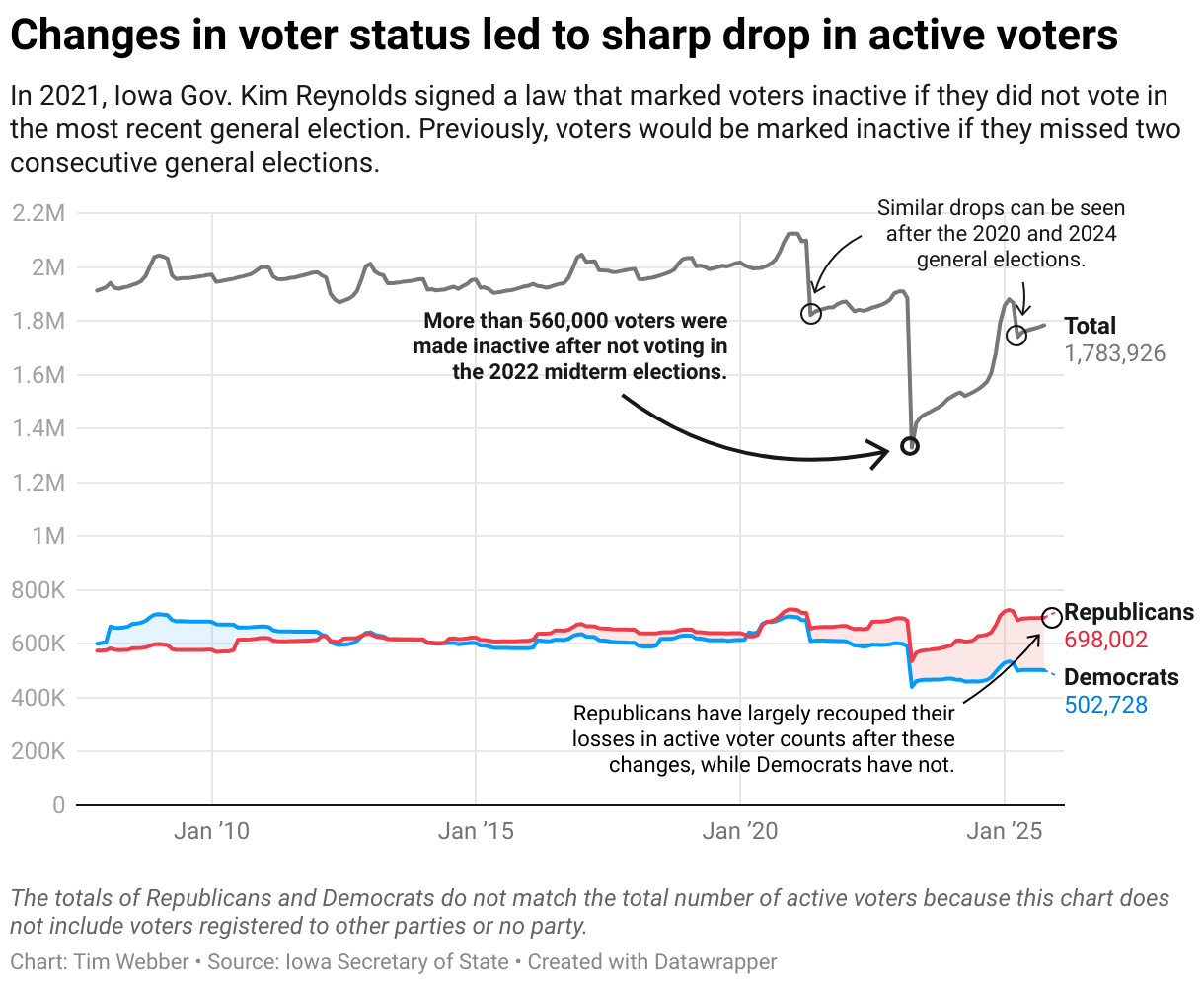
Iowa election law change classifies many voters as inactive. By definition, “active voters” are those Iowa residents who have voted in the most recent general election or who have since registered or updated their voter information. Iowa voters can register as Republicans or Democrats, but they can also register with other parties or with no party at all. In fact, the number of active voters unaffiliated with a party is usually similar to the number of active voters registered with either major party. This means the total of Republicans and Democrats doesn’t match the number of active voters in the state. It also means that even if one party has more active voters during any given election, the Iowans registered to third parties or no party could make the difference.
About 16% of Iowans, or about 340,000 Iowans, who are registered to vote in Iowa currently have inactive status. They can still vote, but they risk having their registration canceled if they remain inactive by not casting a ballot. (Registrations may also be canceled if an individual moves, dies or commits a felony, among other reasons.) The number of inactive voters is much higher than in the 2000s and 2010s because of a change to state election law Gov. Kim Reynolds signed in 2021. The portions of the legislation that grabbed headlines included reducing the amount of time Iowans can vote and imposing additional restrictions on how and when absentee ballots are submitted. But the new law also required any voter who does not participate in a general election to be designated as inactive. Previously, voters would have had to miss two consecutive general elections before that happened. That change resulted in more than 560,000 voters moved to “inactive” status after the 2022 general election. Similar drops, though not as large, occurred after the 2020 and 2024 general elections.

As recently as June 2020 — shortly after the most recent competitive Democratic Iowa presidential caucus — Democrats had more registered active voters than Republicans. By Election Day 2020, Republicans restored a lead of more than 20,000 active voters. And since the change in election law, the disparity between the two parties’ active voter totals has accelerated. Both parties lost a hefty share of active voters after the 2022 general election. But Republicans have since recouped those losses and now have more active voters than before the post-election reclassifications, while Democrats have not. In short, a larger share of Republicans who became inactive took the steps to become active again (or were replaced by new Republican voters). A larger share of Democrats who became inactive stayed inactive, or were removed from the voter rolls.
Eastern Iowa shifts right. So, if Iowa has shifted this much to the right over the past decade, what parts of the state have been responsible for that change? It would be easy to think “everywhere,” but that’s not quite true. A handful of counties have shifted left, but not by anywhere near the amount the rest of the state has swung right. The counties with a leftward shift are among the state’s youngest and most populous, as well as the ones already most inclined to support Democrats: Polk, the state’s largest and home to Des Moines (0.5% swing left); Dallas, containing many of Des Moines’ western suburbs (4.9% swing left); Story, including Iowa State University in Ames (1.8% swing left); And Johnson, home of the University of Iowa in Iowa City (4.6% swing left). Several other counties continue to have more active Democrats than Republicans, but not by as many as 10 years ago. There were over 9,000 more active Democrats than Republicans in Dubuque County, for example, at the start of 2016. As of October 2025, the most recent data, that lead had shrunk to just 11 voters. Dubuque County encapsulates a larger trend in eastern Iowa, once firmly Democratic. Nineteen of Iowa’s 99 counties flipped from having more active Democratic voters to more active Republican voters over the past 10 years; most were in eastern Iowa. Davis County, in the southeast part of the state, had the largest shift right over those 10 years. Democrats held a lead of more than 5 percentage points there in January 2016. Now, Republicans lead by nearly 40 points. Active Democratic voters in the county dropped by more than half in that period, while active Republican voters grew from about 1,500 to about 2,500.
Eastern Iowa’s shift right isn’t a new problem for Democrats. All but one of the counties on Iowa’s eastern border voted for Donald Trump in 2016 after siding with Barack Obama in both 2008 and 2012. Ahead of the 2020 caucuses, it was no secret that reclaiming the region was a vital part of the Democrats’ path to victory. But the gap has only widened since then. What accounts for Iowa Democrats' slip, Republicans' gains? Centers, the Republican political consultant, said the changes in voter registration numbers and voter behavior in eastern Iowa are a key reason Democrats are losing. “The sort of blue-collar voter has completely left the Democratic Party,” he said. “Those were proud manufacturing towns. They're just not there (for Democrats) anymore.” He argues the shift began nearly 20 years ago around the 2008 financial crisis. Iowa Republicans ran on fiscal responsibility and won the 2010 gubernatorial election, with Branstad defeating Culver. “And so, it started with a message of responsible budgeting, fiscal conservative, returning taxpayer dollars to the people of Iowa,” Centers said. “But then it took a hard turn about five years later when the president of the United States took that ride down the escalator at Trump Tower and announced his candidacy for president, and it shifted to a far more populist tone.” He said Trump’s “America First” approach has resonated with Republicans in the state. “In my humble opinion, Democrats haven't quite found an antidote for that and got caught up in a lot of D.C.-based messaging here in Iowa,” he said. “And we all know that all politics is local, and when you don't have a message that resonates back home, you end up in a lot of trouble at the ballot box.” Then, ahead of the 2024 general election, Iowa Democrats lost their first-in-the-nation caucus spot while Republicans maintained their coveted lead-off position, drawing national attention from candidates and the media.
Republican Party of Iowa Chair Jeff Kaufmann said holding onto the lead-spot for the caucuses is “an absolute boon" for Republicans in generating voter enthusiasm and voter registrations. He said his party has been able to grow its voter rolls mostly organically over the last decade rather than through targeted efforts. “We have had some voter registration efforts, both from the RNC and from the Republican Party of Iowa,” he said. “We've reached out to some low propensity voters, and some of the additional Republican voters have come from those ranks.” But he said he believes the Democratic Party has alienated voters in the state and around the country, helping to add to the registration disparities. “I think the Democrats have helped us a great deal in that in terms of what they've done wrong, in addition to what I think we've done right,” he said. Iowa Democratic Party Chair Rita Hart acknowledged the massive deficit the party faces when it comes to voter registration. But she said the registration numbers are only reflective of where the party has been, not where it will end up next November. “These are lagging indicators of what's happened over the last few cycles, and that is going to change as our efforts bear fruit,” she said. Hart said the state party will always be working on voter registration efforts, and she emphasized the role county parties have in targeting potential voters for registration. Since taking over as chair of the state party, Hart has emphasized building infrastructure and resources at the county level. She previously served as chair of the Clinton County Democrats and has said she knows firsthand how those groups can be put to better use. But she also said candidate messaging is going to do more to convince potential voters to show up on Election Day. She pointed to Democratic gubernatorial candidate Rob Sand, who makes a point of welcoming the Republican and independent voters who attend his events. “It doesn't matter how they're registered,” Hart said. “It matters who they're going to vote for.” One year from midterm elections, some Democrats sound the alarm on voter registration deficits. Still, a critical midterm election for Democrats looms one year from now. Two of Iowa’s incumbent Republican leaders — Gov. Kim Reynolds and U.S. Sen. Joni Ernst — will not be running for reelection, and other statewide offices and all four U.S. House seats will be up for grabs. But Democrats face deficits of no fewer than 22,000 active voters in each of the state’s Congressional districts and an overall difference of nearly 200,000. For Democrats to be successful, particularly in statewide races, a combination of things must occur to have a chance at making the math work in their favor. Among them: Democratic voters will have to turn out en masse, independent voters will have to swing in favor of Democratic candidates and a substantial number of Republicans must decide to sit out the election. That reality has some Democrats raising alarms, including Democratic consultant Jessica Vanden Berg. She has begun working on a pilot project to identify and register Democratic voters in the state, hoping it will yield valuable information for the party ahead of the midterms. The effort is funded by North Central States Regional Council of Carpenters and Progressive Turnout Project. “The most important part of the work is getting people to participate in their democracy,” Vanden Berg said. “The second most important part of the work is to win. And we don't have the numbers on the Democratic side right now — potentially in a lot of places — to win.” She urged Democrats to take the voter registration deficit seriously and work to address it early. “You're going to be able to persuade a certain amount of Republicans,” Vanden Berg said. “Nationally, it's 7% to 10% right now if you see and believe polling, which you might not. You're going to be able to persuade a certain number of independents. But if you start out negative 180,000 and have to gain that amount, it becomes more difficult (to win).” In 2018, she noted that Democratic gubernatorial candidate Fred Hubbell came within 3 percentage points of defeating Republican Reynolds. Some Democrats point to that race as a sign that, under the right circumstances, they could edge past a Republican in a statewide contest. But Vanden Berg said the voter registration deficit has ballooned since 2018 in favor of Republicans. “We were about on the level playing field then, and we still lost,” she said. “We're not on a level playing field today." Despite advantage, Iowa Republicans say they must remain 'vigilant' heading into midterms. But even with the GOP’s major registration advantages, state and national Democrats are increasingly viewing Iowa as a viable battleground for the U.S. House and the governor's race. Elections analysts at the Cook Political Report have rated the 1st District U.S. House race as a “toss-up.” And they’ve rated the 3rd District race and the gubernatorial contest as “leans Republican.” Although Kaufmann has talked up his party's election odds, he said “there's nothing inevitable about victory.” Democrats point to four special election victories this year in Iowa where the party has significantly overperformed compared with the 2024 presidential election, saying it shows their potential strength going into 2026. But Republicans have said the wins aren't indicative of what to expect in a general election. And in the 2025 off-year elections that concluded earlier this month, Democrats swept a pair of gubernatorial contests in New Jersey and Virginia by big margins while Democratic socialist Zohran Mamdani cruised to victory in New York City's mayoral election. “Any chair or party that begins to get overconfident will almost undoubtedly get complacent, and that's where things turn,” Kaufmann said. “I think deeply rooted in Iowa is an independent streak and a populist streak that is wonderful. It made Donald Trump in this state. But at the same time, it also makes for a foundation that can shift if you're not vigilant.” Centers said Republicans should go into the midterm election cycle “eyes wide open to the fact that as a party, Republicans haven't quite figured out how to turn out voters at scale without Donald Trump on the ticket.” If those Trump voters stay home, it could shrink Republicans' advantages, particularly in congressional races that are often won by narrow margins. “So Republicans must figure out … how are you going to motivate Iowans to turn out at the polls in a midterm election without President Trump on the ballot?” he said. “It's going to be a tough climate, and you do not have your lead messenger who's going to be as engaged as he would be if he was on the ballot.” Tim Webber is a data visualization specialist for the Register. Reach him at twebber@registermedia.com and on Twitter at @HelloTimWebber. Brianne Pfannenstiel is the chief politics reporter for the Des Moines Register. She writes about campaigns, elections and the Iowa Caucuses. Reach her at bpfann@dmreg.com or 515-284-8244. Follow her on X at @brianneDMR.

Post a Comment for "Iowa Democrats Lost 200,000 Voters in 15 Years: What Happened and Why It Matters for 2026"
Post a Comment