
RFK Jr.'s Idealism Confronts Political Reality in a Rising Movement
The Rise and Challenges of the "Make America Healthy Again" Movement
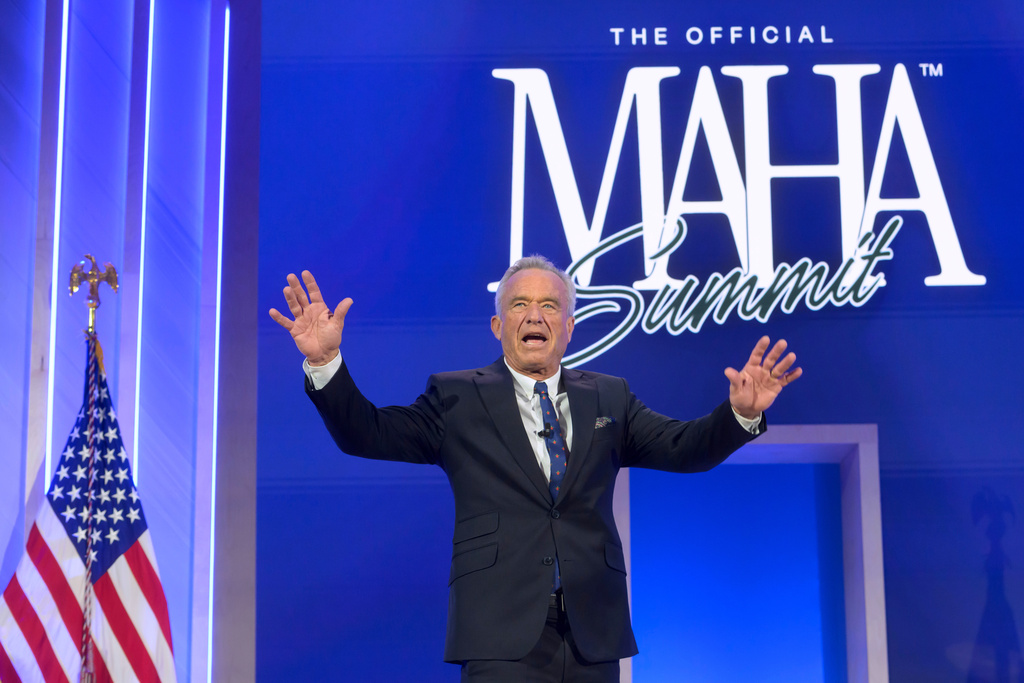
Robert F. Kennedy Jr. recently found himself in the spotlight at a high-profile event in Washington, where he received praise from the vice president and health technology CEOs for his work on the “Make America Healthy Again” (MAHA) initiative. This event was meant to celebrate the achievements of the health secretary and the movement he has cultivated. However, behind the scenes, a different story was unfolding online, as some of Kennedy’s supporters and former employees voiced concerns about the direction of the movement.
A group of individuals, including former Department of Health and Human Services officials, claimed that MAHA was deviating from its original goals. Gray Delany, a former HHS official who was removed in August, expressed his disappointment, stating that the current state of MAHA did not align with what he had originally supported.
These criticisms gained traction, prompting the health secretary to defend his colleagues on social media. This situation highlights the growing tensions within Kennedy's coalition as it expands in influence and scope.
Internal Struggles Within the Movement
The internal conflicts within the MAHA movement are becoming more apparent. Environmental advocates and vaccine skeptics, who were instrumental in propelling Kennedy into politics, are increasingly frustrated with what they perceive as insufficient action on their key issues. They are also concerned about the Health Department's willingness to collaborate with pharmaceutical companies and other large corporations, which they view with skepticism.
This friction poses a risk to the cohesion of a movement that has become an important ally for President Donald Trump and has opened up new avenues for Republican voter engagement. These challenges come at a time when similar issues are emerging within Trump's own Make America Great Again movement, particularly regarding topics like the Epstein files and the White House's focus on global diplomacy.
Despite these internal struggles, the public perception of MAHA remains largely positive. According to a June Ipsos poll, approximately two-thirds of Americans support the federal government's "Make America Healthy Again" initiative. HHS spokesperson Andrew Nixon emphasized that the movement's success is a testament to its impact, noting that Secretary Kennedy is leading a broad coalition focused on improving public health through transparency, accountability, and measurable results.
The Complexity of a Broad Coalition
Public health researchers suggest that the universal appeal of making Americans healthier can lead to conflicts by attracting competing interests. Matt Motta, a professor at Boston University School of Public Health, noted that as the coalition grows larger, it becomes increasingly difficult to satisfy everyone involved.
Kennedy, known for his environmental advocacy and anti-vaccine stance, has taken several steps to limit vaccines this year. He has cut funding for vaccine development, replaced members of a federal vaccine advisory committee, and pledged to overhaul a program that compensates Americans injured by vaccines. Additionally, he has spread false information about vaccines while in office.
Recent changes to the Centers for Disease Control and Prevention's website have sparked further controversy, as it now contradicts the long-standing scientific consensus that vaccines do not cause autism. Despite this, many of Kennedy's supporters argue that more needs to be done. Some want penalties for companies that profited from vaccine and mask requirements during the pandemic, while others advocate for removing mRNA-based COVID-19 shots from the market, despite the scientific evidence supporting their effectiveness.
Diverging Views on Collaboration
Some MAHA influencers and former HHS employees have accused White House chief of staff Susie Wiles and Kennedy's close adviser, Stefanie Spear, of working against Kennedy's efforts to restrict vaccines and challenge pharmaceutical companies. These claims have been amplified by some supporters, who point to Wiles' past work with a lobbying firm that has represented Pfizer as evidence of her opposition to Kennedy.
In response, Kennedy defended his colleagues on social media, emphasizing that Wiles and Spear are strong allies within the administration. He urged the movement to focus on its achievements and continue building its coalition rather than allowing internal divisions to weaken its impact.
Expanding the MAHA Tent
Since the "Make America Healthy Again" slogan emerged on the campaign trail last year, Kennedy and Trump have worked to broaden the movement by inviting a wide range of participants who have concerns about American health, nutrition, and chronic disease. This approach has attracted a diverse group of supporters, including various corporate interests such as health data startups, artificial intelligence firms, drug manufacturers, and even fast-food companies.
At a recent MAHA event in Washington, biotech companies, AI firms, and health startups were prominently featured, raising concerns among some longtime supporters. Leslie Manookian, president of the Health Freedom Defense Fund, expressed discomfort with the inclusion of certain corporate entities, arguing that true health cannot be achieved through pills, creams, or pharmaceuticals.
Tony Lyons, president of MAHA Action, emphasized the movement's commitment to inclusivity and open dialogue. He stated that the strength of MAHA lies in its openness to ideas and diverse perspectives.
Balancing Ideals and Realities
Ethan Augreen, a former volunteer for Kennedy's presidential campaign, expressed concerns about the corporate presence at the event and a recent social media post about meetings with tech leaders discussing personal health data. He hopes that Kennedy will focus on addressing corruption in the healthcare system and removing mRNA vaccines from the market.
Despite these concerns, Kennedy and his team continue to navigate the complex landscape of the MAHA message. At a recent Oval Office meeting, Kennedy praised a deal with drugmakers to expand coverage and reduce the prices of weight-loss drugs, even as he acknowledged that it was not a "silver bullet."
Dr. Mehmet Oz, administrator of the Centers for Medicare and Medicaid Services, acknowledged the scrutiny from Kennedy's base but defended the administration's approach, stating that it was using Trump's negotiation playbook instead of engaging in direct confrontation.
The Future of MAHA
Jeffrey Tucker, founder of the Brownstone Institute, noted that while MAHA activists are idealistic, they may sometimes underestimate the challenges of reforming a deeply entrenched bureaucracy. He emphasized the importance of holding onto ideals while recognizing the difficulty of achieving change.
Motta, the professor, believes that regardless of where MAHA goes next, it has already grown beyond any single policy position. He argued that identities and beliefs are deeply rooted and unlikely to fade easily.

Post a Comment for "RFK Jr.'s Idealism Confronts Political Reality in a Rising Movement"
Post a Comment