
Top Universities Boost Lobbying as Trump Targets Higher Education
Rising Lobbying Spending by Top Universities
The nation’s top schools have significantly increased their spending on lobbying the federal government this year, particularly in response to President Trump’s policies affecting higher education. According to recent disclosures, 24 top universities and one of the largest college systems have already spent approximately $24 million lobbying Washington this year, more than double the amount they spent during the same period last year.
This surge in lobbying activity is driven by the need for universities to influence decisions that could impact their funding, policies, and operations. Thomas Holyoke, a political science professor at California State University, Fresno, noted that universities are trying to gain influence either directly with the White House or through members of Congress who hold sway over the administration.
Major Spenders in Higher Education
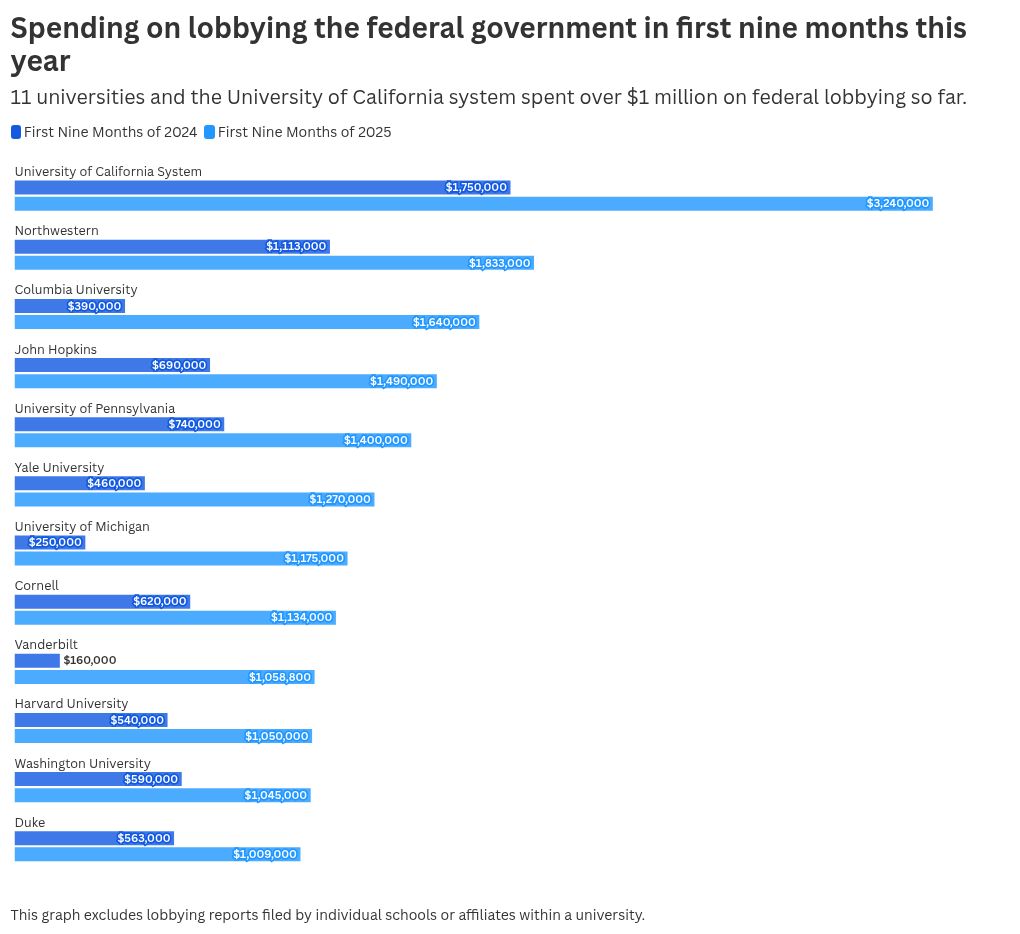
Several leading universities have spent substantial amounts on lobbying efforts. At least 10 universities and the University of California (UC) system have each spent over $1 million. The UC system, which includes UC Berkeley and UC Los Angeles, has spent over $3.2 million this year alone. Northwestern University and Johns Hopkins University together spent over $3.2 million, while Harvard University, which has challenged the federal government in court, spent $1 million. Yale University spent over $1.2 million, and the University of Pennsylvania spent $1.4 million. Cornell University and the University of Michigan-Ann Arbor both spent $1.1 million.
Experts predict that universities will continue to increase their lobbying expenditures as the Trump administration continues to reshape higher education policies. This month, the Department of Education and White House officials requested schools to sign a 10-point federal funding compact, which raised concerns among university administrators. As of now, at least seven universities have declined to sign it.
Key Issues Being Lobbied
Universities have lobbied on various issues, including campus safety, federal funding, and visas for international students. These efforts come as the federal government has withdrawn allocated funds and launched investigations into antisemitism on multiple campuses.
Brian Clark, vice president for news and strategic campus communications at Brown University, explained that the focus of their advocacy efforts centers on issues important to students, faculty, and staff, such as federal funding for scientific research, student financial aid, immigration policy, and other matters.
Increased Use of Lobbying Firms
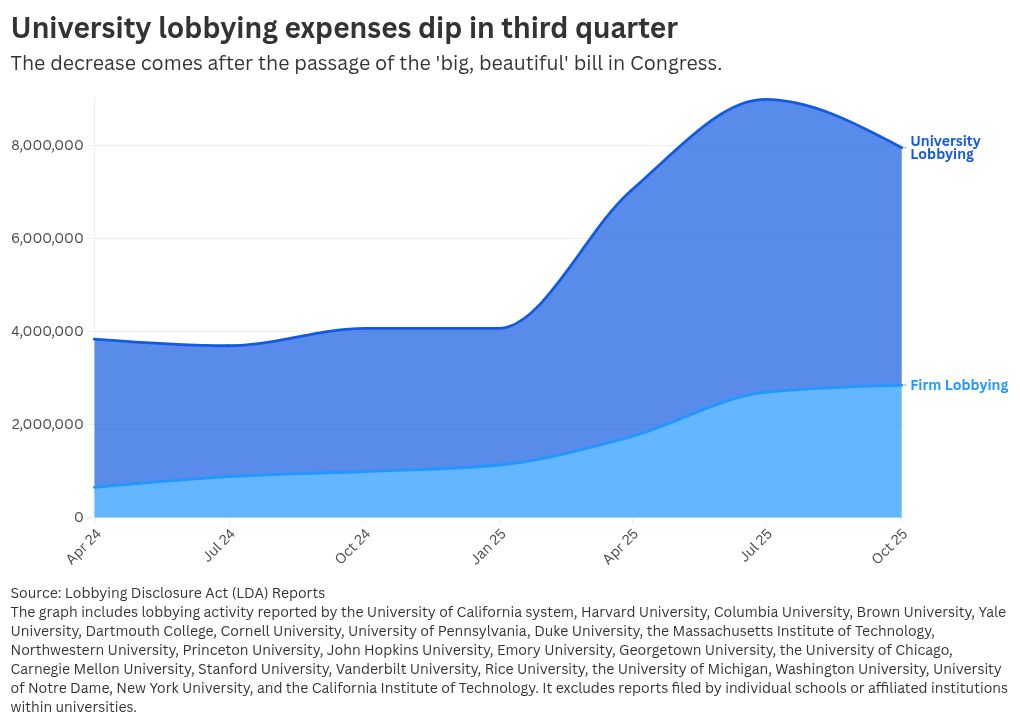
In addition to in-house lobbying, universities have increasingly turned to external lobbying firms. This year, they have spent up to eight times as much on these firms compared to the previous year. At least 15 universities hired new lobbying firms after Trump won the election in November. Institutions like the Massachusetts Institute of Technology, Duke University, Brown, and Yale registered to lobby through firms this year after exclusively using in-house lobbyists in 2024.
Vanderbilt University, which had relied on in-house lobbying for years, hired three new firms after Trump returned to office. Similarly, Georgetown University retained three lobbying firms.
Some of the firms hired include BGR Governmental Affairs, Ballard, S-3 Group, and Miller Strategies — all of which have strong ties to the Trump administration or GOP lawmakers. Other prominent firms such as Brownstein Hyatt Farber Schreck and Akin Gump Strauss Hauer & Feld have also been engaged.
BGR Governmental Affairs and Ballard’s alumni include two members of Trump’s Cabinet: Transportation Secretary Sean Duffy and Attorney General Pam Bondi. According to Politico, these firms have seen significant financial gains under Trump 2.0.
Shifting Strategies in Lobbying
Robert Kelchen, head of the Department of Educational Leadership and Policy Studies at the University of Tennessee, noted that lobbying has become more personal, with universities seeking individuals who can influence the president directly.
“Not just working through Congress — as has often been the case — but going through the president, as power in Washington has really flown away from Congress and toward the White House,” he said.
Kelchen added that while it's common for universities to invest in both in-house and firm lobbying, the effectiveness of each strategy under the second Trump administration remains unclear.
Even universities not directly targeted by the Trump administration have begun increasing their lobbying investments to counter the administration’s broader actions. Rice University spent $510,000 lobbying the federal government in 2025, and the University of Notre Dame shifted its focus to in-house lobbying after years of outsourcing.
Concerns Over Administration Policies
Mia McIver, executive director of the American Association of University Professors, expressed concerns about the climate of fear created by the Trump administration, which has left colleges and universities uncertain about who might be next in the crosshairs.
However, she criticized universities’ lobbying efforts, arguing that they represent an attempt to curry favor with an administration that is not supportive of college students or faculty.
While some universities scaled back their lobbying spending in the third quarter, others maintained high levels. Brown, Cornell, and Northwestern reduced their spending by tens of thousands of dollars, with Brown and Northwestern cutting their expenses by over $100,000. Brown signed a deal with the Trump administration to restore $500 million in funding, while Cornell and Northwestern have yet to negotiate a deal after the administration froze over $1.8 billion in funds.
Jodie Ferise, a former lobbyist and college administrator, described the Trump budget bill as a flash point for colleges, with many private universities investing heavily to influence its provisions. She noted that the bill included several consequential changes for higher education, such as raising endowment tax rates and limiting federal student loans for graduate schools.
Following the bill’s passage, Ferise said universities may have had less reason to lobby, but they must remain vigilant as the administration continues to shape higher education policies. She emphasized that universities must stay active and engaged to navigate the uncertainties of the current landscape.

Post a Comment for "Top Universities Boost Lobbying as Trump Targets Higher Education"
Post a Comment