
Trump's Military Threats in Nigeria and Claims of Christian Persecution
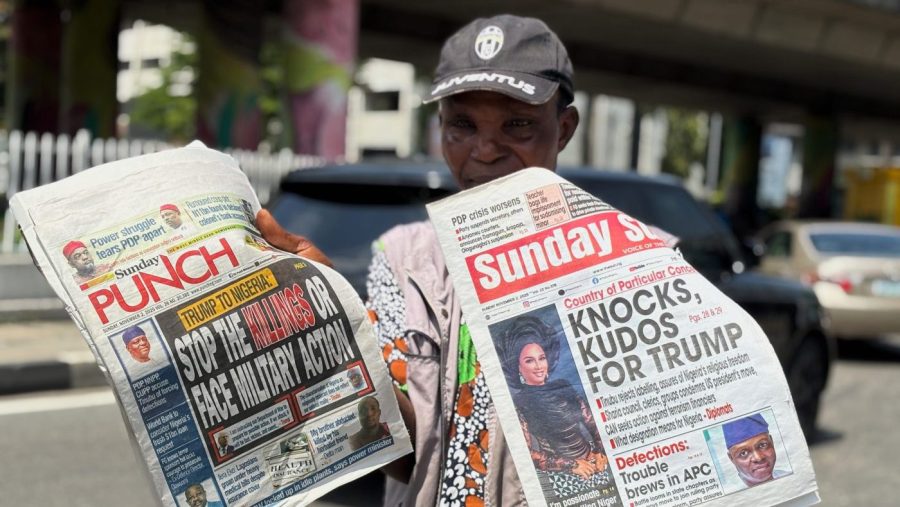
President Trump's recent promise to defend persecuted Christians in Nigeria has placed the country in an unexpected position, drawing attention from the U.S. president's unpredictable approach to international affairs. During the weekend, Trump threatened to deploy American troops against Islamist terrorists who are targeting Christians, criticizing Nigeria’s leaders for their failure to address the issue. He also labeled Nigeria as a "country of particular concern" (CPC) due to religious violence.
The CPC designation requires the president to consult with the designated government, develop a foreign policy action plan, and discuss implementation with Congress within 90 days. Additionally, Trump warned that aid and assistance to Nigeria could be cut off unless significant actions are taken.
Here’s what to know:
Christian Right Has Lobbied for CPC Designation
The CPC designation was a win for advocates who have been pushing for U.S. intervention to protect Christians in Nigeria. Nina Shea, senior fellow and director of the Center for Religious Freedom at the Hudson Institute, noted that the decision was unexpected and had been uncertain until the end.
Shea mentioned that there was no initial decision at the start of the week, but by the end, a decision was made, although it was not anticipated when or if it would happen. She emphasized that Trump had to make the designation by the end of the year under the law.
A group of over 30 advocates, Christian organizations, and conservative think tanks sent a letter to the administration on October 15, urging Nigeria to be designated as a CPC. This effort was supported by celebrity advocacy from comedian Bill Maher and Grammy-nominated musician Nicki Minaj.
Minaj expressed her gratitude to the president and his team for taking the issue seriously. She also mentioned that U.S. Ambassador to the United Nations Mike Waltz invited her to discuss the issue when she is in New York City.
Senator Ted Cruz (R-Texas) has been one of the most vocal advocates in Congress for Nigeria’s Christians, introducing a bill in September that would sanction Nigerian officials involved in the violence.
When announcing the new designation, Trump asked Rep. Riley Moore (R-W.Va.), an outspoken advocate for Nigeria’s Christians, to look into additional measures the U.S. might take and report back to him.
Threat of Military Intervention Stirs Concern
Trump’s threat of military action is more intense than what some advocates were pushing for, but it aligns with his previous suggestions of armed interventions in South America targeting drug cartels.
"If the Nigerian Government continues to allow the killing of Christians, the U.S.A. will immediately stop all aid and assistance to Nigeria, and may very well go into that now disgraced country, 'guns-a-blazing,' to completely wipe out the Islamic Terrorists who are committing these horrible atrocities," Trump posted on Truth Social.
Richard Ghazal, executive director of In Defense of Christians, expressed concerns about Trump’s mention of kinetic operations. Ghazal believes the president is distinguishing between actions that threaten the stability of the Nigerian government and those targeting terrorist groups.
Ghazal, along with other conservative groups and Christian organizations, met with administration officials on October 29, pushing for Nigeria’s designation as a CPC to motivate the Nigerian government to take firm action.
"I’m not a hawk, I hate the idea of war," Ghazal said. "I think it absolutely should always be the last option, we want it to be the last option. We hope the Nigerian government allows the world to move on and not even have to think about it because they take care of their own issue domestically, because that is what their job is as a sovereign government."
Still, Ghazal said that surgical, targeted military strikes against terrorist groups in Nigeria could fall under the justification of the responsibility to protect, enshrined in the United Nations, which compels the international community to address atrocities in states where their national government fails to take action.
"If a sovereign government is not able to protect its own population group from atrocity, which is very much what’s happening in Nigeria, then it’s the international community’s responsibility to go in there in a limited capacity, not intending to destabilize the legitimate government, but to do so in a way to protect the unprotected group," Ghazal said. "And I think this is a textbook case of that."
Advocates for Protecting Christians in Nigeria Say Boko Haram and Other Islamist Terrorist Groups Are Just One Aspect of the Significant Threats Facing Christians in the Country
The Nigerian government’s enforcement of Islamic blasphemy laws, which carry the death penalty and harsh prison sentences, affect citizens of various religions, as raised in their October 15 letter.
"Militant Fulani Muslim herders" attack Christians with impunity, the letter states. "It [Abuja] fails to investigate the Fulanis’ organizational structures and identify who is arming them," it adds.
"The authorities don’t enforce the country’s gun bans against the Fulani. They don’t act to reclaim the stolen farms for their Christian owners, who are instead consigned to destitution in internally displaced camps that receive little, if any, government assistance. They rarely arrest and never convict Fulanis who attack Christians. Even when warned of impending Fulani attacks, government security forces are typically unresponsive or ineffective."
Christians Have Faced ‘Violence and Danger’ for Years
Analysts point out that Nigeria’s majority Muslim population has also faced violence and killing at the hands of Islamic extremists operating in the country. But there is no doubt that Christian communities have been hit hard.
The Observatory for Religious Freedom in Africa (ORFA), a Dutch-based charity advocating religious freedom on the continent, released in July early findings documenting attacks on civilians and Christians in Nigeria between 2019 and 2024.
Of 36,056 civilian deaths, the Fulani Ethnic Militia was responsible for 47 percent of all civilian killings, more than five times the combined death toll of Boko Haram and Islamic State West Africa Province, which together accounted for just 11 percent of civilian deaths, the ORFA stated.
There were 2.4 Christians killed for every Muslim during this period, the group said. In states where attacks occur, Christians were murdered at a rate 5.2 times higher than Muslims relative to their population size.
Open Doors, an international organization dedicated to helping Christians, said in its 2025 World Watch List report that "very little" has changed for Christians in Nigeria, particularly those living in the Muslim-majority north, enduring "violence and danger for their faith."
It documented 3,100 Christians killed and 2,830 abducted, but it cautioned those numbers must be understood as minimum figures as many incidents go unreported.
Nigerian President Bola Ahmed Tinubu on Saturday reacted to Trump’s threats by saying the country is "governed by constitutional guarantees of religious liberty."
"Religious freedom and tolerance have been a core tenet of our collective identity and shall always remain so. Nigeria opposes religious persecution and does not encourage it," he said in a statement.
"Our administration is committed to working with the United States government and the international community to deepen understanding and cooperation on protection of communities of all faiths."

Post a Comment for "Trump's Military Threats in Nigeria and Claims of Christian Persecution"
Post a Comment