
Trump's Oil Drilling Expansion Targets Florida's Eastern Gulf
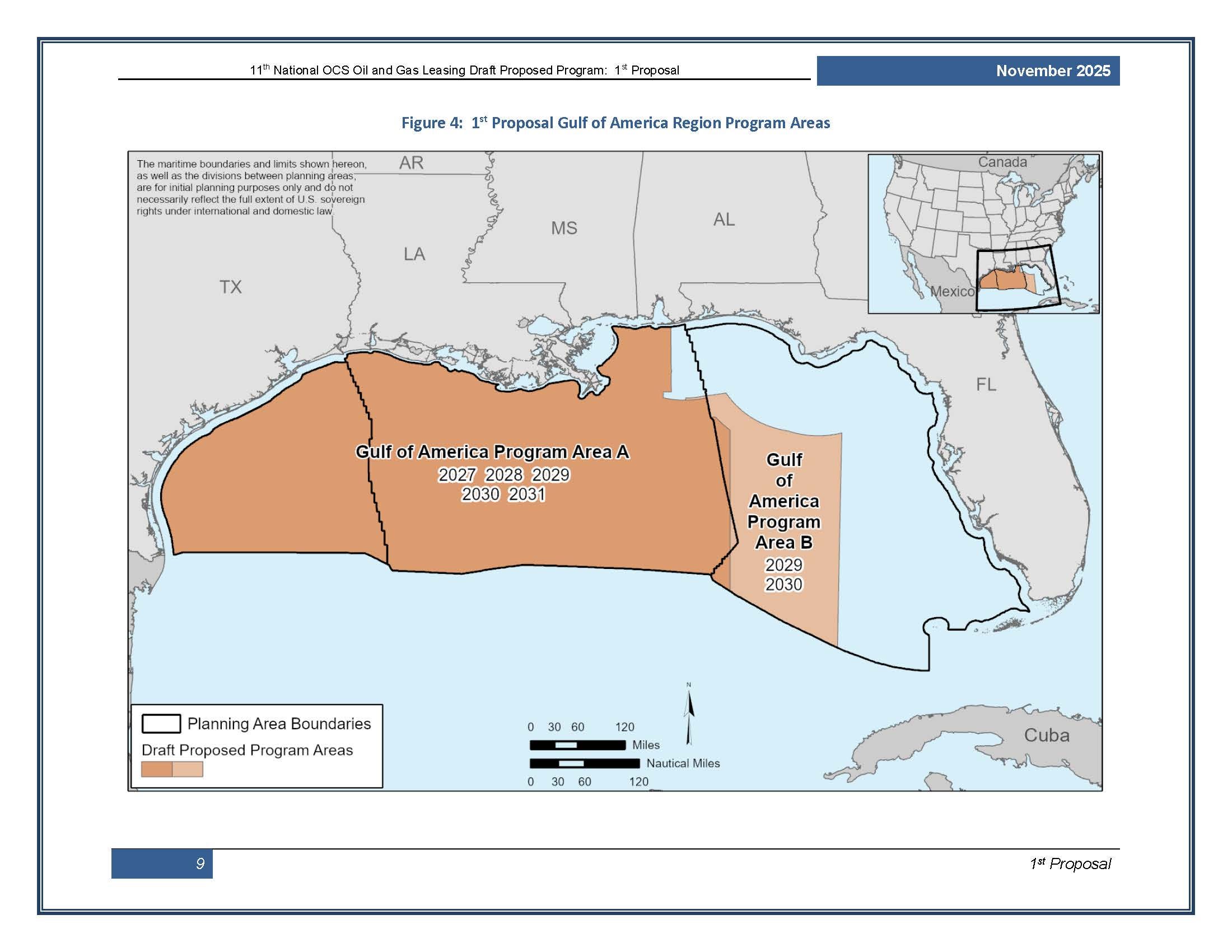
If the Bureau of Ocean Energy Management (BOEM) has its way, a significant portion of the Eastern Gulf, which has long been considered off-limits, could soon be opened to offshore drilling. A map released on November 20 outlines a proposal that would extend oil exploration and drilling opportunities east from the Alabama line across waters stretching along the entire Panhandle of Florida.
The area in question has been designated as "Program Area B" by BOEM. If this plan moves forward, it could bring drilling rigs as far as 100 miles offshore of coastal Florida. If the proposal remains unchanged, the Eastern Gulf could see offshore lease sales in 2029 and 2030.
Politicians and activists have quickly responded to the proposal, expressing deep concerns about its potential impact. Christian Wagley, a representative for Healthy Gulf in Florida, stated in an email that the organization is strongly opposed to the expansion of offshore drilling and plans to rally allies across the region to submit public comments against the plan.
"We have protected Florida in the past from drilling through a broad coalition of business, military, elected officials, and environmental voices," Wagley said. He also called on past supporters of preventing drilling off the coast to unite once again.
The 60-day public comment period, running from November 24 to January 24, 2026, presents an opportunity for local governments, businesses, and citizens to voice their concerns. They can submit resolutions, statements, and letters as part of the public comment process.
First District Congressman Jimmy Patronis joined several colleagues in expressing concerns over the plan in a letter to President Donald Trump. The letter addressed a small portion of the blocks available for lease under the Big Beautiful Gulf Lease Sale (BBGLS) 1 scheduled for December 10, 2025.
"These blocks within the Eastern Gulf Test and Training Range (EGTTR) impact the critical missions at Eglin Air Force Base, Hurlburt Field, Tyndall Air Force Base, and Naval Air Station Pensacola," the letter said. It emphasized the importance of the test and training range extending from Eglin Air Force Base into the Gulf.
"While we wholeheartedly support your push for American energy independence and expanded domestic oil and gas production, the Eastern Gulf Test and Training Range is critical to advanced weapons development, flight testing, and joint exercises essential to maintaining America’s military superiority," the letter added.
Gov. Ron DeSantis also voiced his opposition to the BOEM proposal, echoing the concerns raised by Patronis and other lawmakers. His office stressed the significance of the Eastern Gulf Test and Training Range and the value of the Trump administration's 2020 moratorium.
"Our administration supports the 2020 presidential memorandum and urges the Department of Interior to reconsider and to conform to the 2020 Trump Administration policy," the governor's office stated on X.
Information leaked ahead of the official release of the BOEM plan suggested that a "sliver" of the Eastern Gulf, now referred to as the Gulf of America by the U.S. government, might be targeted for drilling. When contacted by the Pensacola News Journal, Wagley said, "It's worse than we thought."
Is offshore drilling banned in Florida?
According to Wagley, the plan proposes drilling in areas of the Eastern Gulf where it has never been allowed before. These areas were previously declared off-limits to drilling by both Presidents Joe Biden and Trump. Drilling has never occurred off the East Coast of the United States, and it has been scaled back along the West Coast. The Eastern Gulf has traditionally been considered off-limits to drilling.
Wagley also highlighted the damage caused by the 2010 BP Deepwater Horizon oil spill, which affected Florida's coastline despite being over 100 miles from the coast.
"The Trump administration is threatening to impose offshore oil drilling on states, cities, and communities that have fought against it for decades," said Brettny Hardy, a senior attorney with Earthjustice. "Trump’s plan would risk the health and well-being of millions of people who live along our coasts. It would also devastate countless ocean ecosystems that both humans and wildlife rely on. This administration continues to put the oil industry above people, our shared environment, and the law."
In justifying its decision, the Department of the Interior acknowledged that the area it wants open to exploration includes activities related to military readiness, such as critical military training and testing operations, as well as commercial and recreational fishing, tourism, and shipping.
"The Gulf of American Outer Continental Shelf region has successfully managed multiple use conflicts for decades, allowing for the coexistence of oil and gas activities with military activities, commercial and recreational fishing, and tourism, among others, and can serve as a model for how to work closely with stakeholders in other regions to design mitigation measures and minimize conflicts to the extent possible," it said.
Which state has the most oil drilling?
Offshore oil production, primarily occurring in the Gulf, accounts for about 15% of U.S. crude oil production. However, Florida is not the largest producer. Texas leads the nation, accounting for more than 42% of domestic oil production.
In 2024, approximately 76% of total U.S. crude oil production came from six states: Texas, New Mexico, North Dakota, Colorado, Alaska, and Oklahoma. These states have had an established oil and gas industry for decades.
Florida contributes less than 0.1% of the U.S. total, ranking 22nd out of 31 states that produce oil.
Which state is the richest in oil?
Texas is by far the largest oil-producing state in the United States. In 2024, Texas produced over two billion barrels. New Mexico follows in second place with 744.6 million barrels. Virginia is the smallest oil-producing state, with three thousand barrels.

Post a Comment for "Trump's Oil Drilling Expansion Targets Florida's Eastern Gulf"
Post a Comment