
Death's Odor Haunts Sweida Days After Sectarian Violence
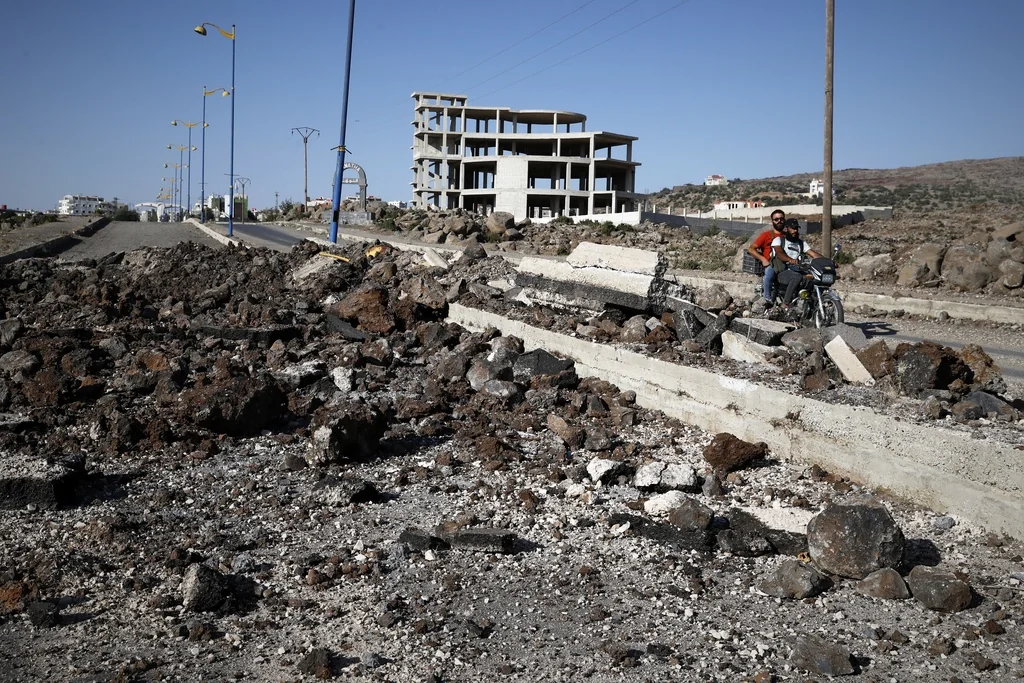
Devastation in Sweida, Syria
The air in Sweida, the capital of Syria’s southern province, is thick with the smell of decay. Once vibrant streets now stand eerily quiet, with only a few people moving through them. In certain parts of the city, the destruction is overwhelming, with buildings and vehicles reduced to blackened ruins. A bank branch lies in disarray, its floor covered in shattered glass, while an alarm continues to blare nonstop. Walls are marked with graffiti from both sides involved in the recent conflict.
This devastation followed violent clashes that erupted two weeks ago, triggered by a cycle of kidnappings between armed Bedouin clans and fighters from the Druze religious minority. The fighting resulted in hundreds of deaths and threatened to destabilize Syria’s fragile postwar recovery. Syrian government forces intervened, claiming to end the violence, but many believe they took sides with the clans. Reports suggest that some government fighters robbed and executed Druze civilians.
Associated Press journalists were able to enter Sweida on Friday for the first time since the violence began on July 13. With a ceasefire largely holding, residents are working to rebuild their lives.
Personal Tragedies Amidst the Chaos
At the main hospital, bodies of those killed in the fighting were piled up for days, and workers were still cleaning the floors, though the stench remained. Manal Harb was there with her wounded 19-year-old son, Safi Dargham, who was shot while volunteering at the overwhelmed hospital. “Snipers hit him in front of the hospital,” she said. “We are civilians and have no weapons.”
Safi suffered injuries to his elbow, behind his ear, and his leg. Harb fears he may lose his arm if he doesn’t receive urgent treatment. Her husband, Khaled Dargham, was killed when armed men stormed their home, shot him, and set it on fire. They also stole their phones and other belongings.
An emergency room nurse, known only as Em Hassib, said she stayed in the hospital with her children throughout the conflict. She alleged that government fighters brought to the hospital opened fire, killing a police officer and wounding another. While the AP could not verify this claim, she described how bodies piled up for days without anyone to remove them, creating a serious medical hazard.
Sectarian Tensions and Revenge Attacks
Videos and reports from Sweida show Druze civilians being humiliated and executed during the conflict, often accompanied by sectarian slurs. After the ceasefire, some Druze groups launched revenge attacks on Bedouin communities. The U.N. has reported that more than 130,000 people were displaced by the violence.
Government officials, including interim President Ahmad al-Sharaa, have promised to hold accountable those who targeted civilians, but many residents remain angry and skeptical. The Druze, an offshoot of Ismailism, a branch of Shiite Islam, number roughly a million worldwide, with more than half living in Syria. Others live in Lebanon and Israel, including in the Golan Heights, which Israel captured from Syria in 1967 and annexed in 1981.
While the Druze welcomed the fall of former President Bashar Assad in December, the new government under al-Sharaa, a former Islamist commander with ties to al-Qaida, drew mixed reactions. Some clerics supported engagement with the new leadership, while others, including spiritual leader Sheikh Hikmat al-Hijri, opposed it.
Resistance to Disarmament
Talal Jaramany, a 30-year-old Druze resort owner, took up arms during the fighting. “What pushed me to put on a military uniform and go to the front lines is that what happened was lawless,” he said. He insisted there was little distinction between the Bedouin clans and the government’s General Security forces. “They used weapons, not dialogue,” he said. He rejects calls for disarmament, saying the Druze need their weapons for self-defense.
“We won’t hand over our arms. Our weapon is sacred,” he said. “It’s not for attacking. We’ve never been supporters of war. We’ll only give it up when the state provides real security that protects human rights.”
Christian Survivors Tell Their Stories
Members of Sweida’s Christian minority were also caught in the violence. Walaa al-Shammas, a housewife, described how a rocket struck her home on July 16. “Had we not been sheltering in the hallway, we would’ve been gone,” she said. “My house lies in destruction and our cars are gone.”
In recent days, hundreds of people — including Bedouins, Druze, and Christians — have evacuated Sweida in convoys organized by the Syrian Red Crescent. Micheline Jaber, a public employee, was trying to flee the clashes with her family when their cars came under shelling. She was wounded, along with her mother-in-law and a young child, but survived. Her husband and other family members were killed.
Jaber now lives in Damascus, her arms bandaged. “When the shell hit the car, I came out alive — I was able to get out of the car and walk normally,” she said. “When you see all the people who died and I’m still here, I don’t understand it. God has His reasons.”

Post a Comment for "Death's Odor Haunts Sweida Days After Sectarian Violence"
Post a Comment