
Dollars and Sense: Mr. Shankle's Inspiring Approach Transforming Special Needs Lives
A Unique Approach to Teaching Special Needs Students
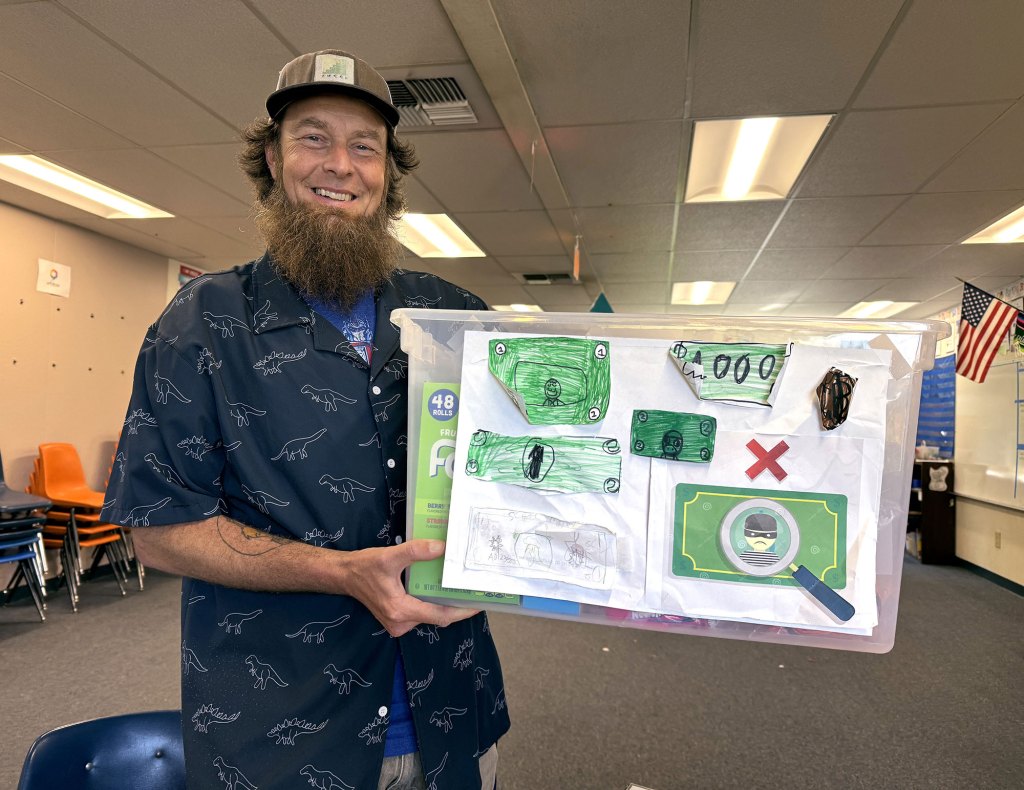
Logan Shankle, a dedicated teacher at Aromas School in San Benito County, has created a unique and effective system for his K-8 students with mild to moderate learning disabilities. His approach involves rewarding students with play money for achieving daily goals, which has led to an unexpected side effect: some students have started creating their own counterfeit bills. One student even attempted to pass off a fake Bitcoin, showcasing the creativity and engagement that Shankle's methods have sparked.
Shankle proudly displays these homemade creations on the side of a plastic bin filled with prizes such as snacks, stickers, juice boxes, and tickets for rewards like a few minutes with an iPad or a round at the basketball hoops. For Shankle, this is more than just a fun activity—it’s a sign that his students are connecting with the concept of learning and understanding tangible goals that often elude them in traditional grade systems.
Building Connections Through Positive Reinforcement
Shankle’s teaching philosophy is rooted in his 16 years of experience with Tucci Learning Solutions, a company that specializes in training educators and parents to support children with special needs. He uses the Competent Learner Model, which includes seven key areas to assess student progress: talker, observer, listener, problem solver, reader, writer, and participator. Each student is evaluated to identify gaps in their abilities, and Shankle works closely with families, sometimes visiting homes to better understand the child’s environment and build trust.
“The secret sauce is having the time with the families,” he said. “You need that moment when you say, ‘This is your child, this is my student. At the end of the day, we're both doing our best to help this student be better.’”
Rewarding Small Steps Toward Success
The expectations for each student vary based on their individual needs. Some may be asked to point to an object in a picture, while others might be required to identify it verbally. One student may work on completing a math problem, while another may only be asked to draw a given number.
Shankle’s play money system is a core part of his positive reinforcement strategy. Inspired by his mother’s work with Guide Dogs for the Blind, he uses operant conditioning to shape behavior and encourage progress. As students complete tasks, they receive verbal praise and gentle corrections when needed. Play dollars are awarded based on performance, with specific behaviors reinforced through encouragement and small corrections.
For example, if a student draws an "X" but misses the order of the lines, Shankle still rewards them, explaining the error and encouraging improvement. This approach helps students learn from mistakes while maintaining motivation.
Adapting Goals to Encourage Independence
As students become more familiar with tasks, Shankle gradually increases the difficulty. A student might start by cutting out a circle and gluing it to a sheet of paper, with scissors and glue within easy reach. If the student completes the task consistently with minimal prompting, the materials might be moved slightly further away, encouraging problem-solving skills.
“I’ll indicate that something is missing that we are looking for,” Shankle said. “I’m looking for that moment when they jump through the hoop, think, ‘I know what this dummy wants,’ and they go get the scissors.”
Throughout the lessons, Shankle keeps students informed of their progress, saying things like, “You've got $20! Way to go! You only need five more for a juice box!” This reinforces the importance of setting and achieving goals.
Fostering Life Skills and Trust
Shankle also focuses on improving life skills, such as remembering to take care of essentials like glasses. “If we don't find them,” he said, “what are we going to do? We have to have them. We reinforce that they should be there, but they're not. And that's a missed opportunity for them to have another dollar.”
Michelle Dougherty, the district’s director of special education, praised Shankle’s ability to connect with students and respond to their needs. “With the close relationships he makes with the students,” she said, “he can keep them on track and find things that are motivating for them. And he communicates well with the parents, which fosters trust between the family and the school.”
Supporting Families Beyond the Classroom
Adon Diaz, whose non-verbal son Gabriel benefits from Shankle’s methods, shared how the teacher has gone above and beyond. Shankle provided tools for home use, including a set of printed icons to help Gabriel express his needs. Before using the icons, Gabriel would often become frustrated and grab his parents because he couldn’t communicate his needs. Now, he uses the icon board to tell them what is wrong.
Diaz also appreciated Shankle’s availability, even on weekends. “He was always telling us to call him,” she said. “Sometimes we would do it just so Gabriel could hear his voice, which calms him and stimulates his mind. He always goes beyond to help.”

Post a Comment for "Dollars and Sense: Mr. Shankle's Inspiring Approach Transforming Special Needs Lives"
Post a Comment