
Astronomers Uncover New Planet Forming Around Young Star
A Groundbreaking Discovery in the Field of Astronomy
An international team of astronomers, including researchers from the University of Galway, has made a remarkable discovery that is reshaping our understanding of planetary formation. The team uncovered a new planet, which was detected during its early stages of development around a young star similar to our own Sun. This planet, named WISPIT 2b, is estimated to be about 5 million years old and is likely a gas giant comparable in size to Jupiter.
The study, led by Leiden University, the University of Galway, and the University of Arizona, was published in the Astrophysical Journal Letters. The discovery was made possible using one of the world’s most advanced observatories—the European Southern Observatory's Very Large Telescope (ESO's VLT) located in the Atacama Desert in Chile.
Dr. Christian Ginski, a lecturer at the School of Natural Sciences, University of Galway, and second author of the study, shared insights into the process. He explained that the team used short snapshot observations of many young stars—only a few minutes per object—to search for signs of planets. However, instead of finding a planet, they stumbled upon a multi-ringed dust disk, which sparked further investigation.
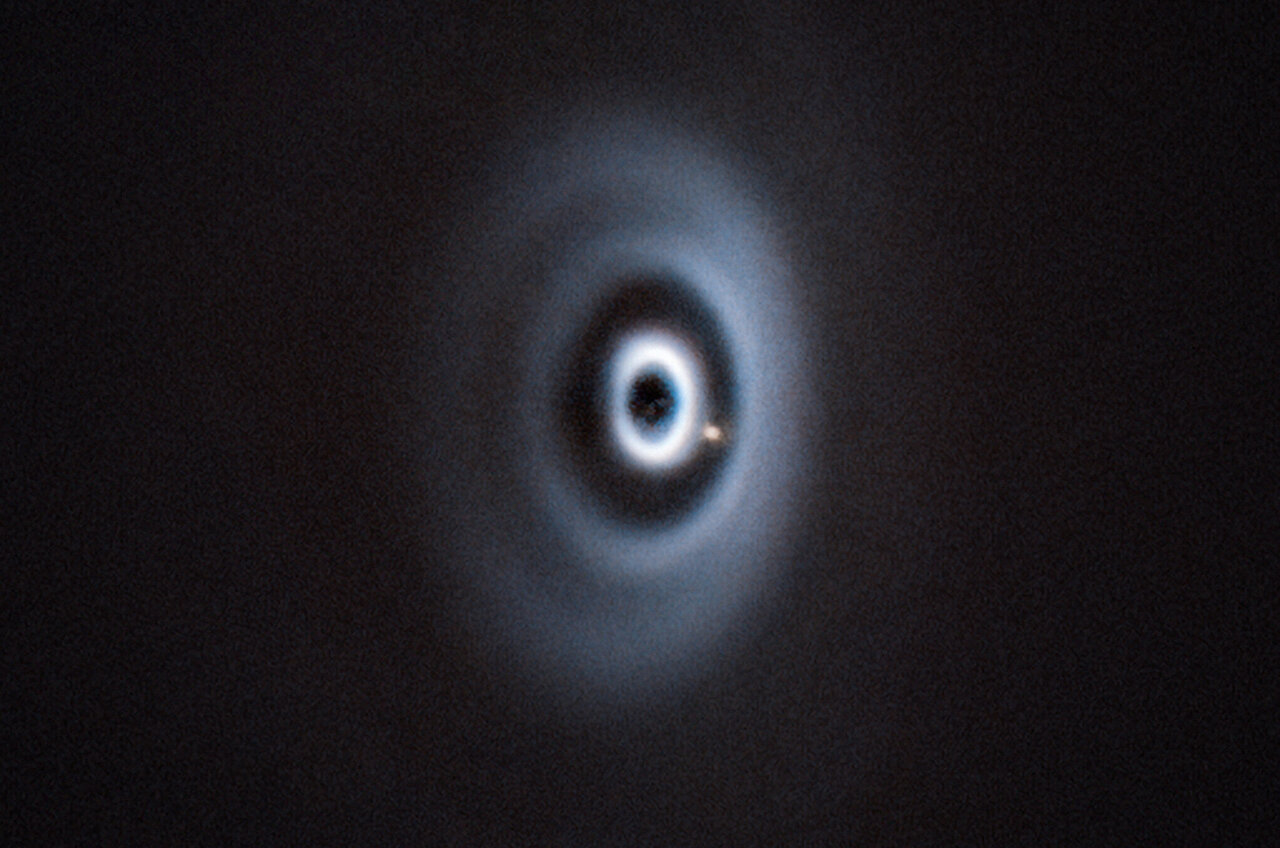
This discovery marks only the second time a confirmed planet has been detected at this early evolutionary stage around a young version of our Sun. The first such detection occurred in 2018, also involving Dr. Ginski. WISPIT 2b is also the first unambiguous planet detection within a multi-ringed disk, making it an ideal laboratory for studying how planets interact with their surrounding disks and evolve over time.
WISPIT 2b was captured in near-infrared light, which resembles what someone would see through night-vision goggles. This is because the planet is still hot and glowing after its initial formation phase. The team at Leiden University and the University of Galway managed to capture a stunning image of the young proto-planet embedded in a disk gap, confirming that it orbits its host star.
Additionally, a team from the University of Arizona detected the planet in visible light using a specially designed instrument. This detection at a specific wavelength indicates that the planet is actively accreting gas as it forms its atmosphere.
The discovery was part of a five-year observational research project aimed at determining whether wide-orbit gas giant planets are more common around younger or older stars. This effort led to the unexpected detection of WISPIT 2b.
Dust and gas-rich disks around young stars serve as the birthplaces of planets. These disks can display intricate structures like rings and spiral arms, which scientists believe are linked to the formation of planets within them. The disk surrounding WISPIT 2b has a radius of 380 astronomical units—about 380 times the distance between Earth and the Sun.
Dr. Ginski emphasized the significance of capturing images of forming planets, stating that it provides a unique opportunity to understand the diversity of exoplanet systems and why they differ from our own solar system. He believes many colleagues studying planet formation will closely examine this system in the coming years.
The study was led by Richelle van Capelleveen, an early career Ph.D. student from Leiden University, and co-led by a graduate student team at the University of Galway. The research findings were co-authored by Dr. Ginski and three Physics graduate students specializing in Astrophysics at the University of Galway.
A companion study by the University of Arizona was led by Professor Laird Close, with observations triggered based on information shared by the University of Galway and Leiden University team.
Van Capelleveen expressed her excitement about the discovery, noting that WISPIT 2, a young version of our Sun, is located in a little-studied group of young stars. She believes this system will serve as a benchmark for future research.
Dr. Ginski highlighted the importance of having these young researchers involved, emphasizing that they represent the next generation of astrophysicists who will make further breakthroughs.
Chloe Lawlor, a Ph.D. student at the University of Galway, described her involvement in the discovery as an incredible opportunity. She sees WISPIT 2b as a valuable example for exploring current planet formation models.
Jake Byrne, an MSc student at the University of Galway, expressed his amazement at the discovery, noting that it could spark significant discussion within the research community and advance our understanding of planet formation.
Dan McLachlan, another MSc student at the University of Galway, reflected on the experience, stating that being part of such a groundbreaking project was a mind-blowing opportunity. He praised the support provided by the University of Galway Physics department and his supervisor, Dr. Christian Ginski.
This discovery not only adds to our knowledge of planetary formation but also highlights the collaborative efforts of international teams in pushing the boundaries of astronomy.

Post a Comment for "Astronomers Uncover New Planet Forming Around Young Star"
Post a Comment