
Boulder image quality lab studying racial bias in consumer cameras
Imaging researchers know racial bias isn't a new concept in photography.
"Even with modern cameras, a lot of times, different skin tones aren’t represented well," Meg Borek, an imaging scientist, said. "This is something that dates all the way back to film photography, where film has always been targeted for lighter skin tones, and it’s something that’s just perpetuated to digital photography as well."
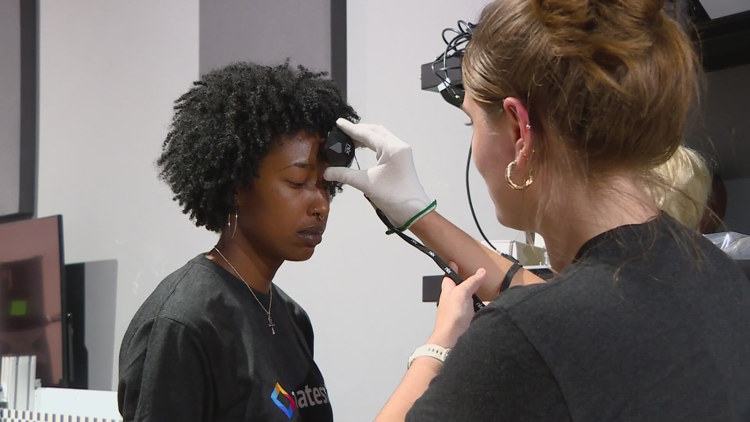
Borek is currently working on a skin tone study at Imatest, an image-quality lab in Boulder. The study looks at different skin tones under different lighting with different cameras.
"Part of our role here is creating test targets for camera makers and people who design cameras and the workflow that goes into them," Borek said. "So by having a standardized test target, that allows them to test their cameras and properties across a wide range of skin tones, is ideally going to help different cameras being created, whether it’s in smartphones, web cams, or whatever else, be better at representing different skin tones."
Borek said the study is based on the Monk Skin Tone Scale, developed by Dr. Ellis Monk of Harvard.
"It’s basically meant to be a better representation of the actual skin tones," Borek said.
Before the Monk Scale, the Fitzpatrick Scale was more commonly used in skin tone studies. It was eventually criticized for its lack of diverse representation and catering to lighter skin tones.
"One thing that I noticed as a professor, as a researcher, was that some of the most dominant, most commonly used measures of skin tone had some very serious flaws to them," Dr. Monk explained. "Either the different tones represented on the scale were not quite what I thought was accurate or faithful enough to the different skin tones we tend to encounter out in the world or there were other issues around, like just how many points on the scale even existed for people to have options to choose the different skin tones when we're measuring the different skin tones in these studies."
He added the historical context of "Shirley" cards that were used by Kodak also did not set the standard for equal representation on film.
"One of the main issues in skin tone imaging was something that was called a Shirley card that Kodak used, which was this calibration card, a picture of a white woman that they called Shirley," Monk shared. "And the whole idea was, at Kodak, if it looked good for Shirley, then it looked good for everyone. And that, of course, you know, in 2025 and even prior to that, people know that's not quite the case. But that means color photography was something that was calibrated with a white woman, and other skin tones were not really involved with that.
Monk said he began working on his scale around 2019. He said he focuses his studies on skin tones and inequalities in health and technology.
"There is this relationship between skin tone and all these different inequalities, health and wealth, the criminal justice system and all these sorts of things," Monk said. "But in order to make that case really clear, you need to have a really strong measure of skin tone that does a really good job of tapping into those differences in skin tone that we see out in the world. And if we have a measure that doesn't really do that, then we might not actually pick up on these inequalities."
Monk said he was eventually approached by Google, which wanted to implement his scale into its Pixel camera phone and AI-tech development.
"The Pixel camera phone has been far better than many other competitors in terms of how it measures and handles skin tone," Monk said. "One of the reasons for that is the adoption of my scale, which expanded the range of skin tones that the technology was forced to be able to deal with the pixel camera phone."
This adoption is what Imatest hopes to see more of from the clients they serve.
"If anything else, I hope that we can inspire the companies that are kind of developing these cameras and pipelines to actually test across a broad range of skin tones," Borek said. "Cameras are in our everyday lives. This is affecting things like cell phones and webcams, but you get into things like security and medical, where being able to properly represent skin tones is really important."
Monk said he hopes to continue to expand his scale use to include medical devices, like oximeters. He said he is having conversations with the International Standards Organization and the U.S. Food and Drug Administration about creating new regulatory standards for using his scale when skin tone is relevant to certain technology.
"One of the issues in pulse oximetry has been that those devices, the idea is that they don't work equally well across the entire skin tone spectrum," Monk said. "Particularly if you have darker skin, research has shown that it actually overestimates your blood oxygen level. So practically, that would mean that the device could say you're 97, but in reality, maybe you're a 93 or 94, and that becomes clinically relevant, because people are making decisions in hospitals, right? Nurses and doctors are making decisions that ride on these devices, being accurate and being very precise as well."
Monk said this part of his research is being done on a $2.5M grant from the National Institute of Health. He said, in response to questions about maintaining federal funding, continued financial support is up in the air.
"If we don't take skin tone seriously from a measurement point of view, then that means we're not going to understand the inequalities linked to skin tone and it means that technologies that are developed where skin tone is important, they're not going to work equally well across the different skin tones because that means those forms of technology are literally not seeing skin tone correctly," Monk said.
The advancement of Borek's study is also dependent on funding. She said, if possible, she would like to invite the models photographed in the first round of data collection back to the lab. She said she wants to test them against the new test charts created from this current round of photographs.
"We’re basically hoping to apply what we learn to actual photographic test charts that represent these same skin tones," Borek said. "So we want to be able to create test charts that are standardized that can be used in a fixed or automated lab setting by a lot of these camera companies that actually correlate or correspond to skin in those different situations."
Borek said she hopes to finish this round of data collection by the end of August.

Post a Comment for "Boulder image quality lab studying racial bias in consumer cameras"
Post a Comment