
Crush Them All, Chevrolet Claimed — But One 1983 Corvette Survived
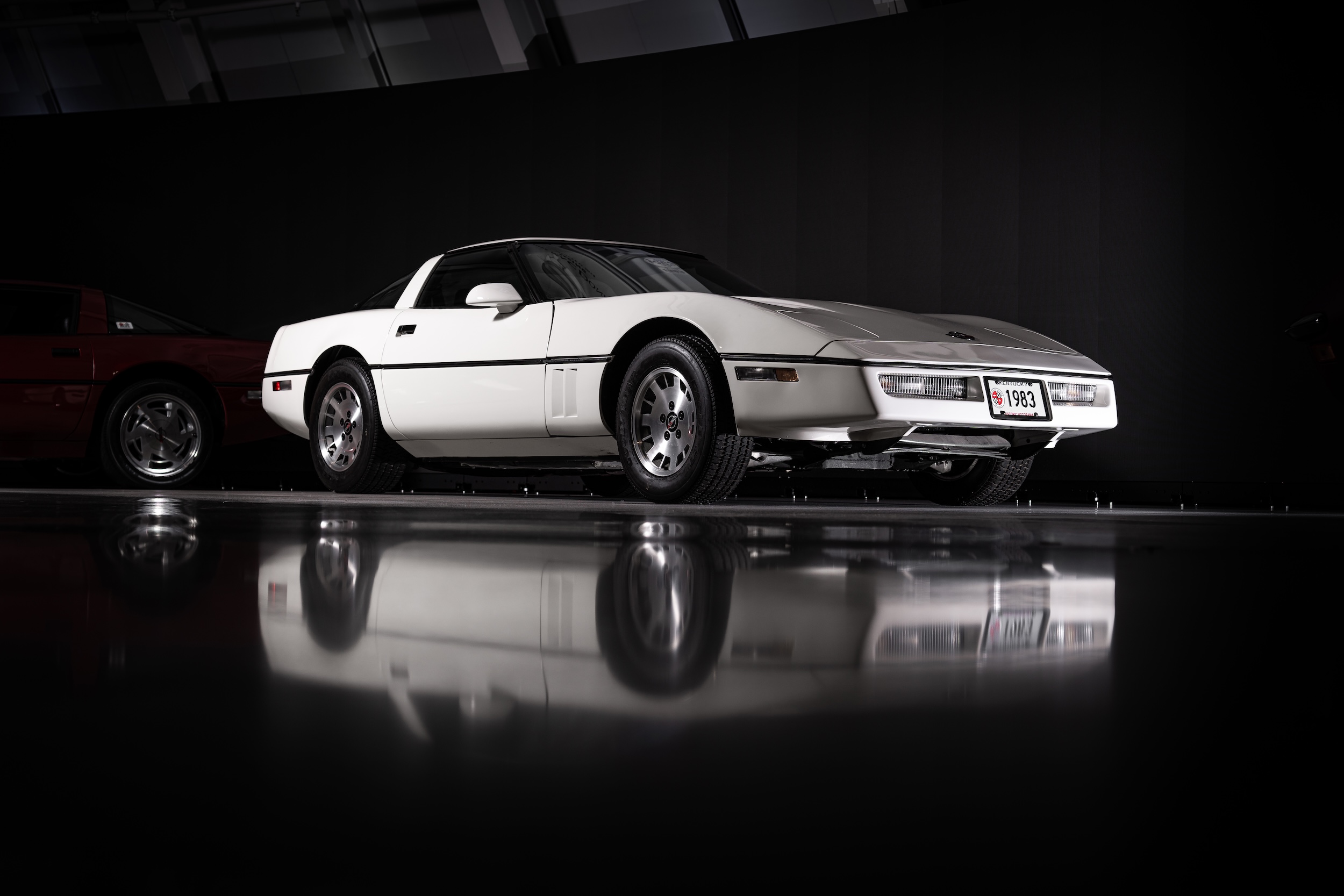
The Strange Tale of the 1983 Corvette That Shouldn’t Exist
In 1982, veteran writer and Hagerty contributor Gary Witzenburg attended the press preview for the all-new 1983 Chevrolet Corvette at California’s Riverside Raceway. He still has a souvenir “1983 Corvette” ashtray to prove it. However, there was no such thing as a 1983 Corvette. This is the story of one of the most unusual and pivotal moments in the car’s history.
C4 Development: A New Era for the Corvette
The C4 Corvette was a complete and dramatic redesign. After nearly two decades of three generations (C1, C2, and C3) of a quick and sexy but structurally crude car, chief engineer Dave McLellan’s team designed an ambitious new model. The C4 was meant to be substantially better and fully competitive with its rivals in the sports car market.
Initially intended as a 1982 model, the new car was 8.5 inches shorter, two inches wider, and about 150 pounds lighter than the body-on-frame C3 it would replace. It featured an integral body and chassis, with a wheelbase that was two inches shorter, using transverse leaf springs front and rear.
But the C4’s radical development process pushed its production launch to the fall of 1982 as a 1983 model. This was significant because it marked the Corvette’s 30th birthday. To give the holdover C3 a suitable sendoff, Chevrolet created a “Collector Edition” ’82 Corvette. It had features like “Cross-Fire” fuel injection, a new four-speed automatic transmission, and a one-piece frameless glass hatchback. It also had special silver-beige clearcoat paint and a matching leather interior. Chevrolet built 6,759 Collector Edition models, which cost $22,537—compared to the base car’s price of $18,290.
The Radical Changes and Their Consequences
Work quickly shifted back to the 1983 C4 model. One of the most significant changes was the decision to switch from a two-piece T-top to a one-piece removable “Targa” roof panel, similar to Porsche’s 911 Targa and Ferrari’s 308 GTS. This seemingly simple change required a major structural redesign, leading to taller side rails and higher door sills, making it harder to get in and out of the car.
Bowling Green, working toward a planned fall launch of what were intended to be 1983 30th Anniversary C4 Corvettes, had started building those validation cars in mid-1982. However, some key pieces were still delayed, emissions certification and structural development were ongoing, and those early examples were too rough and crude to be released to market. The early build was halted at just 44 cars.
The Lucky Lone Survivor
Ralph Montileone, the plant’s quality manager, was ordered to destroy all 44 of the 1983 Corvette “validation” cars. He dutifully did so, except for one white car. How did it survive?
Montileone recalled getting the order to destroy them. He said, “They had so many issues that they just could not have been released.” There were government emissions issues, body fit problems, and instrumentation issues. The instructions given to him were to make them all go away, following a formal General Motors procedure.
Automotive magazines were already printing breathless stories predicting great things for the all-new 1983 Corvette, so GM knew the launch had to be perfect. At that point, it wasn’t. Montileone realized how many issues the vehicle had and decided to delay the launch again. “If that major model change had failed, it could have been the death of the Corvette.”
He had already completed the required paperwork. They brought the 44 cars in, used a dye grinder to cut the windshield and remove the VIN plates, then turned them into the finance department. The cars were moved to a portable crusher stationed there temporarily.
But on the day when he was down to one last car, it began pouring rain. The last white ‘83 Vette was sitting out in about three inches of water. Montileone had on brand new cowboy boots, which cost $200, and he figured he could go out and get the car once the water went down. But by the next morning, word had spread that all the ‘83s had been crushed, and the mobile crusher was gone. He moved the white car to a different location, leading to the impression that all the ’83s had been disposed of.
From Plant to Museum
The lone ’83 Corvette sat out behind the plant for several years. There were closed-door office discussions about Montileone not getting his job done, and he never let that happen again. Over the next few years, upper management changed, a new plant manager came in, and Montileone was transferred to Cadillac in Detroit.
The new plant manager didn’t know why this old engineering vehicle was sitting out back. He decided to keep it and parked it inside at the plant’s tour entrance. Then the National Corvette Museum came along, and GM donated it to be displayed at the museum.
A Rare Appearance
In a rare appearance outside the Corvette Museum, this one-and-only 1983 Corvette, since repainted to its original white, joined 69 other Corvettes, one for each model year, at the 2023 Woodward Dream Show “70 Years of Corvette” display at the M1 Concourse in Pontiac, Michigan.
Why Did Chevrolet Skip the 1983 Model?
There are multiple explanations as to why Chevrolet decided to skip the 1983-model Corvette and the car’s critical 30th anniversary. According to chief engineer McLellan, “It was a big changeover at Bowling Green,” and some major components weren’t available until after the first of the year. The EPA rule states that the model year can only have one January 1st in it, so if you start on January 2nd, the first January 1st is the following year. The company considered building 1983-model cars for seven months, then changing all the paperwork to ’84, but opted not to do that.
This is the story of a car that should have never existed—and yet, it did.

Post a Comment for "Crush Them All, Chevrolet Claimed — But One 1983 Corvette Survived"
Post a Comment