
Is the 3I/ATLAS Comet Alien Technology? No.
The Unusual Case of 3I/ATLAS
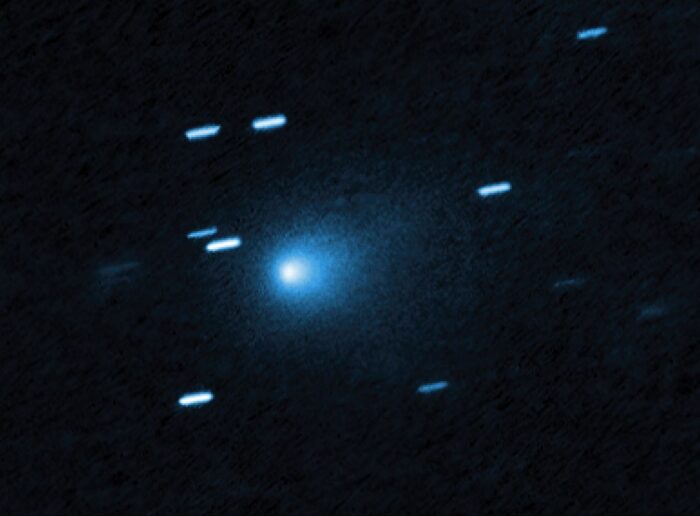
Named 3I/ATLAS, this comet is the third interstellar visitor to our solar system observed by astronomers. By the end of the month, it will pass behind Mars and disappear from view, only to reappear in December. With a size ranging between 5.6 kilometers and 320 meters, 3I/ATLAS is moving at an astonishing speed of 209,000 kilometers per hour. That’s fast enough to travel from Earth to the Moon in about an hour and a half.
For most scientists, the opportunity to observe 3I/ATLAS is a chance to refine our understanding of objects that pass through our solar system. However, for Avi Loeb, a Harvard physicist known for his controversial views, the comet represents something more: the possibility of intelligent extraterrestrial life.
An Alien Emissary?
Loeb was quick to jump on the story of 3I/ATLAS, questioning whether it was a comet or "something else" just days after its discovery. Two weeks later, he released a preprint paper suggesting the object might be of alien origin. He outlined several points, including the fact that the comet's orbital plane is very close to Earth's, within five degrees, which he considered a remarkable coincidence. He also noted that the object is unusually large, over 20 kilometers in diameter, which is rare for a comet. Additionally, he pointed out that the comet would pass near Venus, Jupiter, and Mars, another unlikely coincidence. Finally, he claimed there was no clear evidence of the gas trail expected from a comet.
Using the "Dark Forest" solution to the Fermi Paradox, Loeb suggested that the intelligence behind 3I/ATLAS could be malicious and planning to target Earth. He theorized that the comet’s path would take it behind the Sun, hiding it from Earth, and then use the Sun's gravity to swing back toward Earth, possibly with destructive intent.
A Controversial Theory
Loeb has been publishing blog posts almost daily on Medium, outlining his theories as more information emerges about 3I/ATLAS. However, other astronomers and even NASA have provided information that debunks his theories.
Loeb himself is not entirely committed to his theory. In the recent paper, he and his colleagues state they "do not necessarily ascribe" to the theory but feel it is "an interesting exercise in its own right, and is fun to pursue."
This isn't the first time Loeb has proposed such ideas. In 2017, he suggested that 'Oumuamua, the first confirmed interstellar object, might be artificial. He asked radio astronomers to look for alien signals, but none were found. Three years earlier, he thought a meteor might be the wreckage of an alien spaceship, citing seismic data. A team led by Benjamin Fernando later found the cause of the readings: a truck passing by the sensor.
A History of Skepticism
In a follow-up interview with The New York Times, Fernando highlighted two key takeaways: one, if you want to do seismic analysis, it's best to consult a seismologist first. The second is, it's not aliens. This point explains why Loeb's theories have faced so much skepticism from fellow astronomers. Loeb is not an expert in the fields he discusses, and his claims often lack scientific rigor.
Once respected in his field, Loeb's papers now mostly remain in preprint, with colleagues like Professor of Astrophysics Steve Desch criticizing his work as "conflating the good science we do with this ridiculous sensationalism."
The Comet’s True Nature
The more we learn about 3I/ATLAS, the more absurd Loeb's claims seem. For example, the comet is not nearly as large as he claimed. Observations from the Hubble telescope show it is around 2.8 kilometers, far smaller than his initial estimate of 46 kilometers. Loeb himself cited the paper showing this, yet chose to ignore it.
Other astronomers are unimpressed with the science behind his bold theories. Desch called the paper "sloppy work beneath the level of an undergraduate."
A Comet Like Any Other
Despite the controversy, the comet does have interesting properties. It comes from outside our solar system and may have a different chemical composition than what we typically see. However, Tom Statler, NASA's lead scientist for solar system small bodies, told The Guardian, "It looks like a comet...It does comet things. It very, very strongly resembles, in just about every way, the comets that we know. It's a comet."
Statler agreed that the comet brightens strangely, but explained that this is normal for comets. As they approach the Sun, the heat melts ice, causing changes in size, brightness, and composition.
A Divisive Debate
It isn’t just skeptics dismissing Loeb’s ideas. Many scientists who criticize him are from institutes like SETI, which is dedicated to the search for extraterrestrial life. They believe Loeb’s attention-grabbing, unsupported claims discredit the entire field, making it harder to conduct real science.
You can follow the comet's path live on NASA's website.

Post a Comment for "Is the 3I/ATLAS Comet Alien Technology? No."
Post a Comment