
NYC faces a tough choice: What to do with trucks
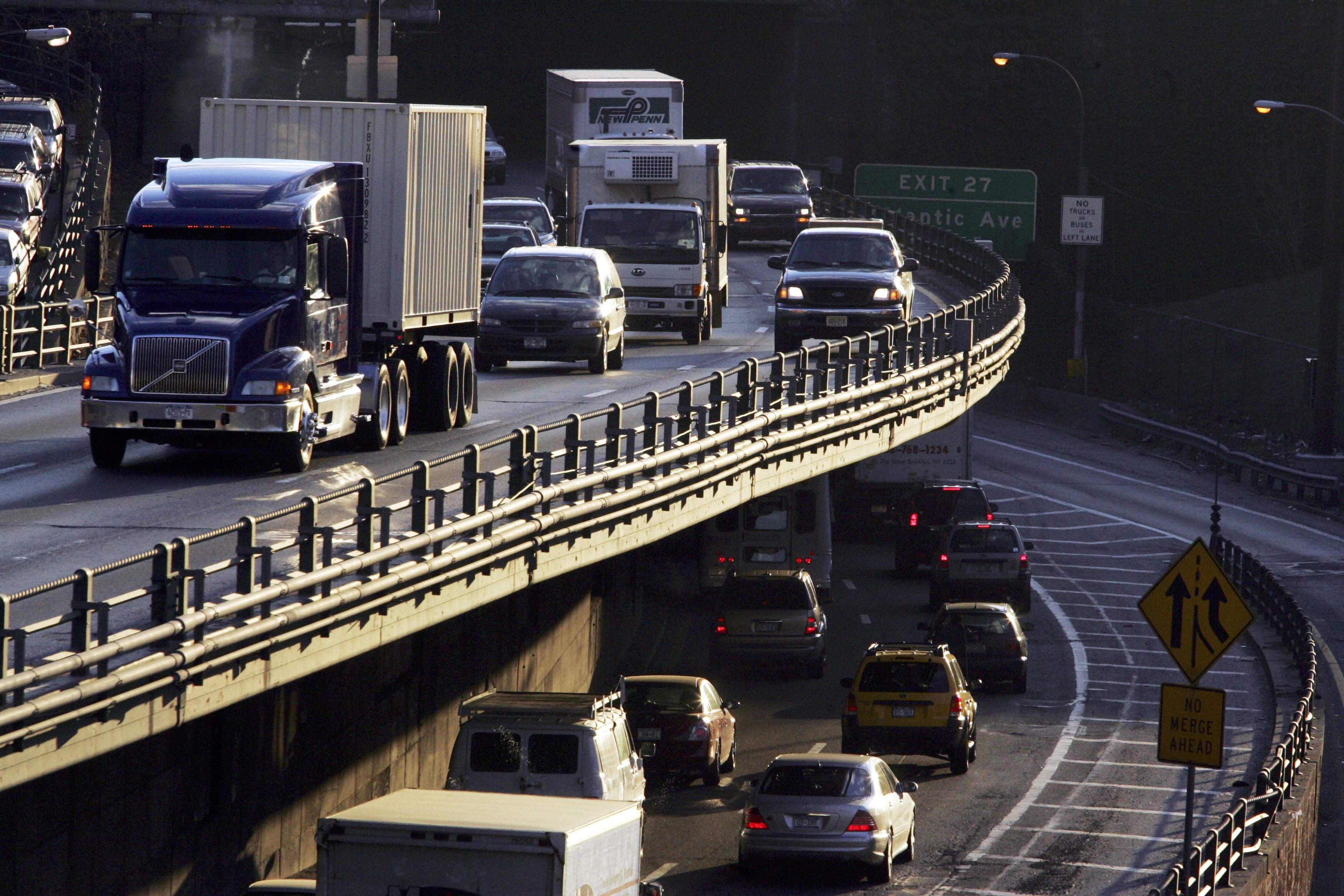
The Brooklyn-Queens Expressway: A Struggling Arterial
Since the late 2010s, it has been evident that the Brooklyn-Queens Expressway (BQE), a critical artery for freight and car traffic in New York City, is at risk of collapse. Sections of concrete have been falling off the “triple cantilever,” a 1.5-mile-long structure of highway decks built by renowned city planner Robert Moses in 1948. A 2019 study identified the main cause: heavy tractor-trailers and trucks. Approximately 13,000 freight vehicles use the BQE daily, with a tenth being 18-wheelers weighing over 40 tons—some nearly double that. These weights far exceed what the mid-century infrastructure was designed to handle.
In 2019, a panel of experts deliberated on two reconstruction options: adding more lanes or reducing the structure’s size. While the panel favored the latter, City Hall opted for a third solution: extending the lifespan of the BQE by another 20 years. This led to a new $5 billion plan to completely replace the structure, though it depends on federal funding that has yet to be secured.
An immediate fix emerged from this situation. In 2021, the state authorized the city’s Department of Transportation (NYCDOT) to implement “weigh-in-motion” technology, which photographs and automatically tickets overweight trucks. This made New York the first U.S. city to adopt such a system.
Four years later, the $650 fines issued by these devices have shown promising results. The number of overweight trucks in the northbound lanes dropped by 60%, from about 8,000 to 3,000 per month. This success prompted Albany to renew and expand the authorization for five more years, allowing NYCDOT to target heavy loads on nine sites, including the BQE’s southbound lane.
The Rise of Weigh-In-Motion Technology
Weigh-in-motion (WIM) systems are not a new concept. They have long been used at weigh stations along highways, where trucks can pull over for inspection. However, New York City's approach was unique in combining existing truck-scale technology with a ticketing mechanism. This required proving the system’s accuracy for direct enforcement. Fortunately, the city already had a robust automated enforcement program, including over 2,000 speed- and red-light cameras.
Tanvi Pandya, a NYCDOT executive overseeing BQE work, noted that enforcing truck weight limits in urban environments has historically been challenging. “This technology takes that out of the mix,” she said.
The importance of truck weight enforcement cannot be overstated. A typical semi-truck weighs around 10,000 pounds without cargo, but loaded trailers can be eight to ten times heavier. While the Federal Highway Administration sets an 80,000-pound limit, state regulations vary, with some permits allowing up to 150,000 pounds. This places immense pressure on roadways and bridges.
Beyond weight, big trucks pose safety risks due to their limited braking ability and blind spots. They also contribute significantly to pollution through diesel emissions, brake and tire wear, and noise.
Scaling Up and Challenges
Despite efforts to manage truck traffic, enforcement remains inconsistent. Many drivers unknowingly violate rules, following routes suggested by apps like Google Maps or Waze. Police officials have also shown a lack of awareness about designated truck routes.
Hank Gutman, a former NYCDOT commissioner, emphasized the significance of WIM as a breakthrough. “It’s a no-brainer,” he said. However, he cautioned that some trucks bypass sensors to avoid detection, highlighting the need for better coordination between city and state regulations.
Trucking associations have raised concerns about the gap between city and state rules. Gian Marco DeFilippis, a spokesperson for the Trucking Association of New York, noted that drivers can quickly move from compliant to non-compliant status, even with a state permit. The association advocates for easier permitting and clearer appeal processes for fines.
The Broader Implications
The BQE’s challenges reflect a larger issue: how cities can coexist with the trucks they depend on. About 90% of goods in New York City arrive via truck, placing increasing strain on aging infrastructure. Historically, these thoroughfares were routed through urban centers, creating conflicts with residential areas.
Gutman stressed the need for a comprehensive plan to reduce reliance on oversized trucks. “The WIM thing has to fit into a larger vision for reimagining freight deliveries in our city,” he said.
National Standards and Political Considerations
NYCDOT officials have called for national standards in truck regulation enforcement, emphasizing the need for consistency. Currently, no such standards exist, and the agency aims to push for their inclusion in federal guidelines.
Automated enforcement faces political challenges. While it can improve safety and maintenance, its use has become increasingly politicized. For example, Republican-dominated states like Texas have banned local jurisdictions from installing speed cameras.
Norway offers a useful case study, with high adoption rates of automated traffic enforcement. Mark Talbot of Q-Free highlighted the importance of trust in the technology, ensuring accuracy and transparency.
Environmental Justice and Future Plans
The BQE has long been criticized for its impact on low-income communities, particularly in Brooklyn. It has been a symbol of urban highways that displace residents and contribute to environmental harm. Kevin Garcia of the New York City Environmental Justice Alliance argues that reducing truck dependency is crucial.
While initiatives like the “Blue Highways” program aim to shift freight to waterways, and e-bikes are gaining popularity for local deliveries, these solutions are still in early stages. For now, the BQE remains a vital but overburdened corridor.
Environmental justice groups continue to advocate for a public-led redesign of the BQE, hoping for a future that prioritizes community well-being and sustainability. As Garcia noted, “We want to make sure that the city is listening to the communities that live along the corridor.”

Post a Comment for "NYC faces a tough choice: What to do with trucks"
Post a Comment