
Russell 2000 Surges: History Suggests Big Gains Ahead
The Russell 2000’s Surprising Comeback
For much of the past three years, small-cap stocks have been the overlooked segment of the financial market. These companies, often more sensitive to economic fluctuations and reliant on debt, were largely ignored by investors during periods of uncertainty. However, this changed recently as the Russell 2000, a key benchmark for small-cap stocks, made a dramatic resurgence.
After the initial surge in 2020 and 2021, when the index rose nearly 150%, the market faced a different challenge. Inflationary pressures led to aggressive interest rate hikes by the Federal Reserve, which had a significant impact on small-cap stocks. These companies, typically more vulnerable to rising rates, struggled through 2022 and into 2023. Even as the S&P 500 and Nasdaq reached new heights driven by AI enthusiasm, small caps remained stagnant, further burdened by trade tensions and tariffs.
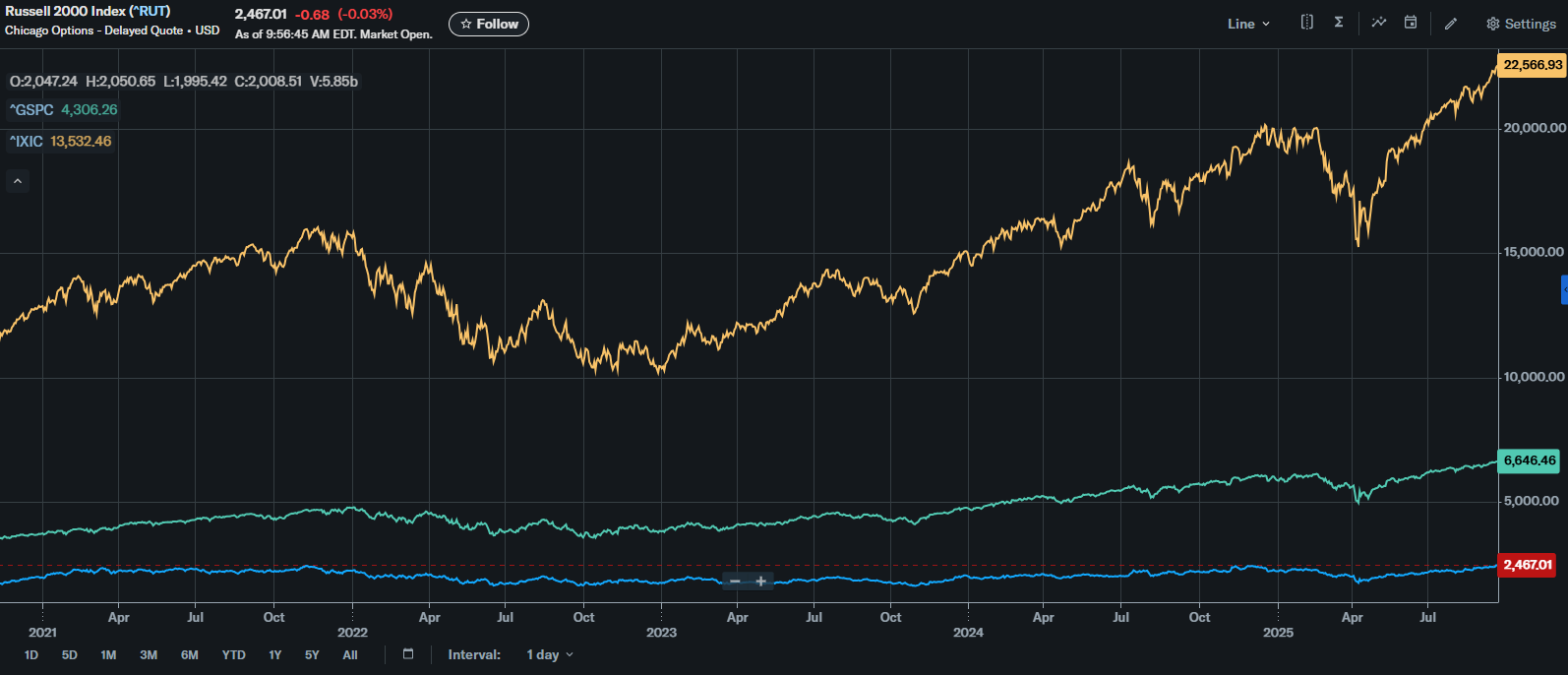
This period of underperformance lasted nearly four years, with the Russell 2000 stuck in a prolonged slump. But this week marked a turning point. The index climbed over 2.5% to reach 2,468, surpassing its previous record high of 2,443 set in November 2021. This breakout was fueled by a combination of factors, including rate cuts, stable inflation, reduced tariff threats, and the potential for economic deregulation.
A Major Indicator for the Broader Market
The Russell 2000's recent performance is more than just a win for small-cap investors—it signals a broader shift in market sentiment. Historically, small-cap stocks have acted as a barometer for investor confidence. When these stocks rise, it often indicates that risk appetite is high, credit concerns are low, and expectations for growth are strong. This positive environment tends to benefit the entire stock market.
Analyzing historical data from 1980, we found that whenever the Russell 2000 hit a new all-time high after being stagnant for over a year, the S&P 500 typically performed well in the following year. Out of 11 such instances, the S&P 500 was higher in 10 cases, with an average return of about 15%. This pattern suggests that the current breakout could be the start of a significant rally across the broader market.
AI and Small Caps: A Powerful Combination
While the Russell 2000's success is a broad-market signal, the most substantial gains are likely to come from the technology sector, particularly in AI stocks. Recent developments highlight the accelerating momentum in AI:
- Nvidia invested $5 billion into Intel to accelerate AI data center chip development.
- Microsoft committed $4 billion to build a new AI data center in Wisconsin.
- Palantir signed a £1.5 billion AI partnership with the U.K. government.
- CrowdStrike unveiled AI-powered cybersecurity products at its Las Vegas conference.
- Rigetti Computing secured a $5.8 million contract with the U.S. Air Force for quantum AI work.
- Meta introduced futuristic AI glasses with holographic displays.
These announcements reflect a global wave of innovation and investment in AI, which is reshaping industries and creating new opportunities. While the headlines focus on big tech giants, the real value creation often comes from smaller companies that supply critical components. These firms, much like chipmakers during the PC revolution, are positioned to benefit significantly from the widespread adoption of AI technologies.
The Future of Humanoid Robotics
One of the most promising areas within the AI space is humanoid robotics. Goldman Sachs projects the global humanoid robot market could reach $38 billion by 2035, while Fortune Business Insights estimates it could grow to $66 billion by 2032. This emerging field has the potential to transform various sectors, from manufacturing to healthcare and even household tasks.
Investors who recognize the long-term potential of this trend could find lucrative opportunities in companies that produce essential components such as actuators, sensors, and AI control systems. As companies like Tesla ramp up their humanoid projects, these suppliers stand to gain from every sale, contract, and deployment.
With the Russell 2000 finally breaking out and the AI industry gaining momentum, the stage is set for a significant market rally. For those looking to capitalize on this trend, focusing on AI and its supporting technologies may offer the best chance for substantial returns.

Post a Comment for "Russell 2000 Surges: History Suggests Big Gains Ahead"
Post a Comment