
The US Drone Dilemma: Falling Behind in the Modern Battlefield
The Rise of Drone Warfare in Modern Military Strategy
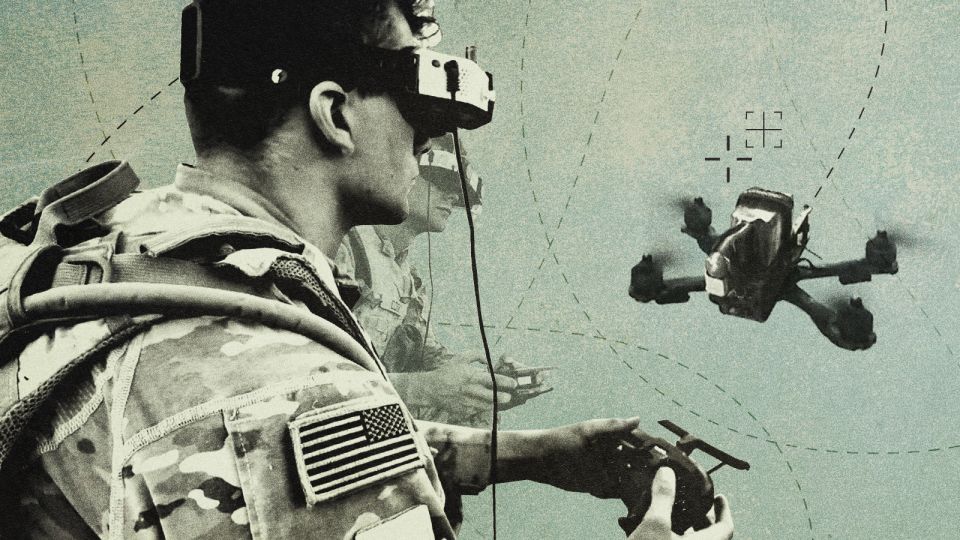
The future of warfare is increasingly resembling a video game, where soldiers don virtual-reality glasses and maneuver joysticks to control small drones. This was the scene at a military base in Texas last month, where American soldiers trained on operating small quadcopters that have become central to modern combat, particularly in Ukraine. These drones, costing less than $1,000, can destroy expensive military equipment like tanks, highlighting their growing importance on the battlefield.
At Fort Bliss in El Paso, members of the Multi-functional Reconnaissance Company, 6-1 Cavalry Regiment, were still learning how to use these systems effectively. For the U.S. military, this lag in drone technology is a pressing issue. Russia’s invasion of Ukraine has accelerated the evolution of drone warfare, leaving the U.S. behind in some aspects. While the U.S. excels in producing large, high-cost weapons such as fighter jets and precision-guided missiles, it struggles to quickly manufacture large quantities of small, affordable drones.
Defense officials are now working to catch up. In July, Secretary of Defense Pete Hegseth issued a memo urging the acceleration of drone adoption within the military. Recent efforts include training troops on simulators that mimic video games, allowing them to learn how to guide drones through complex environments. Maj. Gen. Curt Taylor, commander of the U.S. Army’s 1st Armored Division, emphasized that drone warfare is no longer a distant concern but an immediate challenge.
Learning from Ukraine
Ukraine has become a critical player in the development of drone technology. The country has shown significant progress in using drones for reconnaissance, targeting, and even direct attacks. Ukrainian officials have sought to deepen ties with the U.S., offering assistance in drone production. During a visit to the White House, Ukrainian President Volodymyr Zelensky proposed a $50 billion deal to co-produce drones with the U.S., aiming to deliver 10 million unmanned systems annually over five years.
Mykhailo Fedorov, Ukraine’s vice prime minister, noted a surge in demand for Ukraine’s drone data, including videos of successful strikes used to train artificial intelligence systems. This data could be leveraged to secure more financial or materiel support in the future, making Ukraine a key player in the global drone industry.
A Drone for Every Soldier
At a conference in Germany, Ukrainian military leaders stressed the need for NATO to invest heavily in drones. Maj. Robert “Madyar” Brovdi, commander of Ukraine’s Unmanned Systems Forces, argued that no tank could survive first-person view (FPV) drones. Maj. Gen. Volodymyr Horbatiuk added that 80% of Kyiv’s success in hitting targets comes from drones, emphasizing that drone warfare is now a routine part of their conflict.
American officials have echoed these sentiments. Hegseth’s memo urged commanders to embrace risk and accelerate drone integration into training. Col. Nick Ryan highlighted plans to ensure every Army unit receives unmanned aircraft systems by fiscal year 2026, treating drones as essential tools for soldiers.
Training and Innovation
Training programs for drones have expanded across the U.S. The initial two-week course at Fort Bliss includes classroom instruction on building and repairing drones, followed by simulator training and practical exercises. Soldiers practice flying drones through obstacles, simulating real-world scenarios. Similar training is being implemented across Europe and at Fort Benning, Georgia, where new soldiers will receive foundational drone training.
In North Carolina, the 82nd Airborne Division is leading innovation in drone technology. Capt. CJ Drew noted that training courses are continuously updated based on feedback from soldiers and observations in Ukraine. Drones are seen as critical for identifying threats and enhancing reconnaissance missions.
Expanding Roles of Drones
Drones are not only used for combat but also for support roles such as delivering supplies and medical aid. Emil Michael, former Uber executive and head of the Pentagon’s research and engineering office, emphasized the potential of drones to reduce risks for human personnel. “You could do a lot of things where there was otherwise risk to humans, and do it now with machines,” he said.
Cracking into the Ukrainian Market
While most drones used by Ukrainian forces are domestically produced, the U.S. initially provided Switchblade loitering munitions. However, feedback from Ukrainian soldiers led to a shift toward locally developed alternatives. Ukrainian companies have gained an edge due to their proximity to the front lines, allowing rapid iterations based on field feedback.
Companies like Neros and Anduril have entered the Ukrainian market, seeking to test their drones in real combat conditions. Soren Monroe-Anderson, CEO of Neros, noted that early U.S. defense interest in small drones was limited, but the company’s focus on FPV drones eventually caught the Pentagon’s attention.
Challenges in Production
Producing smaller, cheaper drones presents challenges for the U.S. defense industry. The Pentagon’s Replicator initiative aims to build 3,000 drones in two years, but current production rates are low. Ukrainian companies, by contrast, have scaled up to produce millions of drones annually. The reliance on Chinese components, which are prohibited in U.S. weapons, further complicates domestic production.
Despite these hurdles, the drone arms race continues. Analysts warn that the Indo-Pacific region will see similar drone warfare, with China already producing tens of millions of small drones annually. As the battlefield becomes more dominated by drones, the U.S. must adapt to remain competitive.

Post a Comment for "The US Drone Dilemma: Falling Behind in the Modern Battlefield"
Post a Comment