
Trump's 'War Department' Name Change: All Talk, No Action
The Evolution of U.S. National Security Policy
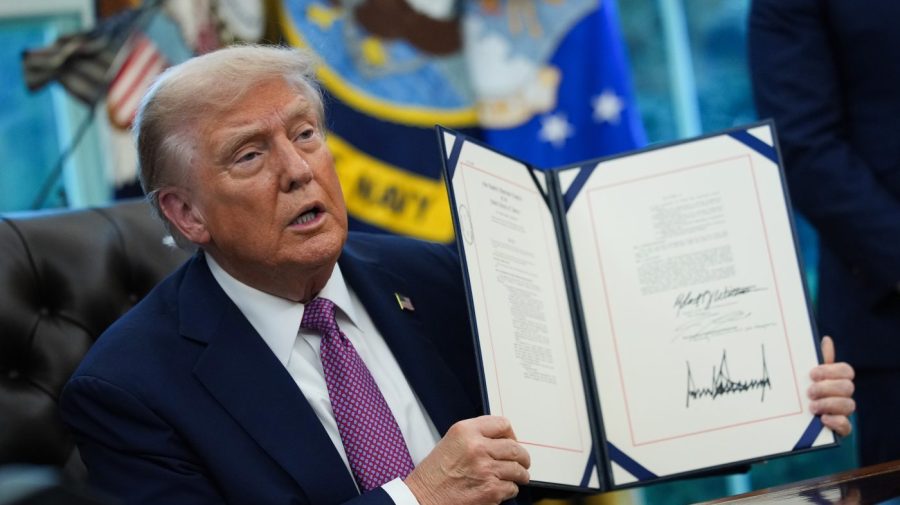
President Trump recently made a notable statement about the Department of Defense, saying, “We won the First World War. We won the Second World War. We won everything before that and in between. And then we decided to go woke, and we changed the name to Department of Defense.” This comment was made during an announcement that the Defense Department would revert to its original name, the War Department, which it held from 1789 until the National Security Act renamed it in 1949.
The Korean War, often referred to as America’s first “forever war,” began shortly after the establishment of the Department of Defense. While this timing might seem coincidental, it is important to recognize that the cause of the conflict was not the department's name change but rather a different verbal formulation from the Truman administration.
In January 1950, Secretary of State Dean Acheson delivered a speech at the National Press Club outlining America’s vital security interests in Asia. He defined a strategic perimeter that communist powers—such as the Soviet Union, China, and North Korea—were not to cross. However, South Korea and Taiwan were excluded from this perimeter. This omission was interpreted by Mao Zedong and Kim Il Sung as a green light for their expansionist ambitions. They consulted with Joseph Stalin to determine which of his allies would act first. Kim Il Sung moved quickly, leading to the outbreak of the Korean conflict in June 1950.
Harry Truman responded by mobilizing a United Nations coalition to oppose North Korea’s invasion of South Korea. He also reversed a previous decision and sent the Seventh Fleet back into the Taiwan Strait to prevent the conflict from escalating further. The primary goal was to deter Mao from invading Taiwan and to discourage Generalissimo Chiang Kai-shek from attacking Mainland China.
Defense Secretary Pete Hegseth emphasized that the name change to the War Department signifies a return to an offensive mindset in wartime situations, moving beyond just defense. The Korean War serves as a useful template for understanding this shift. It marked the first “limited war” after World War II, where the U.S. goal was not the enemy’s unconditional surrender or regime change.
Truman fired General Douglas MacArthur for advocating advancing U.N. forces to the Yalu River, fearing it could trigger a third world war. After three years of negotiations, an armistice was signed, and North Korea returned home with its leaders still in power. The only international punishment Pyongyang faced was a U.N. condemnation for aggression, along with its Chinese ally. Despite the limited objective being achieved, North Korea has continued to threaten peace and stability on the Korean Peninsula for the past 72 years.
Communist powers learned valuable lessons from the Korean War experience. They understood not to rely solely on Western statements regarding military intervention. Additionally, they realized that any aggressive move should not be overt and unambiguous to avoid clear moral and strategic consequences. Deng Xiaoping later advised China’s strategic planners, “Hide your capabilities, bide your time.”
After World War II, the U.N. Charter was established to prohibit unilateral use of force to change borders or governments. The West feels bound to honor these principles, even if enforcement is not always consistent.
The lessons from Korea were applied to communist expansion in Southeast Asia. After France’s colonial rule in Indochina ended, the U.S. sought to prevent another Asian “domino” from falling. Ho Chi Minh, the leader of North Vietnam, aimed to unify the country. He avoided sending large-scale armies across the 17th Parallel, unlike the North Koreans had done with the 38th Parallel. Instead, he organized and funded the Viet Cong to conduct an armed insurgency against the anti-communist government in South Vietnam.
U.S. Presidents Kennedy, Johnson, and Nixon increased U.S. forces and bombing campaigns in the North but avoided targeting key strategic locations such as the dikes. They also did not retaliate against Russia and China, which supplied weapons and supplies to North Vietnam, with China even deploying forces to fight the Americans and South Vietnamese.
After more than 15 years of sabotage and terrorism, and following the U.S. withdrawal in 1975, Hanoi finally revealed its true intentions, leading to the calamitous U.S. withdrawal and a prelude to the abandonment of Afghanistan.
If Donald Trump is indeed changing not only the name but the fundamentals of U.S. national security policy to make it more coherent and assertive, it could be a positive development. However, his actions on Ukraine—and increasingly ominously, Taiwan—suggest otherwise. His affinity for Vladimir Putin and sympathy for Russia’s aggression, including echoing Putin’s absurd claim that Ukraine started the war, makes it unlikely that his administration will address the “forever war” syndrome that undermined Western interests in Korea, Vietnam, Iraq, and Afghanistan.
Despite Trump’s strong attack on Iran’s nuclear program, it does not change the reality of ongoing challenges. The War Department may be back, but the semi-accommodationist policies of the past 72 years remain in place.

Post a Comment for "Trump's 'War Department' Name Change: All Talk, No Action"
Post a Comment