
What Is the Heliosphere? A New Mission Unlocks Its Secrets
Understanding the Heliosphere
Surrounding our solar system is a natural and enigmatic cosmic shield known as the heliosphere. This vast bubble, created by the solar wind—a constant stream of charged particles flowing from the sun—acts as a protective barrier against cosmic radiation that permeates the Milky Way galaxy. Alongside Earth’s magnetic field, the heliosphere plays a crucial role in maintaining conditions suitable for life on our planet and potentially on other planets like Mars.
Over the years, multiple missions have contributed to our understanding of the heliosphere. Notably, the Voyager probes have provided key data after exiting the heliosphere to explore interstellar space. However, a new mission called the Interstellar Mapping and Acceleration Probe (IMAP) aims to delve deeper into how the sun generates its solar wind and how this wind interacts with interstellar space at the edge of the heliosphere.
The IMAP Mission
IMAP is designed to investigate the formation of the solar wind and its interaction with the boundary of the heliosphere, which starts at a distance three times that between Earth and Pluto. The spacecraft will use 10 instruments to fill gaps in the existing map of the heliosphere, built from data collected by previous missions. These instruments will help further explain how the heliosphere shields our solar system from harmful cosmic rays.
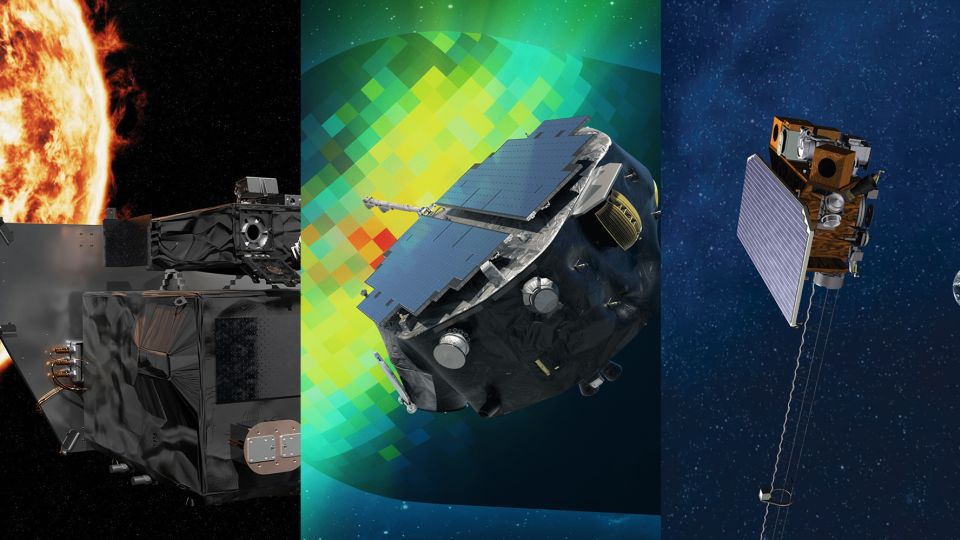
Alongside two other space weather missions launched on the same rocket, IMAP will assist scientists in predicting when solar storms could impact Earth. These storms, characterized by intense radiation, pose risks to astronauts on the International Space Station and can interfere with communications, power grids, navigation, and satellite operations.
Dr. Joe Westlake, director of NASA’s Heliophysics Division, described the mission as “the ultimate cosmic carpool,” emphasizing its potential to provide unprecedented insights into space weather. Every human on Earth and nearly every system involved in space exploration is affected by space weather, making these missions essential for future space endeavors.
Mapping the Heliosphere
The concept of the heliosphere was first theorized in the late 1950s by scientists studying cosmic rays and the solar wind. They proposed that the sun's magnetic fields and solar wind create a boundary around the solar system. Mariner 2, the first successful mission to another planet, measured the solar wind in 1962, confirming its existence. Subsequent missions like Pioneer 10 and 11, as well as the Voyager probes, provided further evidence of the heliosphere.
Scientists are particularly interested in understanding the boundaries of the heliosphere. While the Voyager probes have offered glimpses of these boundaries, they are the only spacecraft to have crossed them. Voyager 1 reached the boundary in 2012, while Voyager 2 did so in 2018, providing snapshots of specific locations. These findings have helped scientists understand the heliosphere’s comet-like shape.
The Interstellar Boundary Explorer (IBEX) satellite has been mapping the heliosphere since 2008. However, IMAP will offer more detailed exploration due to its advanced imaging capabilities, which allow for 30 times higher resolution than previous missions.
Once in orbit about 1 million miles from Earth, IMAP will capture real-time observations of the solar wind, measure particles traveling from the sun, and collect data from interstellar space. It will primarily focus on energetic neutral atoms (ENAs), which form when charged ions collide with neutral atoms. Tracking these particles will help create a more complete map of the heliosphere.
Monitoring Space Weather
IMAP launched alongside the Carruthers Geocorona Observatory and the SWFO-L1 mission on a SpaceX Falcon 9 rocket from NASA’s Kennedy Space Center. The Carruthers Geocorona Observatory will observe Earth’s exosphere, capturing images of the geocorona, a faint ultraviolet glow. Named after Dr. George Carruthers, who developed the first moon-based observatory, the mission will study changes in the exosphere caused by space weather.
Meanwhile, the SWFO-L1 mission acts as a solar storm detector, providing early warnings to protect astronauts and satellites. Its compact coronagraph telescope will monitor the sun for activity and measure the solar wind, sending images of solar storms to NOAA’s Space Weather Prediction Center within 30 minutes.
These missions are vital for ensuring the safety of critical infrastructure and supporting future space exploration. As astronauts venture farther into deep space, accurate space weather forecasts become increasingly important. The data collected by these missions will provide valuable insights into the complex interactions between the sun and our solar system.

Post a Comment for "What Is the Heliosphere? A New Mission Unlocks Its Secrets"
Post a Comment