
Air Force Report
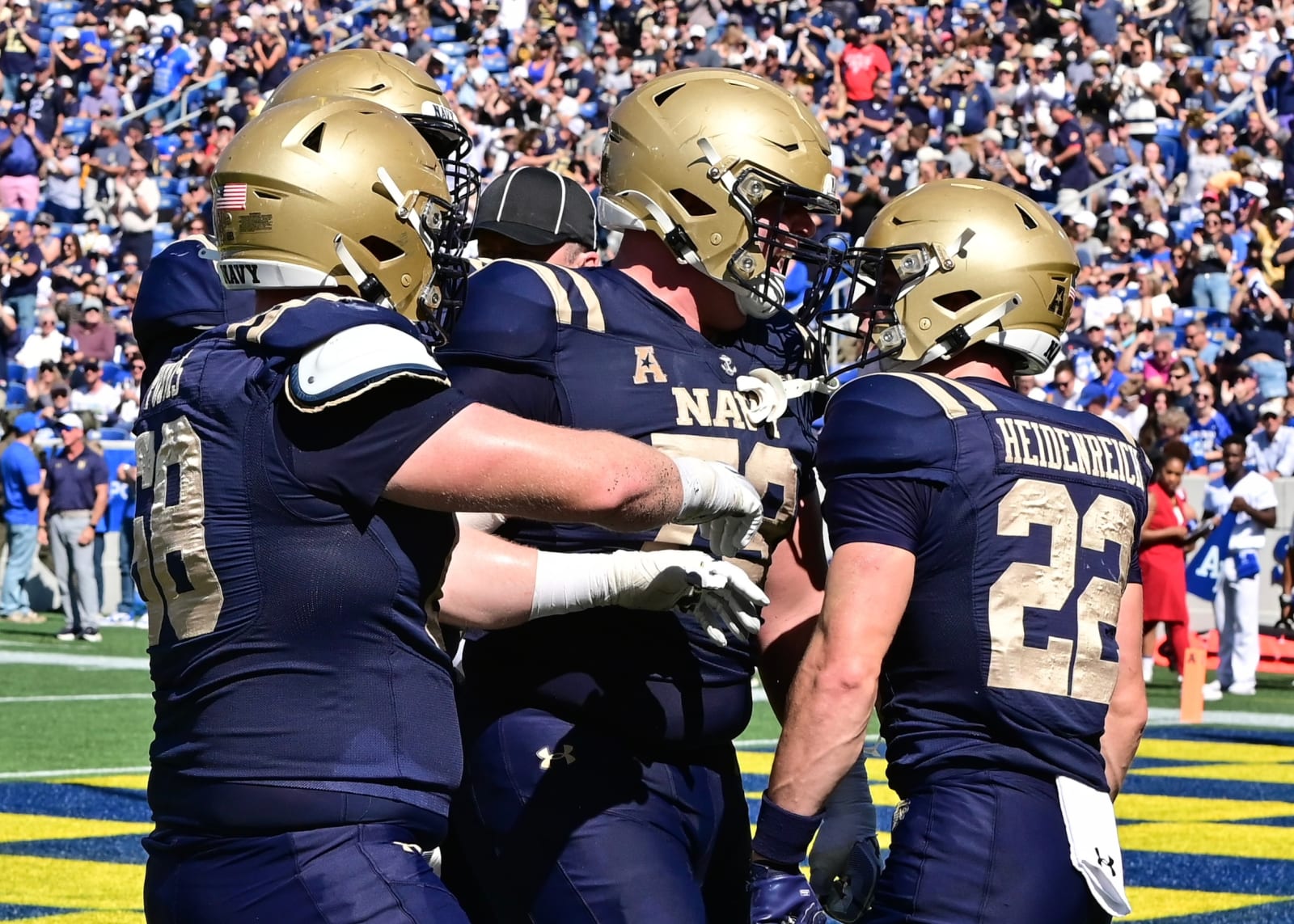
A Thrilling Game Between Navy and Air Force
In their Zoom calls with the media during the week, Navy’s coaches emphasized that they didn’t care about Air Force's 1-3 record. They knew that Saturday’s game would be a tough battle. However, no one could have predicted the instant classic it turned out to be.
Blake Horvath delivered a standout performance, throwing for 339 yards and three touchdowns while also adding 130 yards and a score on the ground. His 469 total yards set a school record. Eli Heidenreich was the primary beneficiary of those passing yards, with 243 receiving yards and three touchdowns of his own, also setting school records. The three touchdown receptions put Heidenreich at 14 for his career, breaking yet another school record. As a team, the Mids had 517 yards of offense, and the 339 passing yards were the fifth-most in school history.
Air Force’s offense was equally impressive, putting up 460 yards of total offense. Quarterback Liam Szarka, who had just set his own school record for total offense a week earlier, had another stellar day, throwing for 212 yards and running for 152. However, a critical mistake in the option game—a batted pitch by Jaxson Campbell as the Falcons were driving near the end of the game—ultimately sealed Air Force’s fate.
This was not a game of protracted, time-consuming drives. Instead, both teams focused on setting up knockout blows.
Defensive Challenges for Air Force
Air Force came into the game accustomed to needing big plays to stay competitive. Unfortunately, they often received help from the Navy defense, starting right from the beginning. On their first play from scrimmage, they ran a quarterback counter trey with jet sweep motion. The defensive line stemmed to the left, but the inside linebacker and safeties overcommitted to the sweep, leaving a big hole for the QB going the other way.
Later in the drive, the stem was more effective in influencing the PST, and the playside ILB scraped outside. However, both the ILB and the safety took on the same blocker, leaving an uncovered gap that the quarterback ran through.
Bad run fits were a problem throughout the game, but the bigger issues were in pass defense. In fairness, Air Force had a little to do with that. Tight end Bruin Fleischmann had been used primarily as a blocker and had only six catches for 43 yards coming into the game. But Air Force made him the focal point of their attack on Saturday, with six catches for 166 yards. Some of his production can be attributed to the Falcons saving him for this game, but most of it was due to the secondary having their eyes in the wrong place.
On this play, Air Force ran a wheel-post, with Fleischmann on the post. The corner was playing man defense on the post, leaving the safety to cover the wheel. But the quarterback’s rollout put the safety in conflict. He had his eyes in the backfield in case the quarterback decided to run, making him late getting over to cover the tight end.
Later in the drive, Air Force tried to take advantage of this with a two-for-one block on the triple option, but neither the safety nor the cornerback was fooled. I’m not sure what the wide receiver accomplished on that play.
Air Force found other ways to take advantage of the secondary’s focus on the backfield. On these plays, they faked a swing pass to the running back, and the tight end set up looking like he’s blocking. The defender takes the bait, and the TE heads upfield. The Mids were lucky the first time, but not so much the second time.
Interestingly, one name that wasn’t mentioned very much was Cade Harris, the Falcons’ leading receiver. It wasn’t for a lack of trying, though. In this play, Harris is put in motion before running a crossing route. The receiver lined up on the other side of the formation also runs a crossing route, while the third receiver runs a go route. Navy has a cornerback blitz on, and the safety lined up on the blitz side picks up that receiver. On the other side, though, both the safety and the cornerback take the go route. Nobody covers Harris, who ends up wide open on the other side of the field. Fortunately for Navy, Justin Ross hit Szarka as he threw, averting disaster.
Key Plays That Decided the Game
Not all was bad, though. The game was ultimately decided when Campbell batted Szarka’s option pitch, but that play was set up earlier in the game. When Air Force faced a third and long in the second quarter, they called a triple option play. It seems like a strange play call, but the logic is the same as running the option in the two-minute drill. If the secondary is playing back, expecting a pass, it can set up perimeter runs.
The first time they ran it, the outside linebacker forced Szarka to cut upfield, where he was met by a Navy lineman who beat his block. Facing third and long again in the fourth quarter, Air Force called the same play, in almost the same formation. Again, the playside lineman beat his block, and again, the outside linebacker stepped into Szarka’s path. This time, however, Szarka pitched the ball, likely hoping to avoid a repeat of the last time he ran that play. But he turned upfield as he did so, which put Campbell’s hand right in the path of the ball. Landon Robinson, who had stunted around to the back side of the play, was Johnny-on-the-spot.
During his Zoom call this week, PJ Volker noted that, despite the numerous mistakes made by the defense, their three best plays were actually their last three plays on the field. This wasn’t the defense’s finest hour, but they made the plays they had to make when the team needed it most.
Offensive Highlights
The offense, on the other hand, put on an aerial show that could replace the Blue Angels at graduation. In a lot of ways, the running game looked like most Navy games as far as playcalling goes. The goal was to get lateral movement from Air Force’s inside linebackers by running outside, then cutting behind those linebackers, or using misdirection and counters. There were a few wrinkles thrown in, though, with the most notable being the shovel pass to Cody Howard.
The first time Navy tried it, they ran it out of a power read look. It appeared similar to a counter trey, but instead of the guard and tackle pulling, it was a guard and the tight end. The jet sweep didn’t do enough to influence the “read,” though, and he came inside to make the tackle. It still picked up a first down.
The second time Navy ran it, they ditched the mesh and had Horvath fake a rollout. This got the defense moving away more, making the pass more effective.
Howard was tripped up by a linebacker behind him, diving at his feet. If not for that, he might have scored. Navy didn’t run this play after the first drive, but I bet we’ll see it again in future games.
The other notable wrinkle Navy used was putting Braxton Woodson in the backfield next to Horvath. In this play, the Mids ran a power read, just like any other. Air Force had an EZ stunt on, and the outside linebacker did a good job knocking the playside tackle off his path to the inside linebacker. But it didn’t make a difference, because the ILB was so focused on Woodson that he immediately scraped outside. That left nobody in the middle of the field when Horvath kept the ball.
Special Teams Excellence
Navy’s special teams also deserve some recognition for how well they played. Nathan Kirkwood, who is quietly having an outstanding season, drilled both of his field goal attempts. Isaiah Bryant had a 43-yard kick return. Lance Gossett returned to kickoff duties and put the ball in the end zone. Jacob Carlson had two punts: one that went 52 yards, and one that was downed at the six. In a three-point game, special teams can easily be the difference between winning and losing. Navy excelled here.
Both teams had outstanding games throwing the ball, but they achieved their success in different ways. There were one or two plays where Heidenreich was turned loose by the secondary, but for the most part, Navy’s aerial success was due to Horvath’s accuracy and the equally impressive hands of his receivers. Air Force’s success came primarily due to Navy coverage busts. I’m not sure one way is better than the other, but you can be assured that Army will be well aware of Navy’s coverage problems in December.
But that’s a topic for another time. For now, Navy fans can revel in another win. We don’t know where the Commander-in-Chief’s Trophy will be next year. But we know where it won’t be, and that’s a start.

Post a Comment for "Air Force Report"
Post a Comment