
Geologists Find First Clue to 4.5-Billion-Year-Old Earth's Origins

Uncovering the Secrets of Proto Earth
Scientists at MIT and other institutions have made a groundbreaking discovery, uncovering rare remnants of "proto Earth" that formed about 4.5 billion years ago. This ancient planet was significantly altered by a massive collision, which reshaped its composition and gave rise to the Earth we know today. Their findings, published in the journal Nature Geosciences, offer valuable insights into the primordial ingredients that shaped early Earth and the rest of the solar system.
Billions of years ago, the early solar system was a swirling disk of gas and dust that gradually clumped together to form the first meteorites. These meteorites eventually merged to create proto Earth and its neighboring planets. In its earliest phase, Earth was likely rocky and covered in lava. Then, less than 100 million years later, a Mars-sized meteorite struck the young planet in a dramatic "giant impact" event that completely transformed its interior and reset its chemistry. It was long believed that the original material of proto Earth had been entirely erased by this event.
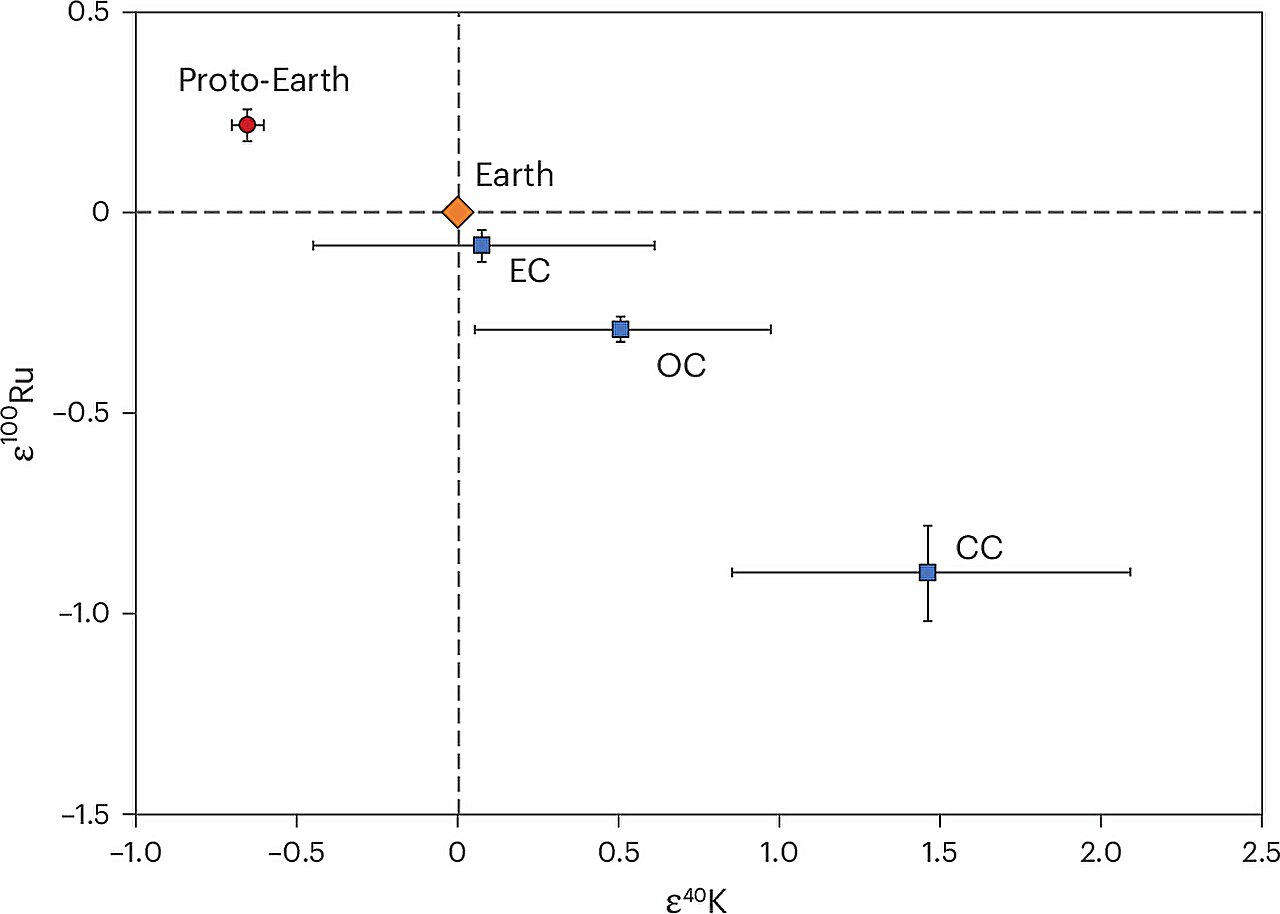
However, the MIT team's research challenges this assumption. They have identified a unique chemical signature in ancient rocks that differs from most materials found on Earth today. This signature is a subtle imbalance in potassium isotopes found in samples of very old and deep rocks. The researchers determined that this potassium imbalance could not have resulted from any known large impacts or geological processes currently occurring on Earth.
A Glimpse into the Past
The most plausible explanation for the samples' chemical composition is that they are leftover material from proto Earth that somehow remained unchanged despite the massive collision. Nicole Nie, the Paul M. Cook Career Development Assistant Professor of Earth and Planetary Sciences at MIT, says, "This is maybe the first direct evidence that we've preserved the proto Earth materials. We see a piece of the very ancient Earth, even before the giant impact. This is amazing because we would expect this very early signature to be slowly erased through Earth's evolution."
The study involved several researchers, including Da Wang of Chengdu University of Technology in China, Steven Shirey and Richard Carlson of the Carnegie Institution for Science in Washington, Bradley Peters of ETH Zurich in Switzerland, and James Day of Scripps Institution of Oceanography in California.
A Curious Anomaly
In 2023, Nie and her colleagues analyzed various meteorites collected from around the world. These meteorites, which formed at different times and locations in the solar system, represent changing conditions over time. When comparing their chemical compositions to Earth, the researchers discovered a "potassium isotopic anomaly." Isotopes are variations of an element with different numbers of neutrons. Potassium has three naturally occurring isotopes: 39, 40, and 41. On Earth, potassium-39 and potassium-41 dominate, while potassium-40 is present in very small amounts.
The meteorites studied showed different balances of potassium isotopes compared to Earth. This anomaly suggested that any material with a similar imbalance likely predates Earth's current composition. In other words, a potassium imbalance could indicate material from proto Earth before the giant impact.
"Built Different"
In their current study, the team looked for signs of potassium anomalies within Earth itself. They analyzed rock samples from Greenland and Canada, where some of the oldest preserved rocks are found. They also studied lava deposits from Hawaii, where volcanoes bring up some of Earth's deepest materials from the mantle.
"If this potassium signature is preserved, we would want to look for it in deep time and deep Earth," Nie says. The team dissolved the samples in acid, isolated the potassium, and used a mass spectrometer to measure the ratio of each isotope. They found a deficit in potassium-40, which is already a minor component on Earth. However, the samples contained an even smaller percentage of potassium-40, making it like finding a single grain of brown sand in a bucket of yellow sand.
The team concluded that these materials were "built different" compared to most of what we see on Earth today. To determine if these samples were remnants of proto Earth, they assumed this might be the case. They reasoned that if proto Earth was originally made from such potassium-40–deficient materials, most of this material would have undergone chemical changes due to the giant impact and subsequent events.
Simulations and New Insights
The researchers used data from known meteorites and simulated how the potassium-40 deficit would change after impacts. They also considered geological processes that Earth experienced over time, such as mantle heating and mixing. The simulations produced compositions with slightly higher potassium-40 fractions compared to the samples from Canada, Greenland, and Hawaii. Importantly, these simulated compositions matched most modern-day materials.
The work suggests that materials with a potassium-40 deficit are likely original remnants from proto Earth. However, the samples' signature does not match any known meteorite, indicating that the original materials forming proto Earth may still be undiscovered.
"Scientists have been trying to understand Earth's original chemical composition by combining the compositions of different groups of meteorites," Nie explains. "But our study shows that the current meteorite inventory is not complete, and there is much more to learn about where our planet came from."
Conclusion
This research opens new doors for understanding Earth's origins and the processes that shaped the early solar system. By studying these ancient materials, scientists can gain deeper insights into the building blocks of our planet and the cosmic events that led to its formation.

Post a Comment for "Geologists Find First Clue to 4.5-Billion-Year-Old Earth's Origins"
Post a Comment