
Orca vs. Great White: Battle for Apex Predator Supremacy
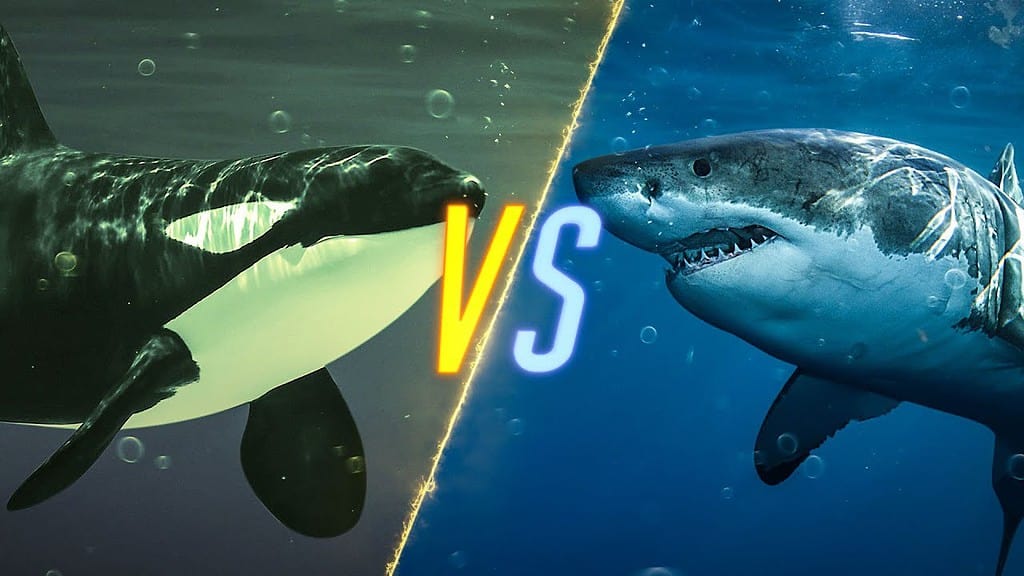
The Ocean's Top Predators: Orca vs. Great White Shark
The ocean is home to a variety of predators, but none are as iconic as the shark. Movies like Jaws have made sharks synonymous with fear and danger. However, beneath the surface, another predator has been quietly challenging this narrative.
The orca, often referred to as the "killer whale," is not only intelligent but also incredibly powerful. Evidence from drones, DNA tests, and scientific studies supports the idea that orcas are more than just the name suggests. Let’s take a closer look at these two formidable creatures and see who truly dominates the ocean.
In the Red Corner: The Giant Orcas
Orcas are the largest members of the dolphin family. Their striking black-and-white coloring and imposing size make them instantly recognizable. These marine mammals are known for their intelligence, complex communication patterns, and cooperative hunting techniques. Each pod of orcas has its own unique set of sounds, which help them identify one another over long distances.
Orcas use echolocation as a tool for both communication and hunting. This sonar system allows them to detect objects in the water, providing information about their location, size, and shape. This advanced ability makes them highly effective predators in the underwater world.
Orcas also live in matriarchal societies, where older females lead the pods. They teach younger generations about strategies and hunting methods. These pods often hunt together, using sophisticated techniques to capture their prey.
In the Blue Corner: The Menacing Great White Shark
Great white sharks, scientifically known as Carcharodon carcharias, are often portrayed as ruthless killers. While this image is partially accurate, it doesn’t tell the whole story. Media portrayals have contributed to this perception, but new research shows that great whites play an important role in maintaining the balance of marine ecosystems.
These sharks are torpedo-shaped swimmers with powerful tails that allow them to reach speeds of up to 15 miles per hour. Their ability to breach the water’s surface while hunting has fascinated and frightened observers for centuries.
Great White versus Killer Whale: The Stats
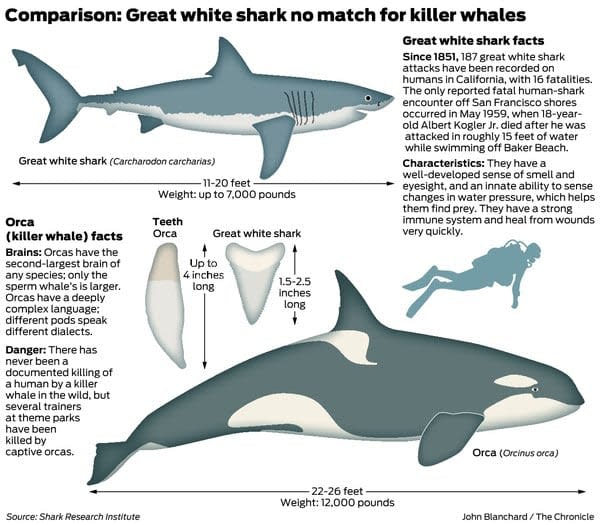
When comparing size, mass, and velocity, orcas clearly have the advantage. The largest recorded orca measured 32 feet (10 meters) long, while great white sharks typically reach lengths of up to 21 feet (6.4 meters). Male orcas can weigh between 8,000 and 12,000 pounds (3,630 to 5,443 kilograms), significantly more than male great white sharks, which weigh between 1,150 and 1,700 pounds (522 to 771 kilograms).
Lifespan is another interesting factor. Great white sharks were once thought to live between 25 and 30 years, but recent studies suggest they may live up to 73 years. Orcas have variable lifespans, with females living longer than males. A female orca that survives the first six months can expect to live 46 to 50 years, while males live between 30 and 38 years on average.
Hunting Prowess
Both species are well-adapted hunters. Great white sharks have rows of serrated teeth and an acute sense of smell, allowing them to locate prey from great distances. They can also detect electromagnetic fields, which helps them find hidden prey.
Orcas, on the other hand, are cooperative pack predators. They use sophisticated techniques to obtain food, often working in groups of up to 40 individuals. Their diet varies depending on their location, with some populations specializing in fish and others in mammals.
The Grand Finale: Orca versus Great White Shark
In real-world encounters, orcas have consistently emerged as the victors. Experts agree that orcas are the superior competitor in a direct confrontation.
Deborah Giles, science and research director for Wild Orca, stated, “An orca wins hands down. No question.”
Several documented instances support this claim. For example, South African orcas named Port and Starboard have been known to kill great white sharks. Off the coast of San Francisco, orcas attacked and killed a great white, causing all the other sharks to flee. Some even traveled thousands of miles to escape.
A 2024 study found that orcas actively hunt great white sharks, and even a single orca can take one down. Another study noted that some orcas have developed a taste for great white livers, leaving the rest of the shark behind.
In 2025, further studies confirmed that orcas also target other shark species.
Conclusion
Orcas and great white sharks are both titans of the ocean, each with unique traits and adaptations. However, in a direct confrontation, orcas clearly have the upper hand. With their superior size, agility, and intelligence, they are the true apex predators of the ocean.


Post a Comment for "Orca vs. Great White: Battle for Apex Predator Supremacy"
Post a Comment