
From Classrooms to AI: How Will Learning Change?
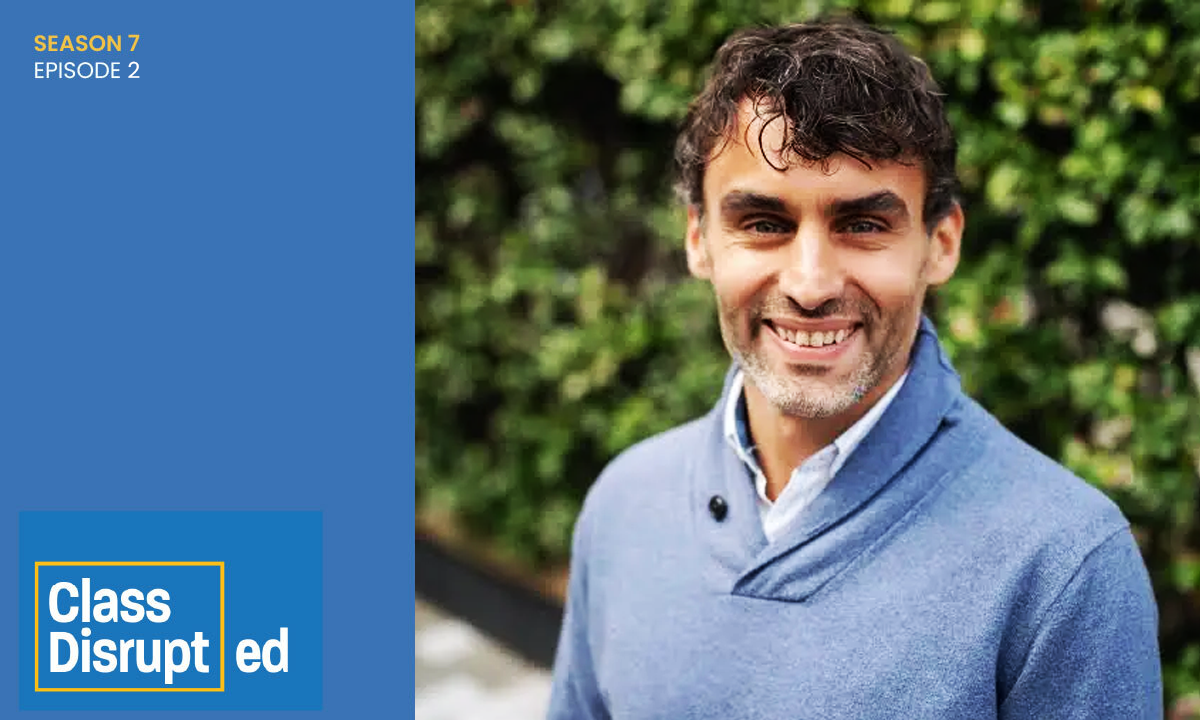
Class Disrupted: A Conversation on AI and Education
"Class Disrupted" is an education podcast featuring author Michael Horn and Futur's Diane Tavenner in conversation with educators, school leaders, students and other members of school communities as they investigate the challenges facing the education system in the aftermath of the pandemic — and where we should go from here. Find every episode by bookmarking our Class Disrupted page or subscribing on Apple Podcasts, Google Play or Stitcher.
Hosts Michael Horn and Diane Tavener sit down with Neerav Kingsland, a longtime education leader now working at AI safety and research firm Anthropic, to explore the evolving intersection of artificial intelligence and education. Neerav shares his journey from working in New Orleans’ public school reform to his current role at a large AI company. The conversation covers the promise of AI tutors and teacher support tools, the key role of application "wrappers" for safe and effective student interaction with AI, and the need for humility and caution, especially with young learners. The episode also delves into the broader societal impacts of AI, the future evolution of schools, and the increasing importance of experimentation and risk-taking for students navigating an uncertain, tech-driven landscape.
Get stories like this delivered straight to your inbox. Sign up for The 74 Newsletter. Listen to the episode below. A full transcript follows.
AI’s Role in Education Trends
Diane Tavenner: Hey, Michael.
Michael Horn: Hey, Diane. It is good to see you and excited to get into this conversation that we’ve been teasing our audience with in the opening episode around AI. And then we had a few weeks to get our guests lined up. And I think, as today’s conversation will show, it has been well worth the wait, I suspect. But there are a lot of developments, obviously, AI to large companies, constantly making some exciting updates, rolling out new applications and features and the like. And so you and I have been constantly updating our own thinking, emailing back and forth a lot, and I think today is going to be really exciting to continue to update our thinking.
Diane Tavenner: Yeah, I agree. I have conversations regularly with people who listen, who say, you know, this is the dialogue we want to have about AI and education. And honestly, I can’t think of a better person I’d like to be talking about this topic with. Our guest today is Neerav Kingsland. And Neerav is someone Michael and I have both known for many, many years. And the reason why is he’s worked in New Orleans in post Katrina days helping to build the nation’s first public school system there, where over 80%, 90% of the students attend charter schools. He served as the CEO of New Schools for New Orleans and then in a variety of philanthropic roles with the Arnold foundation and Reed Hastings and a managing partner at the City Fund. And then Neerav made this big jump a few years ago and joined Anthropic, which is of course one of the handful of leading foundational AI companies known for its large language model Claude, and he leads strategy there. So with education and AI sort of covered, Neerav, it was hard for us to imagine someone better positioned to come and open this season and talk to us about the big picture of AI and education. And so welcome. We’re really happy to have you here.
Neerav Kingsland: So thrilled to be here. Thanks, Diane.
The Pathway from Education to AI
Michael Horn: No, well, so, Neerav, I want to start with this because I’d love to just understand your pathway from education to Anthropic. And I’ll say up front, Diane may already know some of this, but I don’t. On your LinkedIn, it looks like you effectively left education and moved hook, line and sinker, if you will, into one of the leaders in AI. So I would love to just understand what is, you know, what led to the move. What does your day job look like these days? Is education still present in it?
Just help us understand the pathway.
Neerav Kingsland: Yeah, totally. So I had been following and reading about AI since my time in New Orleans. The book that really hooked me was The Singularity is Near, the Ray Kurzweil book, which is 25 years old now, but pretty prescient. I think he predicted AGI in like 2033 or something. And here we are. And so I think that opened my eyes to the possibility I wasn’t technical enough to know how right he might be, but kind of big if true. After you, you know, you read a book like that and then, you know, as a layperson, just kept on reading, listening to podcasts, blogs and so forth. And then it was really when GPT2 came out, so kind of, you know, maybe 15.
AI Tutors and Teacher Support
Neerav Kingsland: So it just feels like the AI tutors are going to happen. They’ll likely be very impactful and we’ll get fairly close to the dream of scaling a high quality, one on one instruction for at least an hour or two a day for every kid. The other thing I’m super excited about is AI teacher support, both in the efficiency sense of lesson planning, but more in classroom facilitation. So you guys might have seen Course Mojo, which Eric and Dacia founded, where you basically combine AI giving live feedback in a classroom, that information going back to the teacher, the teacher then being able to modify their instruction and how they’re facilitating the class. And that all just seems pretty magical to me. And so very excited about that as well. The things I’m worried about are: you can cheat with AI. Obviously we’ve seen that happen.
Transforming Education with Tech Innovation
Neerav Kingsland: And I know groups like Alpha School are thinking a lot about the cultural piece now, but yeah, just the idea that if school was set up to really maximize the interaction here with the app layer, we could have, you know, amazing gains, I really do think. But yeah, that’s the short of it is I, I don’t think typing into a box for maybe, you know, kids under 18 is just great pedagogy. It’s so much more you can do and we’re thrilled to be doing it. So maybe one last thing on the app layer, when I took over this role in the Mission labs, because I knew education was a place I thought we could start. So I just did a sprint and probably over two months met with 40 or 50 ed tech companies, philanthropists, VCs, to see what was out there. And then kind of informally, we just started working with 10 or 15 of them and giving them the same technical support we’d give to like the Fortune 500, but, you know, more out of a mission perspective. And so through that, we’ve got to start building with a lot of the app layer companies that have just been wild.
Navigating AI in Education
Diane Tavenner: That’s awesome. Let’s shift to older young people if you will. I think, you know, I’m now really focused on the successful launch of young people post high school into whatever their post secondary pathway is and into their first foothold job and careers and life. And I think that your CEO has been one of the first and few people to be really honest about maybe the short sort of medium-ish term impacts potentially on careers, especially for young people. And I think we’re seeing some data and statistics that suggest that, you know, recent college graduates are struggling to find first jobs and AI might be an impact there. And clearly there’s complicating factors around the economy and whatnot. But I think if we look back in history it’s logical to assume with such a seismic transformation that we will see, you know, many jobs go away and new jobs will be created. But there might be some, you know, gaps and timeline where that’s, that’s going to be a little bit rough.
Future Potential of AI Models
Michael Horn: I am struck how you are in this very moderate position though. Right. Because we’re seeing tons of legislation right now starting to move toward getting rid of all digital screen time. And then there’s the flip side of not wanting it to be sort of the zombie apocalypse, if you will. So maybe as we wrap up, let me ask this sort of broader question. Zoom back out away from education and just the larger set of tools. Right. That you’re working on and applications.
You’re seeing all sorts of different things that Anthropic, Claude, not just you, all the other LLM foundational models. Right. Are starting to tackle and sort of, I’m curious, like what folks maybe like me and Diane, others in education are sort of discounting or don’t understand that these models are capable of doing today or is right around the corner that we may be discounting and not seeing?
Neerav Kingsland: Seeing. Yeah, it is hard. Like things are moving exponentially and our brains don’t think exponentially. One thing to do is like go play with GPT2. Like I think that was four years ago now, three years ago now. And then like go talk to, you know, GPT5 or Claude or whatever. I think visceral ways to feel how fast things are moving help you understand where we might be five years from now. Because if we make the jump like we did then for another five years.
Reflecting Growth Over Time
Diane Tavenner: I love this suggestion of going to play with GPT2. I don’t know if you remember, but I had the good luck of, we were in a conversation right before the big models were announced and you showed me, I guess what the early version of.
Neerav Kingsland: I remember that. Yeah, Claude in Slack was, I mean.
Diane Tavenner: I was like, I must admit, like I really didn’t get it. I was like, wait, is this like, am I just googling something? Like I don’t really understand exactly what’s happening. You certainly saw much more than I did at that moment. It took me a little bit to wrap my head around it. But I think about that moment which I remember so clearly having with you and totally not getting it and quite frankly not being terribly impressed. And now and what a. I mean it’s just so dramatic, you know, my learning curve and my arc and I’m a novice and a layperson and. And so I love this idea of can we sort of, you know, sort of set markers for ourselves where we kind of document or record what we thought or believed in that moment or how we experienced it, and then look back and reflect on those as kind of this as things progress? Because it is.
I mean, I almost feel out of breath some days. Like it goes so fast.
Neerav Kingsland: Well, you shouldn’t feel too bad as somebody who was a part of leading our series C six months later, maybe dozens of investors also were not too impressed with Anthropic at the time, but here we are.
Diane Tavenner: Well, by then I was, so maybe.
Neerav Kingsland: There you go.
Diane Tavenner: This has been awesome. Thank you so much for joining us. Before we let you go, Michael and I have a tradition of we just like to share with each other something we’ve been reading, listening to, watching. We really try to keep it outside of our day jobs, but we fail at that quite often. And so we’d love to invite you to join in that tradition. Anything, anything fun to share. Intriguing. Interesting that you.
You’ve been consuming.
Neerav Kingsland: Yeah. Two things for you. One maybe too like a little window into our world over here. The podcast everyone listens to at all the AI labs is Dwarkesh Patel. And so if you want to go deep, I’d recommend listening to that. A lot of our CEOs have been on that and a lot of the researchers, and I always learn a ton there. And then the book I’ve been reading lately is a really a wild one. It’s called Blitzed, the history of drug use in the Third Reich, which might be the best title for a book ever.
And you know, it was kind of. It’s probably fairly obvious what the book is about, but like, there was a lot of speed going on, particularly in the later years of the war. And not that that was monocausal of like the fall of the Third Reich, but it played a role. And so, you know, it’s just like an interesting aha. Of like, why did historians miss that? And like what might be going on in our own time that is non obvious. That is pushing history in one direction or another, whether it be drugs or something else. But that’s a fun read. Yeah.
Diane Tavenner: Yeah, that one’s.
Michael Horn: I was gonna say it sounds like you knew that one, Diane.
Diane Tavenner: It’s on our shelf as well. The title and the cover are very fitting, for sure.
Michael Horn: Dan, what about you? What’s been on your, what’s been on your playlist or. Or bedside table recently?
Diane Tavenner: Well, I’ve gotten pretty obsessed with a lot of what Scott Galloway is talking about, and he is on a lot of podcasts, so he talks about it all over the place. I’vw really been listening to the Lost Boys podcast series, which is focused on sort of bringing light to what he would describe as a crisis among our young men in America. And there are a number of stats that suggest that these young folks are in crisis. And for me, I think I went down this path as a mom of two, sort of young, young men. And what I find is when I talk about some of the challenges or worries I have, I. There are lots of moms who come to me sort of quietly, in sort of whispered tones, and they’re feeling the same thing, experiencing the same thing, worried about the same thing. And so I do.
I think that it’s interesting and important, and I don’t know exactly what to do about it yet, but I feel compelled. So that’s where I’m spending some time.
How about you?
Michael Horn: That’s good.
Yeah. We had Richard Reeves on our Future you podcast last year around this and which was a great conversation. And Jeff Salingo is obsessed with Scott Galloway. I think it’s okay that I say that here. So those books both resonate as well. Mine, I. I finished Scott Anthony, who was an early collaborator with Clay Christensen, he wrote a book called Epic Disruptions, which is like disruptive innovation throughout history, some of which. I don’t know if I qualified them all as disruptive innovations myself, but they were all moments that changed things in pretty significant ways and sort of the establishment’s reaction or. Or struggle, if you will, to get their heads around what was coming and what.
How that would change things. And so it’s. It’s some pretty interesting flashpoints told in entertaining ways. So that’s been on my list, but we’ll wrap it there. Neerav, just huge thank you. This has been a great conversation and stretched, I think, both of our thinking. And so just thank you and for all of you listening, please, please, please keep writing in with comments, questions, lines of inquiry you want us to follow.
It’s been a real inspiration to me and Diane and directing us as we thought about the season. And so we look forward to more and we’ll see you next time on Class Disrupted.

Post a Comment for "From Classrooms to AI: How Will Learning Change?"
Post a Comment