
Porsche and Hyundai Outperform Lucid in Key Metric
The Key to a Great Road Trip EV: Range and Charging
When it comes to road trip electric vehicles (EVs), range is just one piece of the puzzle. The true test lies in how well an EV balances its range with charging speed. This combination determines whether a vehicle can handle long-distance travel without frequent stops or excessive downtime.
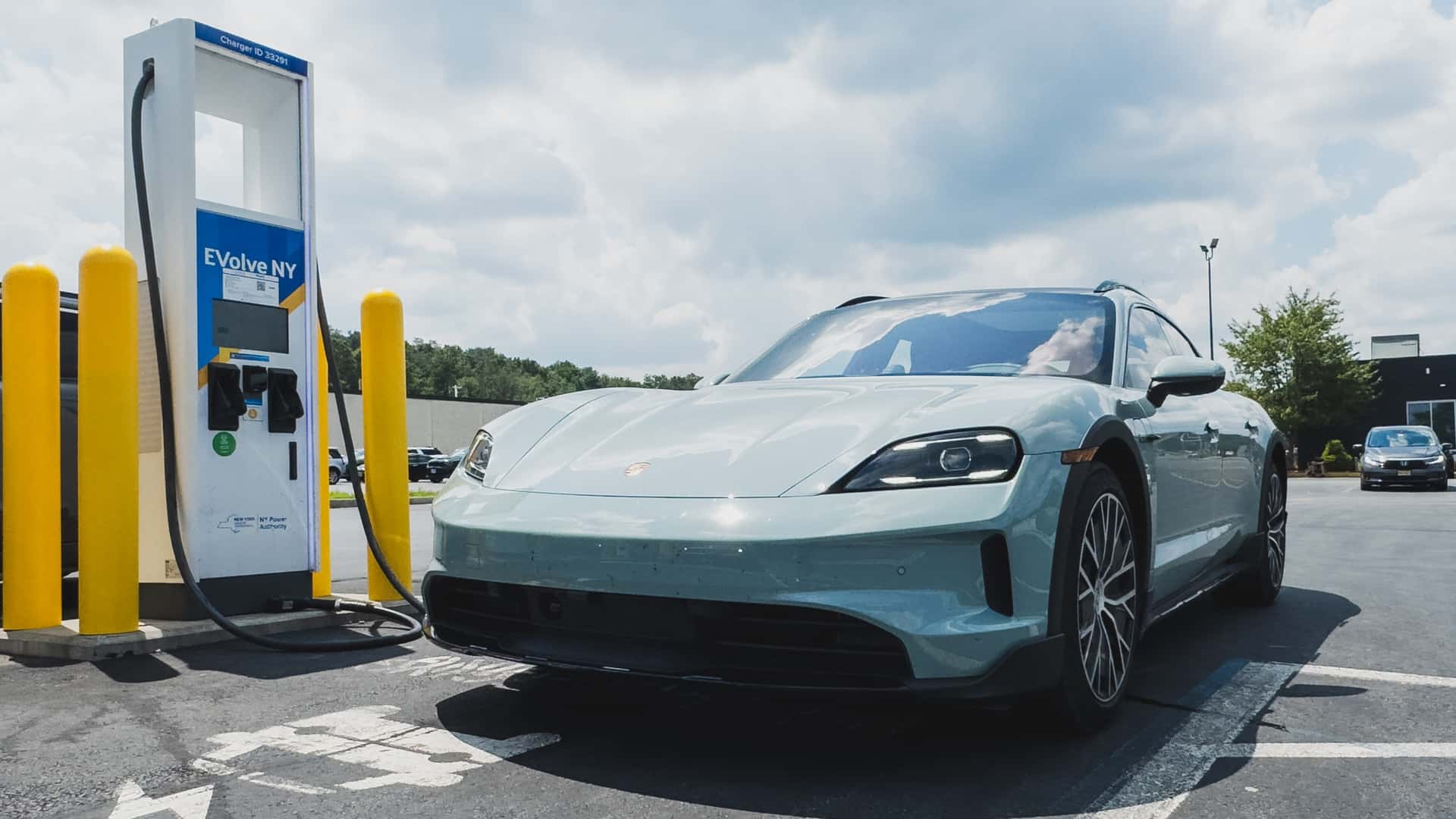
In a recent evaluation conducted by Germany’s largest automotive club, ADAC, the Porsche Taycan has emerged as the top performer in a long-range EV test. It outperformed the Lucid Air, which was once considered the gold standard for long-range EVs. The Hyundai Ioniq 6 also showed strong performance, coming close to matching the Taycan's capabilities.
The ADAC test is designed to simulate real-world conditions for long-distance driving. Instead of running vehicles to their limits, the test uses a dyno to simulate a mixed driving route, draining the battery until only 10% remains. Then, the car is charged for 20 minutes, and the amount of range gained is measured. The total distance covered before and after charging is calculated to determine the vehicle’s overall suitability for road trips.
How the Test Works
ADAC has been conducting this test for several years. The Lucid Air Grand Touring used to rank highly, but with more vehicles entering the top ten this year, it has dropped to fifth place. Despite having the largest battery among all tested EVs (112 kWh) and the second-highest range before needing to charge at 10%, the Lucid struggles when it comes to charging speed.
The Lucid is rated to charge at up to 300 kW, allowing for a 10% to 80% charge in about 20 minutes. However, during the ADAC test, it only reached 243 kW and exhibited a declining charging curve. By the time it hit 50%, the power had dropped to 145 kW, and by 70%, it had fallen below 100 kW. As a result, it only gained 192 miles (309 km) in the 20-minute charging session, bringing its total to 533 miles (859 km).
Porsche Taycan Leads the Pack
The Porsche Taycan Performance Plus topped the rankings with a combined rating of 609 miles (981 km). It managed 318 miles (518 km) before reaching 10% battery and then gained 291 miles (469 km) during the 20-minute charge. Its charging curve was significantly better than the Lucid’s, starting at 290 kW and peaking at 295 kW. It maintained a consistent power level above 250 kW until 63%, and even at 75%, it was still pulling 200 kW. The average charging power was an impressive 274.9 kW.
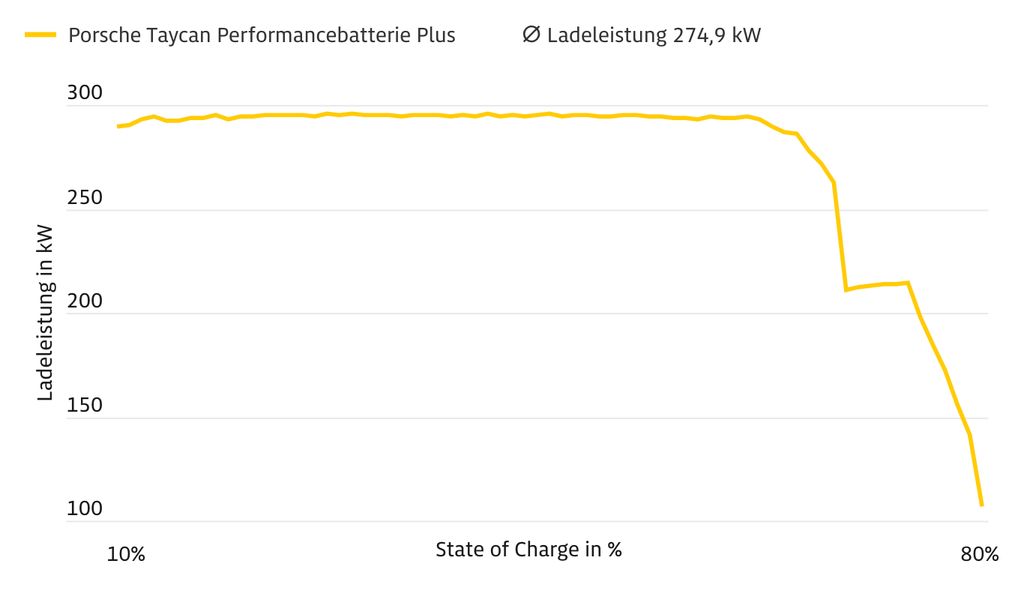 Porsche Taycan charging curve
Hyundai Ioniq 6 Shines in Second Place
Despite having a smaller battery (77.4 kWh), the Hyundai Ioniq 6 single-motor model secured second place. It covered 311 miles (502 km) before being charged and regained 266 miles (429 km) in 20 minutes, totaling 578 miles (931 km). While its charging curve wasn’t as strong as the Porsche’s, it averaged 189.7 kW, which was still better than the Lucid’s 153.4 kW. The affordability of the Hyundai makes its performance even more impressive.
Audi A6 E-Tron Takes Third
The Audi A6 E-Tron placed third with a total of 572 miles (921 km). It covered 325 miles (524 km) before recharging and added 246 miles (397 km) during the charging session. The Audi exceeded its claimed peak charging rate of 270 kW, peaking at 281 kW and maintaining that level through 27% before dropping to 200 kW.
The Importance of Consistency
While headline figures like battery capacity, claimed range, and peak charging power are often emphasized, the ADAC test highlights the importance of consistency. A vehicle with a large battery may not perform as well if its charging curve is inconsistent. The test shows that real-world performance is influenced by multiple factors beyond just numbers on a spec sheet.
Future of EV Testing
ADAC uses a 300 kW charger as the benchmark for its tests, as it reflects the most common DC fast charger in Germany. However, the club plans to update its testing procedure to include more powerful chargers, such as 400 kW models. This change could impact future rankings, especially as new EVs capable of utilizing higher charging speeds become available.
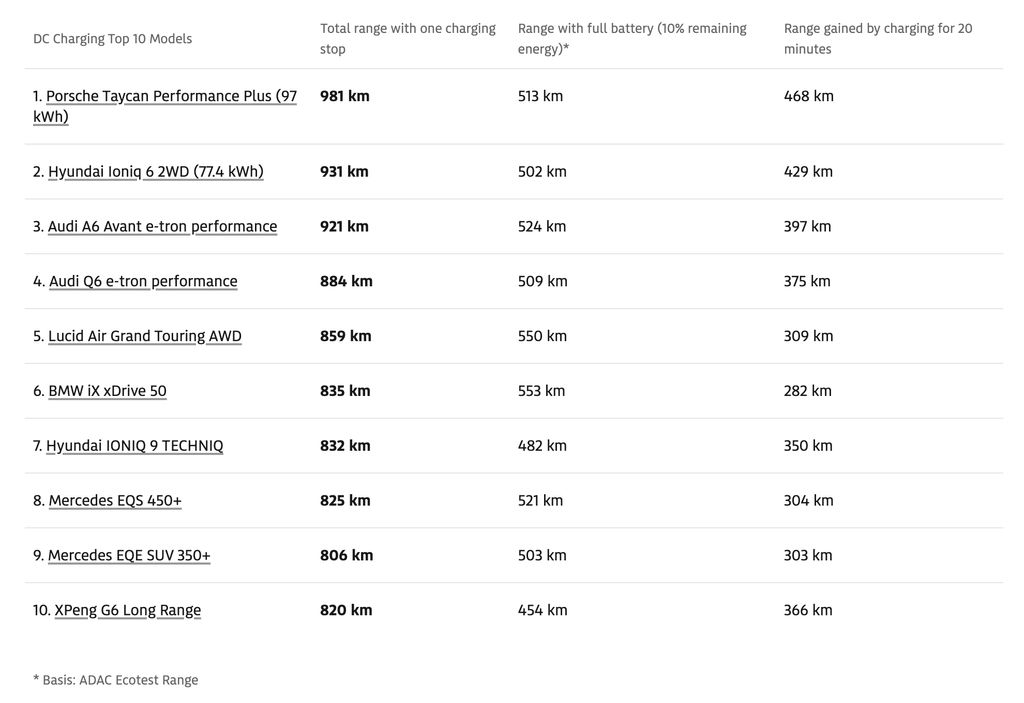 ADAC's current top 10 best long-range EVs
Conclusion
The Porsche Taycan’s ability to maintain high charging speeds throughout its session is remarkable, proving that larger batteries aren’t the only path to success. The Hyundai Ioniq 6’s consistent performance and efficiency show that smaller batteries can still deliver impressive results. As EV technology continues to evolve, the focus will likely shift toward balancing range, charging speed, and efficiency to meet the needs of long-distance drivers.

Post a Comment for "Porsche and Hyundai Outperform Lucid in Key Metric"
Post a Comment