
Secret conservative donors fund opposition to Trump's tariffs
The Legal Battle Over Trump's Tariff Policy
President Donald Trump has often found himself in legal battles at the Supreme Court, but this week’s high-stakes argument over his tariff policy presents a unique challenge. This time, the opposition is not just liberal advocacy groups, but a legal center funded by some of the country’s wealthiest conservatives. The Liberty Justice Center, a nonprofit with a libertarian-leaning agenda, has been supporting small businesses that argue Trump’s tariffs have harmed them by increasing their costs.
The cases being heard by the Supreme Court were brought by these small businesses, which claim that the tariffs have raised their expenses and disrupted their operations. Behind them, however, is the Liberty Justice Center, which is funding some of the high-priced legal representation. This organization has previously challenged public-sector unions and sued to prevent the ban on TikTok from taking effect.
Although the Liberty Justice Center does not disclose its donors, a Washington Post analysis of tax filings revealed that it has received money from Donors Trust, the Walton Family Foundation, and the Bradley Foundation. These are all prominent conservative donors. Donors Trust is a fund that collects money from wealthy individuals whose identities remain undisclosed and channels it toward conservative causes. It has frequently supported organizations linked to Leonard Leo, a Federalist Society co-chairman who advised Trump on judicial appointments during his first term. However, Trump recently criticized Leo, partly due to the tariff case.
The Liberty Justice Center is also listed as a national partner of the State Policy Network, a network of conservative nonprofit organizations connected to Charles and David Koch. This network also receives funding from Donors Trust.
A Divided Conservative Movement
Some of the most prominent groups and scholars within the conservative movement have taken a stance against Trump in the tariff lawsuit. This highlights how import taxes have become a clear fault line between the president’s MAGA base and free-market groups that shaped Republican politics before Trump.
Filings in the case reflect this division: Prominent conservative economists, lawyers, and judges have submitted briefs supporting the businesses challenging the tariffs. One such brief was signed by 31 former judges appointed by Presidents Ronald Reagan, George H.W. Bush, and George W. Bush. The Chamber of Commerce, which historically aligned with the Republican Party, also filed a brief in support of the companies. Other conservative organizations, including the Washington Legal Foundation and experts from the American Enterprise Institute, Mercatus Center, and Cato Institute, have also backed the challenge.
On the other side, think tanks and legal groups that have influenced Trump’s policies, such as the America First Policy Institute and the America First Legal Foundation, have supported the administration’s position. The latter was co-founded by Stephen Miller, now Trump’s deputy chief of staff.
The Legal and Financial Implications
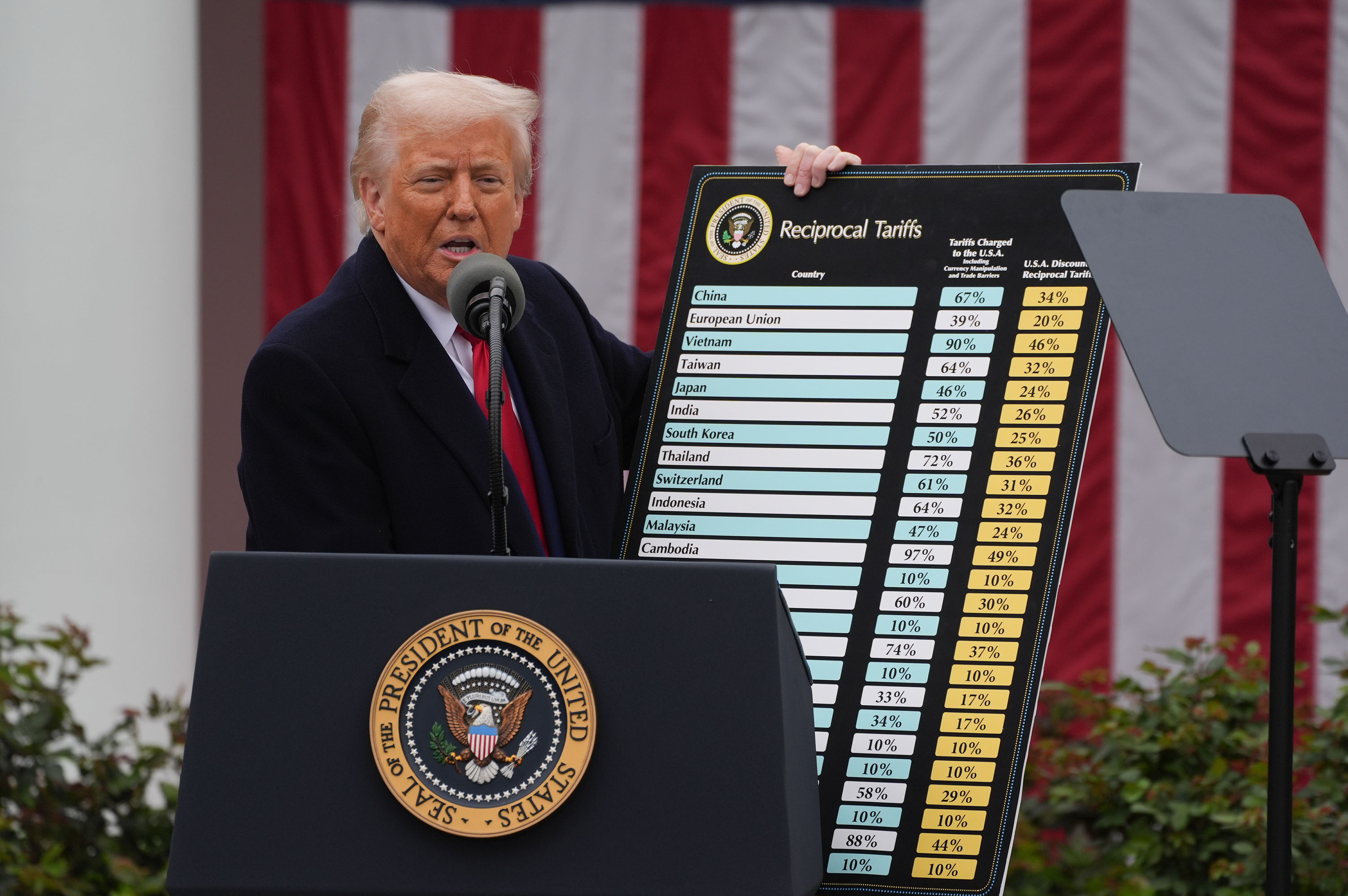
The issue at hand involves the sweeping import taxes Trump has imposed on numerous countries. He claims authority for these tariffs under the International Emergency Economic Powers Act (IEEPA), a 1977 law that does not mention tariffs. Instead, it gives presidents the power to “regulate” international commerce in response to an emergency. Trump argues that the nation’s trade deficit constitutes an emergency, and that regulating under the emergency law includes the power to impose taxes.
Businesses have paid approximately $90 billion in tariffs implemented through emergency powers as of late September, according to U.S. Customs and Border Protection data. If Trump loses the case, the federal government may have to refund this money, worsening the federal deficit.
Beyond the financial impact, a loss on tariffs would be a major blow to Trump’s economic agenda. He has used the levies as a tool of economic coercion in trade and defense-spending negotiations. He has also used them to punish countries with which he has grievances, such as Canada, after Ontario aired a television ad featuring excerpts from a 1987 radio address in which Reagan criticized tariffs.
“If a President is not allowed to use Tariffs, we will be at a major disadvantage against all other Countries throughout the World,” Trump said in a social media post. “If a President was not able to quickly and nimbly use the power of Tariffs, we would be defenseless, leading perhaps even to the ruination of our Nation.”
The Role of Legal Advocacy
Without groups like the Liberty Justice Center, the small companies challenging the tariffs would likely not be able to afford the legal costs, according to Scott Lincicome, vice president of general economics at the Cato Institute.
“It is really expensive to fight government in court,” he said. “You need highly skilled lawyers to do it.”
Trump’s tariffs are widely unpopular among voters. A recent Washington Post-ABC News-Ipsos poll showed that 65% of respondents disapprove of the president’s tariffs on imported goods.
Many conservatives are skeptical of Trump’s tariffs for two main reasons: they are taxes, which conservatives historically seek to limit, and they represent a delegation of congressional power to the executive branch. However, big businesses have largely remained silent on the issue, instead lobbying the president and administration officials for exceptions to the tariffs.
The Broader Political Landscape
The legal battle has highlighted the broader division among Republicans over tariffs. While Trump has a strong grip on the party, there are cracks in support on the issue of tariffs. Some of his most prominent supporters in Congress and the business world criticized the rollout of his tariffs in April, which caused market turmoil until Trump backed off.
Last week, four Republicans joined Democrats in the Senate to pass resolutions that would nullify some of the national emergencies Trump has declared to justify the import taxes. Although this move is likely symbolic, it reflects growing concerns about the scope of presidential power.
The uncertainty around the Supreme Court’s potential ruling has led to speculation about how the justices might decide the case. Three of the nine justices were appointed by Trump, and in the first nine months of his second term, the court has generally ruled in favor of expanding his powers. However, several lower-court judges who ruled against Trump on the tariff issue were also his appointees.
“I think it will be close,” said Stan Veuger, a senior fellow in economic policy studies at the American Enterprise Institute. “Some of the Republican-appointed justices will be hesitant to strike down one of the president’s signature economic policies.”

Post a Comment for "Secret conservative donors fund opposition to Trump's tariffs"
Post a Comment