
Texas Prosecutors Battle Human Trafficking Cycle
AUSTIN — Justice is hard to come by for many who are affected by the harsh realities of a multi-billion-dollar industry: human trafficking. A KXAN investigation reveals that while Texas is a leader in legislation aimed at stopping it, few individuals actually face trafficking charges. The investigation highlights the challenges prosecutors in Texas face when trying to dismantle modern-day slavery and what this means for those seeking justice.
 Our team wanted to better understand the prosecutorial barriers and delays affecting human trafficking cases in Central Texas counties and areas of similar size. These include Travis, Williamson, Hays, Bexar, and Dallas counties. We requested all publicly releasable data fields associated with cases under Texas Penal Code: Chapter 20A (trafficking of persons) from 2021 to September 2025. These fields included the defendant’s name, case number, case year, offense, final disposition or case status, and the reason for the disposition.
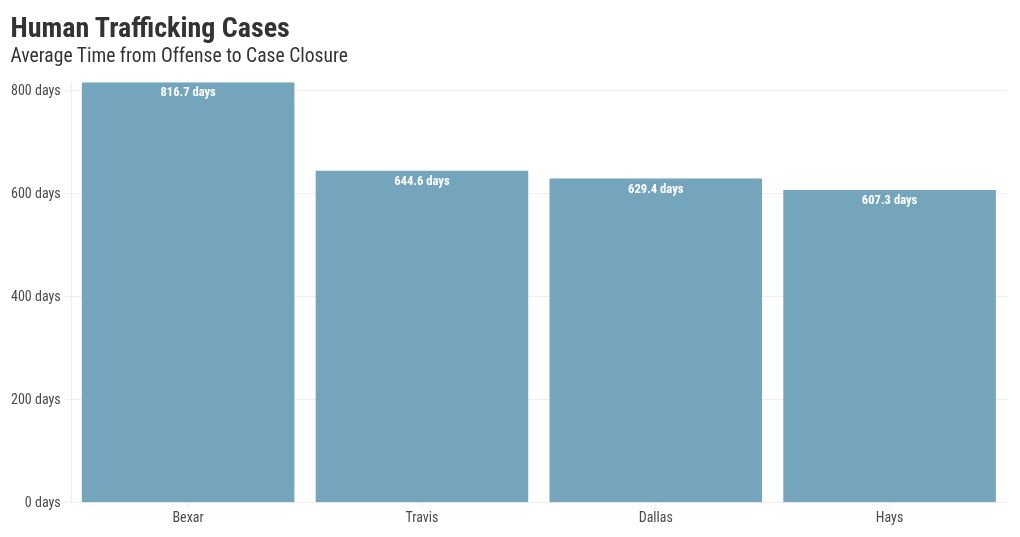
 This chart shows the average time from an alleged human trafficking offense to the case closure date in the five counties KXAN analyzed. KXAN excluded Williamson County because the three cases provided were either declined or dismissed. Source: OCA and various district attorney’s offices (KXAN Interactive/Christopher Adams)
Our team found more than 90 human trafficking cases still pending in the counties we analyzed. Victims in these cases have been waiting an average of more than 530.5 days for closure since their alleged offenses occurred. It took an average of 674 days to reach a final disposition for closed cases in those counties.
How to Spot Human Trafficking
Since 2021, district court data shows prosecutors filed more than 1,600 human trafficking cases statewide. However, Texas Department of Criminal Justice data shows only 112 people currently serving prison sentences statewide for trafficking convictions during the same period. We asked Williamson County District Attorney Shawn Dick what makes human trafficking cases so difficult to prosecute in the state of Texas.
“There are a lot of reasons. I think it starts with really identifying (the cases). It’s like a closed community,” Dick said. “I think the secondary challenge is it’s crossing state lines. It’s crossing national borders. Finding witnesses, even once you locate them originally, has become a problem.”
Dick admits that across Texas, prosecutions under the human trafficking statute are rare because usually there are more elements of the crime to prove for a conviction. Thus, prosecutors often explore other offenses with comparable sentences.
“When you can prosecute someone for a first-degree felony … you can still put that information on in punishment. So, a jury can still sentence them based on all the factors,” Dick said. “It’s usually preferable to take our easier charge to prove and then they’ll hold the individual accountable for all of their conduct, as opposed to trying to go into a very specific charge and prove very specific factors.”
In the counties where we focused our data analysis, human trafficking cases that result in plea agreements are most often negotiated down to “compelling or promoting prostitution.” In exchange for a guilty plea to those charges, prosecutors typically drop the trafficking charge.
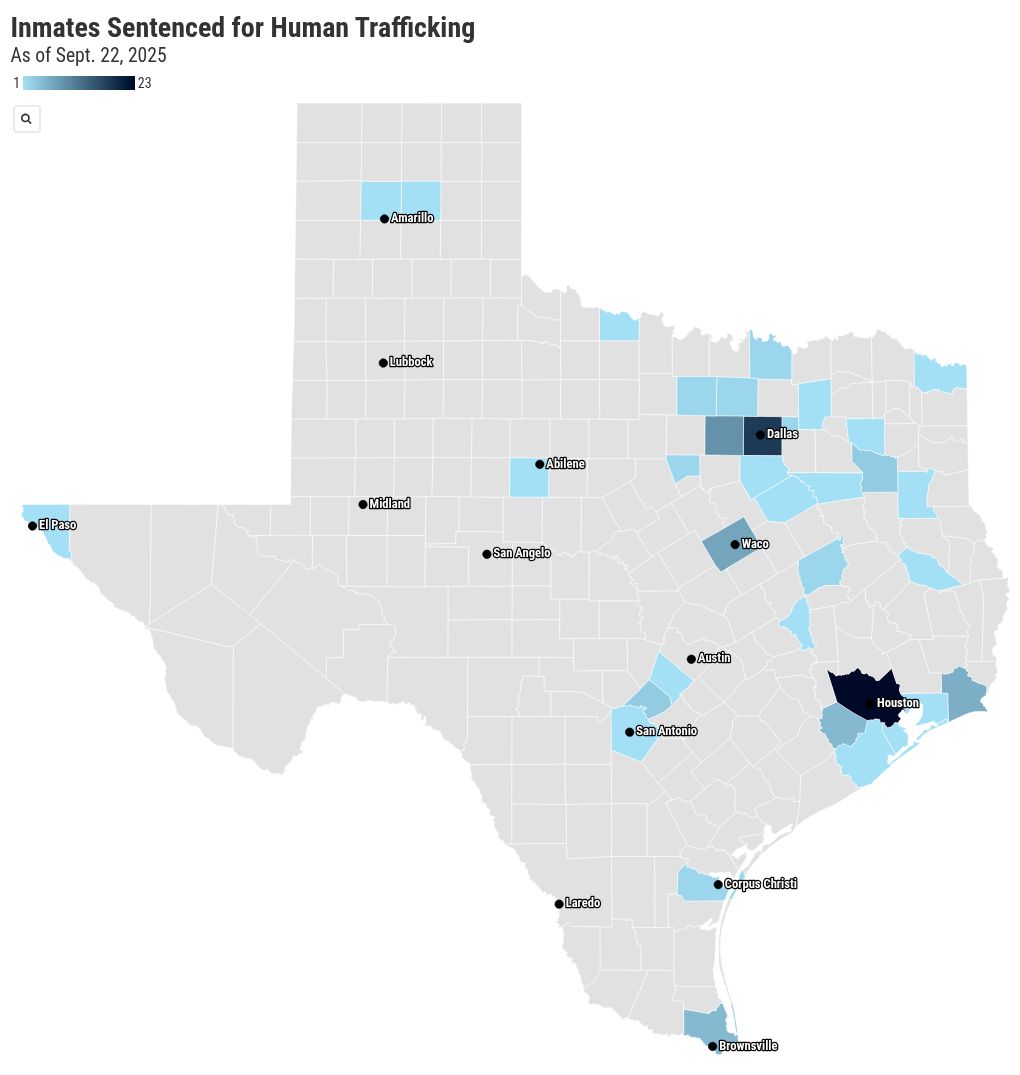
There are 181 inmates currently serving a sentence in Texas Department of Criminal Justice for human trafficking-related offenses. This map shows where those inmates were convicted and sentenced (from 44 different Texas counties). Source: TDCJ (KXAN Interactive/Christopher Adams)
To secure trafficking convictions, Dick said his office is focused on specialized training and getting prosecutors involved in cases earlier to work with police and build a case that can secure a conviction under the human trafficking statute.
“I know every prosecutor cares about human trafficking. Every prosecutor wants to prosecute human trafficking cases,” Dick said. “It’s a matter of educating the public, educating law enforcement, and then educating prosecutors and providing us the resources to do it.”
Are Texas’ Laws Working? ‘Data is Critical’ to the Fight
While experts said the state of Texas is one of the leaders in anti-human trafficking legislation, they, along with victims, said tracking and enforcement of current legislation needs to be more of a focus.
State Senator Tan Parker, who has spearheaded the passage of many human trafficking laws in Texas, authored Senate Bill 11 (SB 11), which passed in the last special session. It provides an affirmative defense for certain human-trafficking victims who commit alleged crimes under their trafficker’s force, fraud, or coercion.
“It’s going to give prosecutors a much more enhanced level of success because victims are going to feel so much more comfortable now being able to talk to prosecutors about what happened in their case. It is going to turn this entire paradigm around,” Sen. Parker said.
Sen. Parker said as the author of the bill, he holds himself responsible to ensure that the bill is implemented as intended and that district attorneys in Texas are using the tools the state is giving them.
“We all depend on the agencies of government to implement them with fidelity. That means at the state agency level, but it also means things that put that requirement on a city or on a county or a school district, so we are always trying to collect data to understand whether or not there is fidelity to the legislation we passed,” Sen. Parker said.
Sen. Parker admits the state needs to continue improving comprehensive data collection around human trafficking.
“I think access to that data is very important,” said Sen. Parker. “Data is critical to the law enforcement fight, the prosecution fight, all of those things, but we need to make certain that individual’s names are never accessible to the public at large or anything along those lines. We have to protect the confidentiality of those victims.”
Supreme Court Intervenes After Lower Court Blocks Texas Redistricting Map
Texas lawmakers in the summer approved a new congressional map, designed to favor Republicans in 30 of the state’s 38 congressional districts in the 2026 elections. On Tuesday, a 2-1 vote by a federal judge panel blocked the map, setting the stage for an appeal to the U.S. Supreme Court.
U.S. District Judge Jeffrey Brown, a Trump appointee, wrote the opinion. Brown wrote that “substantial evidence shows that Texas racially gerrymandered the 2025 Map” saying that the new congressional lines could not be used during next year’s elections.
Texas Republicans had drawn a new map earlier this year amid pressure from President Trump and national GOP lawmakers as the party braces for a challenging midterm environment, passing a new set of congressional lines that looked to give Republicans up to five pickup opportunities next year.
That map would go on to set off a broader redistricting tit for tat across the country, with Democratic and Republican states alike moving to redraw their congressional lines.
A handful of groups and individuals, including League of United Latin American Citizens and the Texas State Conference of the NAACP, sued to block the Texas maps from being used in time for next year’s elections.
On Friday, Texas asked the Supreme Court for an emergency order to allow the congressional redistricting plan to be used in the 2026 elections. Attorney General Ken Paxton asked the court to rule by December 1. Hours later, Supreme Court Justice Samuel Alito granted the state’s request, temporarily pausing the order from the lower court.
Alito set a deadline of the end of the day Monday for plaintiffs to respond to the state’s motion. The Supreme Court will decide at a later date what map Texas will use in next year’s elections.
The state is calling on the high court to act quickly to avoid confusion as congressional primary elections approach in March. Filing for the March primary is underway now. The deadline for candidates to file for a spot on the ballot is December 8.
If the lower court’s order stands, Texas would use the congressional map drawn in 2021 in next year’s primary. Reaction to that order falls largely along party lines, as does the view of how the Supreme Court could rule.
“I think the Constitution is on his side of these two judges that ruled with us,” Rep. Lloyd Doggett said. Doggett has said he would not run for reelection if courts approve the new map. If the current districts remain in place, Doggett plans to stay in the race.
“I hope the court will uphold it,” Doggett added, referring to the Supreme Court.
Republicans like Sen. Ted Cruz do not expect the decision to stand.
“I fully expect the U.S. Supreme Court to stay the result,” Cruz said in an interview days before Alito granted the state’s request. “Within the next couple of weeks, I think we’re going to see the map that the legislature drawn used in this upcoming election,” the Senator predicted.
Report: FEMA Move to Texas Under Consideration
This is a time of upheaval at the Federal Emergency Management Agency, or FEMA. The agency is seeking a new leader, after Acting Administrator David Richardson resigned from the job after just six months in the role.
Richardson faced criticism over his handling of FEMA’s response to deadly flooding in Texas over the summer, though Richardson defended that response at a hearing in July.
FEMA’s current headquarters are in Washington, DC, but amid the leadership change the agency is reportedly considering a big move down to Texas. That’s according to Politico, which reports that former FEMA officials say the move would be to accommodate Nim Kidd. Kidd is the current head of the Texas Division of Emergency Management.
The Politico report noted that Kidd interviewed with the Trump administration for the FEMA top job earlier this year. The outlet reports that sources said even though the administration wanted Kidd — he was committed to serving Texas first.
Kidd is also part of the FEMA review council that President Trump created to make big changes to the agency.
President Trump has been critical of the agency’s disaster response and has suggested a major overhaul — even eliminating the agency altogether.
A spokesperson for the Department of Homeland Security, which oversees FEMA, tells NewsNation the FEMA review council is expected to release its final report soon. That report could include a potential recommendation about moving the headquarters.
There are some concerns that if that does happen, it could make coordination with DHS more difficult because DHS is headquartered here in Washington, DC. There’s potential that those two agencies being so far apart could pose challenges for coordination of disaster relief.

Post a Comment for "Texas Prosecutors Battle Human Trafficking Cycle"
Post a Comment